0
0

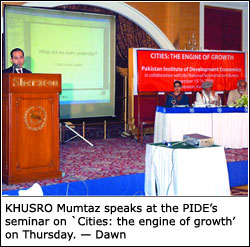 KARACHI, Nov 16: The two-day national conference on cities and urban issues in Pakistan failed to do justice to the topic as speakers were given very little time in the working sessions to make their presentations on the problems pertaining to urban planning, architecture, urban economics and other social and cultural issues.
The morning session was dedicated to urbanisation development paradigms and impact of globalisation on Pakistani cities and issues, characteristics, issues, challenges and solutions to urban sprawl. But their details were eclipsed by the element of haste exhibited by the organisers. As such many of the important issues of urbanisation could not be deliberated upon.
Presentations focused more on lifeless clusters but did not pay much attention to the people who live in them. Nevertheless the session on culture and society did generate some interest.
Many participants felt that more time should have been allocated for discussing problems of law and order, civic infrastructure and amenities besides nevertheless impediments, changing social and cultural values due to unplanned
urbanisation amid rising population, cost of living and building materials and safety measures.
However, the conference failed to come out with specific proposals for tackling the problems of environmental degradation, rising slums and the growing trend towards violation (or lack of) building and development control. Some of the presentations did talk about the affordability and cost of living and housing but during the question and answers and presentations, such issues were not given much time.
Organised by the Pakistan Institute of Development Economics (PIDE), the concluding session was chaired by the chairman of the National Reconstruction Bureau (NRB), Daniyal Aziz, who did not share the perception that district governments were involved in corruption.
Mr Aziz maintained that the culture of percentage and kickbacks allegedly took root during Nawaz Sharif’s era. But to root out corruption from the devolved system of governance, divisional system has been dissolved and Public Accounts Committees have been made functional, he added.
Responding to a question, Mr Aziz said that there was no proper regulation for smooth functioning of NGOs and transfer and postings of officials.
Hence, there was a need for the formation of district management services for capacity building and resolution of issues relating to the local government system.
Moreover, he said that there was also the need for restructuring of functions of provincial governments. He did not agree with the contention that too many amendments had been made to the Local Government Ordinance and maintained that there were some overlapping of local government laws with the provincial laws, which had been corrected by amending the ordinance.
District nazims of Quetta and Peshawar also spoke on the occasion and demanded that decisions by the government agencies at district level should be taken in unified manner so as to avoid delay and duplication of work.
Participants of the National Reconstruction Bureau (NRB) suggested that there was an urgent need to activate the office of Zila Mohtasib and the monetary, ethics and accounts committees.