0
0

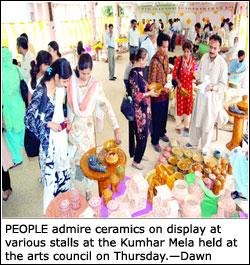 KARACHI, Nov 16: A fair of local ceramists (Kumhar Mela) was formally opened at the Arts Council in which over a dozen kumhars (potters) from across the country put up their work on display and for sale.
The Mela is part of the Asna Clay Triennial that was inaugurated last week and will conclude on Nov 24. The Mela is scheduled to continue till Saturday evening, said an organizer.
The organizers had succeeded to gather traditional ceramists from all the four provinces and all of them had their own art and expertise to share with their urban hosts and visitors.
A ceramist from once vibrant city of Balakot, which was flattened by the deadliest earthquake of the region’s history last year, had no beautiful and extraordinary pottery and artworks to offer to his visitors but his experience as a direct victim of the earthquake was unrivaled.
Juma Khan, 60, said he had lost two of his three sons and one of his six daughters in the earthquake. Besides, he had three houses in the once tourism-friendly town of Balakot and a huge collection of his work, all of which had turned to dust.
“What you see here is nothing I cannot even call them peanuts to the collection I had before the earthquake,” he said pointing to the ordinary pottery on display.
He recalled the early days after the earthquake and said it was too tough to live life because they had lost everything.
“I lost everything even the potter’s wheel and it took a lot of time before I managed to gather some money to resume my work,” said Mr Khan, whose both young sons were also potters and died in the earthquake.
“I have five daughters and a minor boy who is admitted to a school. I am the only one to support the entire family, including the two grandchildren,” he said.
He said the government had paid only 25,000 rupees to every family affected by the earthquake and the people had to build mud houses on their own to get a better shelter than tents.
“Life is still difficult but one has to live for the sake of those who depend on you,” he said.
Mohammad Qasim, a Kashigar from Nusserpur (Matiari district), said his family was the only one left in the field of Kashi work.
“Nusserpur was famous for its Kashigars and cloth but all those belonging to the two fields have opted for other fields because it has become too expensive and less profitable,” said Mr Qasim.
He said the oxidized colours and components for glass, which they develop indigenously, were much expensive.“We are still in the field because we are the fortunate ones who have some contacts in Karachi and other big cities where our work has better market and appreciation,” he said.
He said his ancestors’ work was still there to live. “You can see Kashi work on Badshahi Masjid in Thatta, Shah Abdul Latif Bhitai’s tomb, Sachchal Sarmast’s tomb and many other places, which was created by our grandparents,” said Mr Qasim.
Mohammad Nawaz of Sahiwal had his own distinction in the field. He lives near the ancient city of Harappa and chooses primarily to recreate the artwork resembling to the one created by the artisans of 5,000 years ago.
“Harappa’s pottery and artwork fascinates so many of us who have sense of appreciation and some money to purchase them to beautify their houses with these showpieces,” he said.
He said his work had great demand in the country and abroad but it was not he but the ones who exported his work to Western countries earned more profits.
“But, I can still earn ample money to live a respectable life,” said Mr Nawaz.
Hameedullah of Dera Ghazi Khan said he preferred to make simple pottery, which could be used for water storage.
“Water is one big problem in our area and we make containers of different sizes to cater to the varied needs of storing and carrying water from one place to another.”
He said big containers were normally used for storage of water and smaller ones were designed for the rural women to carry water from remote localities to their houses.
“It is not too simple in our area to get water, sometimes we have to go as far as 15 miles to get water,” he said.
Kaura Khan had come from the ancient city of Mahergarh of Balochistan and he had a variety of works ranging from simple containers to showpieces and artworks.
“Our family has been engaged in this business for more than 700 years,” he said with a sense of pride. He pointed at his son Fazal Ahmed and said the tradition would continue for many centuries to come.