0
0

 KARACHI, Nov 15: City Naib Nazim Nasreen Jalil said here on Wednesday that the total amount of the Karachi package was about Rs29 billion in the beginning but it has now come down as some of the stakeholders have backed out of their pledges.
Speaking at a conference on Cities: the Engine of Growth, organized by the Pakistan Institute of Development Economics, she, however, said that the Asian Development Bank was likely to give 400 million dollars to the Sindh government for various development projects to be undertaken by the local government.
She further stated that the population of this cosmopolitan city had been increasing at a rate of six to nine per cent per annum while it was about three per cent in the rest of the country.
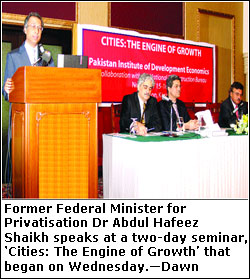
The seminar was also addressed by former federal minister for privatization Dr Hafeez Sheikh, Lieutenant General (Retd) Tanveer Naqvi, former chairman of NRB.
She indicated that some of the uplift projects being undertaken by the city government included construction of 80 roads at a cost of Rs8.51 billion, 12 flyovers costing Rs12.35 billion, six water projects worth Rs47 million, sewerage projects costing Rs3 billion, and improvement in lighting condition at a cost of Rs30 million.
She said Rs1.3 billion were being spent on solid waste management and Rs7.5 billion on other 290 development projects.
Besides these projects, she said, the premier had pledged to provide Rs7 billion for construction of three effluent treatment plants while Rs50.76 million were being spent on devising a master plan.
Former federal minister for privatization Dr Hafeez Sheikh said that the economic growth of cities was the most comprehensive solution to poverty.
Dr Hafeez said integrated governance at every level especially at city level, was key to development which in large extent was not witnessed in the country.
Nazims, he said, are willing to carry out uplift projects, but they simply do not have capacity to successfully complete them.
Another point he mentioned was non-enforcement of laws in uplift projects, saying there were two basic two reasons for failure of implementation i.e. absence of follow up and lack of capacity to monitor pace of projects.
He said another problem was the role of federal, provincial and district governments, saying it was very hard to know the exact jurisdiction of these governments.
He emphasized on adopting a balanced system while giving equal importance to environment and commerce, private and pubic partnership, role of stakeholders and good governance.
General (Retd) Tanveer Naqvi, former chairman of NRB, said distinction between political and administrative issues should be made clear as this problem was the root-cause in raising problems regarding development activities.
He said cities had failed to provide citizens with facilities, like health, water and sewerage, recreational activities, electricity and gas, etc.
The reason is phenomenal rate of population growth as after every three years another million people are added to the population, he said.
He said there was no grand plan or scheme to cater to this urban sprawl.
Another bottleneck in improvement of devolution plan was the behaviour of the feudal elite who do not wish to transfer the fruits of devolution plan to people living in rural areas, he said.
He said that in Karachi about 95 per cent of the population had acquired only 35 per cent land of the city while the remaining land was in the use of the elite.
He said that without reforming the civil service structure, it was impossible to coherently run the city administration.
Dr Nadeemul Haque and Lubna Hasan of PIDE also spoke.—PPI