



 0
0

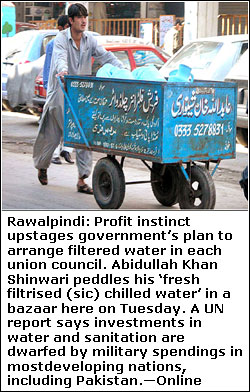 ISLAMABAD, Nov 14: Government’s claims about its Rs7.5 billion water filtration plants scheme became an embarrassment for its officials at the launch of a UN report on the water issue here on Tuesday.
Deputy Chairman Planning Commission Dr Akram Sheikh warded off questions put to him on the occasion about the quality of water being produced by the filtration plants by announcing that the government was giving the scheme “a second look”.
This year’s Human Development Report titled “Beyond Scarcity: Power, Poverty and the Global Water Crisis” focuses on the availability, use and politics of water.
UNDP’s Assistant Resident Representative Arif Allaudin said the most important message of the report was: “we are in the midst of a crisis in water and sanitation that overwhelmingly affects the poor”.
The report states that across urban Pakistan unclean water poses a constant threat to public health and that the issue was
so severe that the government had to launch a major investent programme to finance more than 6,000 water filtration plants.
Some 118,000 die each year, or 325 each day, in the country as a result of diseases caused by unclean water and poor sanitation.
In the first half of 2006, major outbreaks of water-borne epidemics swept some major urban centres of the country.
The audience at the launch ceremony was concerned about the viability of the water filtration plants project of the government, its ability to improve access of the public to clean drinking water.
Most of the questions from the audience related to the water filters.
In a rare admission coming from a senior government official, Dr Sheikh conceded that the project was not going the way the government had intended to.
“The filtration plants are suffering from management issues,” he said, cautioning that if the managers of the project did not pay heed “we would soon be getting more contaminated water than the tap water”.
Dawn had reported the malaise earlier this month. Under the ‘Clean Drinking Water for All’ project initiated in 2004, a total of 7,044 water filtration plants are to be installed in the country by 2007 - one in each union council.
So far some 550 plants have been installed.
Dr Sheikh agreed that the project would not be able to provide clean water to the entire population but argued that the project could not be given up for the sake of the population benefiting from these.
“The project would be able to solve a fraction of the problem,” he said.
Asked if the filtration plants were “the ultimate solution”, the deputy chairman said “they are not the solution but only short-term measures and that the government has to make a start from somewhere.
“What we are now having is a pilot project and the private sector and local governments will have to pick up from here,” he added.
He ruled out any replacement of the dilapidated supply infrastructure - the main source of contamination - for being too expensive.
Winding up the discussion on filtration plants, Dr Sheikh advised the critics to adopt “a more constructive attitude rather than being over critical”.


























