



 0
0

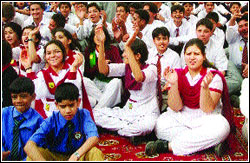 ISLAMABAD, Nov 8: Translating energy and imagination, Norwegian and Pakistani musicians collaborated to give folk music a new sound in a concert brimming with enthusiasm and delightful passion.
The concert grew out of the concept to bridge gaps and to introduce the Pakistani children to Norwegian music.
Lok Virsa had organised the event in collaboration with the Norwegian Embassy and Rikskonserene Norwegian Concert Institute aimed at harnessing culture for education, promoting soft image of Pakistan.
Five performers on the stage and more than 2,000 schoolchildren in the audience created an exhilarating experience.
In a unique fusion of Norwegian and Punjabi music, the performers transformed a simple afternoon into legend.
The concert opened with the rich performances as musicians played the introduction to the composition titled “Saiful Maluk”.
Distinctive, innovative and foremost saxophonist and composer Karl Seglem and Harald Skullerud on percussions made music ebb and flow with grace. Stylistic versatility and expressive sensitivity set the Norwegian musicians apart.
Harald’s drum beats were earthy, hard swinging and volcanic as he combined his sounds and improvised with the Dhole and Tabla players. And Karl made the notes from his sax burst with feelings.
Although the two Norwegians had a little more than a day to practice with the Pakistani musicians to get the feel of Punjabi folk music, the two, masters of their instruments had no problem at all improvising. And it was if all of them were complimenting one another.
Equally impressive were their selection of compositions like “Halling” and “Edrarden” that only Karl and Harald performed.
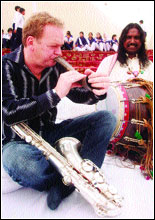 The Punjabi group of musicians, Saghir Ali on Dhole, Azam Hussain Jogi on Tablas and Mohammad Asghar vocalist (and Chimpta player) were their usual bag of energy as they took on Karl and Harald in their first ever performance with foreign musicians.
Playing the beat of the Punjab was Saghir on his dhole and it was impossible not to bhungra on the stimulating rhythm of his Dhole.
The five players performed “Meri Jan”, “Dhola vay Dhola” and “Saiful Maluk” together.
Saghir and Karl played on the Shehnai and the Rams Horn, improvising, echoing and answering each other. This section was turned into the Norwegian song called “burn blue”. And everyone played together “Shahbaz Qalander” to end the show.
The musician’s playful attitude created an engaging atmosphere. Students explored all aspects of performances, including singing and the stage movements in this 45 minutes of awe-inspiring concert.
School boys and occasionally some girls who could not resist danced to the compositions like there was no tomorrow. It was very sad near the ending for the children who had to leave because their teachers thought that they were late. Even then on their way towards the exit, they found it hard not to move their bodies to the irresistible music.
“We are looking forward to a lot of music playing throughout our tour. And we will collaborate with these interesting Punjabi musicians to create great music,” said Karl Seglem while children took pictures with him and got him to sign autographs.
Harald had never played with Pakistani musicians before and his experience was fascinating and electrifying. “I am also looking forward to playing with these musicians at the Adiala Jail for juveniles, something I have not done before,” he said.
Head of International Projects, Rikskonsertene-Norwegian Concert Institute, Anne Moberg said, “It is very very important to introduce children to music when it is not part of their education. Musical collaborations provide lots of group interaction and, by emphasising poise and self-confidence, gives students a feeling for their individual capabilities and potential.”
These musicians would go into the heart of Punjab and perform in Jhelum and Kharian, which is also home to majority of the Norwegian Pakistanis in Oslo.
“Such concerts are important for us too. We will invite these Punjabi musicians to come and perform in Norway and collaborate with more Norwegian musicians so that children there could learn about the Pakistani music.”




























