



 0
0

 ISLAMABAD, Nov 6: President Gen Pervez Musharraf on Monday called for restructuring the Organisation of Islamic Conference (OIC) urgently which he said was “the only way forward for socio-economic uplift” of its 57 member countries.
President Musharraf told delegates to the 2nd World Islamic Economic Forum that religious extremism and intolerance in Muslim societies were blocking their political and economic development.
“What eclipses the Muslim world is the unfortunate reality that radical clerics are reinforcing misconception that Islam is an intolerant religion,” he said, stressing that the two ills must be removed through individual and collective efforts.
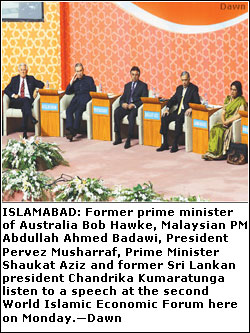
Malaysian Premier Abdullah Ahmed Badawi, Prime Minister Shaukat Aziz, former Australian premier Bob Hawke and former Sri Lankan president Chandrika Kumaratunga, participating in a roundtable discussion, said the Muslim world must achieve economic and political strength before calling upon the United States and its western allies to resolve disputes of Iraq, Palestine, Afghanistan and Kashmir.
President Musharraf said that one of the reasons of poverty, economic depreciation and illiteracy in the Muslim world was the lack of education. He pointed out that the entire GDP of 57 Muslim countries was less than the GDP of Germany alone.
“We are suffering from political alienation which is leading to helplessness, and the international quality media is nonexistent in the Muslim world,” he said, calling for the Islamic world to have a first class media to correct misperception about Islam. He called for projecting true values of Islam.
Muslim countries, he said, were also suffering from poor governance and they must ensure improvement in living standard of their people through moderation and modernisation and not through westernisation.
He said the Muslim countries would have to go for liberalisation and privatisation to integrate with the globalised world.
Gen Musharraf said that the OIC must be restructured and intra-OIC members trade and investment enhanced to augment the development process.
He said that OIC’s restructuring was imperative to meet challenges of extremism and terrorism and for resolution of political disputes affecting the Muslims.
He underlined the need for setting up departments of trade, education and Islamic thought for making OIC a vehicle of socio-economic change.
Gen Musharraf called for establishing a fund in the OIC to help the least-developed Muslim states and urged them to contribute 0.02 per cent of their GDP to the fund.
“This would mean about $200 million, out of the total $2 trillion GDP of the Muslim world and Pakistan would instantly contribute its $11 million share in this fund,” he announced.
He asked the OIC and the Islamic Development Bank to work in synchronisation to ensure socio-economic development in the Muslim countries.
He warned that without developing strong industrial base, Muslim countries would never be able to transform themselves into developed nations.
He said Muslim countries should go for gradual transformation from agrarian to industrial societies.
Gen Musharraf said that Muslim countries should empower their women — both politically and economically – as part of efforts to develop.
“We need to mainstream and empower the women in the Muslim world. They constitute 50 per cent of the population, generally. We must empower them politically and economically, but it’s easier said than done. We need to develop their capacity, first of all.”
He noted that extremism was on the rise which was spawning terrorism. He said that lack of socio-economic development, poverty, unemployment, absence of modern education and political disputes affecting the Muslims were fuelling extremism.
He urged the key world players, particularly the United States and the European Union, to help resolve political disputes affecting the Muslims in a just manner. He said these disputes lay at the heart of extremism and terrorism.
He said the Palestine dispute must be resolved now otherwise the turmoil in the world would never cease.
He said his strategy of enlightened moderation was a way forward which calls upon the Muslims to reject extremism and terrorism and go for socio-economic development.
He said his strategy also urges the West to fulfil its responsibility for a durable peace in the world.
He asked the developed nations to make available their mandatory contribution of 0.7 per cent of their GDP for socio-economic development of the less-developed nations under the UN Millennium Development Goals.
Malaysian Prime Minister Badawi stressed the need for exchanging expertise and know-how to exploit natural resources and tap potential of the Muslim countries.
He said that oil-rich member countries should assist the least-developed Muslim countries economically.
He called for resolving political disputes, especially Palestine, to end extremism and terrorism and supported President Musharraf’s strategy of enlightened moderation.
Prime Minister Shaukat Aziz said the government had undertaken economic and political reforms which had helped Pakistan made economic progress. The government, he pointed out, was providing level playing field to local and foreign investors and had adopted a liberal privatisation approach to spur economic growth.
“Pakistan has been able to bring down poverty from 34 per cent to 24 per cent,” he said but added that much more needed to be done in this regard.
Mr Hawke, the former prime minister of Australia, underscored the need for sharing the benefits of economic growth. He said Pakistan had vast resources which must be utilised effectively for economic development.
He highlighted the importance of modern education in the socio-economic uplift saying it would be the best investment for the generations to come.
Former Sri Lankan president Kumaratunga said that equitable distribution of resources would help generate pace for economic progress and prosperity of people. In order to address the issues of extremism and terrorism, she said, political dispute resolution was imperative as there were no terrorism genes in any people.




























