0
0

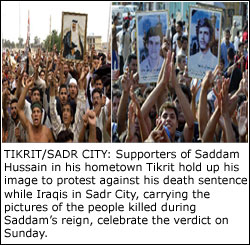 BAGHDAD/WASHINGTON, Nov 5: The Amnesty International on Sunday questioned the fairness of Saddam Hussein’s trial while the Human Rights Watch slammed the trial and sentencing of deposed Iraqi leader Saddam Hussein and six co-accused as a failure to establish the facts and, as a result, a loss for the victims.
The trial "was a failure to establish an indisputable record of the facts and a sense of responsibility for what happened," HRW's director for international justice Richard Dicker told AFP by telephone from New York.
"It was a lost opportunity to give a sense of the rule of law and a loss for the victims in that the trial and verdict are unlikely to stand the test of time," he said.
"The trial offered the opportunity to bring justice to the villagers of Dujail who suffered enormously," Dicker said, adding he was still awaiting the detailed judgements to see how well charges and verdicts were linked by evidence.
"It's crucial that the judgement and sentences are based on connections between the evidence of prosecutors and the specific charges they're alleged to have committed.
"That's the $64,000 question: how, particularly for the three sentenced to death, does the judgement connect those dots?"
Marieke Wierda, an expert on international tribunals at the International Centre for Transitional Justice, hit out at what she said were "basic issues of equality between the prosecution and defence".
Our Correspondent in Washington adds: The Amnesty International on Sunday questioned the fairness of Saddam Hussein’s trial in an Iraqi court, saying that the proceedings were "marred by serious flaws," and were "not impartial”.
The rights group also condemned the death sentences given to the ousted Iraqi president and two of his former senior aides after they were found guilty of crimes against humanity.
The organisation opposes capital punishment.
In a statement distributed worldwide, the AI said it deplored the decision to impose the death sentence on Saddam Hussein and two of his seven co-accused after a trial “which was deeply flawed and unfair”.
"This trial should have been a major contribution towards establishing justice and the rule of law in Iraq, and in ensuring truth and accountability for the massive human rights violations perpetrated by Saddam Hussein’s rule," said Malcolm Smart, Director of the Middle East and North Africa Programme. "In practice, it has been a shabby affair, marred by serious flaws that call into question the capacity of the tribunal, as currently established, to administer justice fairly, in conformity with international standards."
In particular, political interference undermined the independence and impartiality of the court, causing the first presiding judge to resign and blocking the appointment of another, the AI noted.
It pointed out that the court failed to take adequate measures to ensure the protection of witnesses and defence lawyers, three of whom were assassinated during the course of the trial.
Saddam Hussein was also denied access to legal counsel for the first year after his arrest, and complaints by his lawyers throughout the trial relating to the proceedings do not appear to have been adequately answered by the tribunal, the AI said. "Every accused has a right to a fair trial, whatever the magnitude of the charge against them. This plain fact was routinely ignored through the decades of Saddam Hussein's tyranny,” said Mr Smart. “His overthrow opened the opportunity to restore this basic right and, at the same time, to ensure, fairly, accountability for the crimes of the past. It is an opportunity missed and made worse by the imposition of the death penalty."