



 0
0

 The Nobel awards in the first half of October each year arouse considerable excitement, sometimes even controversy, both among the academic community and other well-informed people, who treat them as pointers of excellence in various fields of learning and human endeavour.
Three prizes are given for medicine and physical sciences, one in economics, one in literature and one for peace. The physical sciences, as well as economics awards, have usually gone to people in developed countries, most often to Americans, while the award for literature and peace prizes is more geographically balanced, though more prone to controversy.
This year¹s Nobel prizes have followed this familiar pattern. All the three Nobel prizes: in medicine, physics and chemistry have gone to Americans, which shows that despite the country¹s declining fortunes in many other areas, it continues to provide leading-edge research in the physical sciences.
The award of this year¹s economics prize to a neo-classical economist of Columbia University, Professor Edmund Phelps, for his anti-Keynesian theory of employment, rebutting Keynes idea, later modified by the Phillips curve, that unemployment can be financed through fiscal deficits financed by the central bank, without serious inflationary impact, is in piece with the past awards in this field which have ignored more progressive economists, in preference to those of a neo-classical bent.
The only recent exceptions to the foregoing have been the award to Professor Amartya Sen in 1998 and, arguably, to Professor Joseph Stiglitz in 2001.
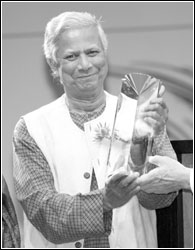
The award of the Nobel peace prize to Professor Muhammad Yunus and his intellectual offspring, the Grameen Bank is, however unique in that it has been awarded to a founder of a grass roots movement which has played a pioneering role in alleviating poverty in Bangladesh, in general, and in a large number of developing countries who are emulating his model.
More than anything else, it has served to bring the objective of poverty alleviation to the centre stage of development policy. One may argue whether Professor Yunus¹s dream of making ³poverty history² can be achieved by micro credit alone and within the foreseeable future, but no one can deny the tremendous impact his efforts have made in highlighting the lack of a very basic resource, credit, which has hitherto been the exclusive preserve of the rich, as a means of alleviating poverty in Bangladesh and the developing world at large.
The basic idea behind Professor Yunus¹s Grameen Bank is rather simple and not very novel either. Although he is an economist, the idea or its application would not have earned him the Economics Nobel.
However, its impact on changing economic policy has been more profound than those of the many other distinguished economists that Bangladesh can be proud of (including those who were behind the idea of Bangladesh).
One can also find a striking similarity in the work of this year¹s Economics Nobel laureate, Professor Phelps and the Peace laureate, Professor Yunus. While Phelps has won the prize for showing that at the macroeconomic level excessive credit creation (or cheap money policy) could have a negative impact on the economy, Yunus has been awarded the prize for demonstrating that credit availability to the poor at the microeconomic level can have highly beneficial effects on creating productive employment and in reducing poverty.
The results of the works of the two economists for which they have been awarded the Nobel prizes (albeit in different categories) may thus appear to be in contradiction. (It is not the first time, however, that this has happened. The classic example of this was when the Economics Nobel in 1979 was awarded to two economists, Sir Arthur Lewis and Theodore Schultz, whose seminal contributions were based on identically opposite views about the marginal productivity of labour in developing country agriculture).
The difference between the ³monetarism² of Prof Phelps and Prof Yunus is not only that the former has a macroeconomic and the latter a microeconomic vantage point, but also that Prof Yunus¹s focus is on the distribution and Prof Phelps¹s focus is on overall supply of credit.
Perhaps, an even more significant difference between the two is that Yunus is a hands-on development economist who is passionately involved in removing poverty as a social impediment in developing countries, while Phelps is an armchair theoretical economist interested in proving the superiority of the market to ensure the stability and growth of developed economies.
Professor Yunus¹s pioneering idea of lending small amounts of money to the poorest people in Bangladesh without collateral may not yet have permeated deep enough to change the mind-set of central and commercial bankers in the way he would have wished, but it certainly has deprived the latter with a key subterfuge used in the past to deny access of credit to the poor, that they were unbankable (or, in economic sense, ³untouchable²) as they didn¹t have any collateral.
As Grameen¹s website succinctly puts it: “Credit is a cost-effective weapon to fight poverty and it serves as a catalyst in the overall development of socio-economic conditions of the poor who have been kept outside the banking orbit on the ground that they are poor and hence not bankable.”
For Yunus the difference between his Grameen and conventional banks is not only of mind-set, but also of motivation. Whereas conventional banks are owned by the rich and with clients who are largely men, Grameen Bank is owned by and serves largely poor women.
While the overriding objective of the conventional banks is to maximise profit, Grameen Bank’s objective is to bring financial services to the poor, particularly women, to help them fight poverty, stay profitable and financially sound.
Grameen claims to have brought the service of banking within the reach of the poorest and weakest section of the population, viz. poor rural women, transforming it from being the preserve of the rich and economically powerful. This was nothing less than revolutionary as what Yunus tried to do was to turn the traditional theory of prudential banking on its head.
According to Yunus, “Conventional banks start with the principle that the more you have the more you can get, which provides a spring board for those who are already well off. Our principle has always been the less the person has, the higher the priority she gets.”
The visionary efforts of Professor Yunus in pioneering the micro credit movement through his Grameen Bank in Bangladesh need to be viewed in a broader context than as a merely technical innovation of bringing the benefits of banking to the poor.
Simultaneously with Yunus’s Grameen bank, other non-governmental movements, such as fellow activist Fazle Hasan Abed¹s huge cooperative efforts across the country through BRAC (the Bangladesh Rural Advancement Committee) were launched to reduce poverty and vulnerability.
These movements were based on a clear understanding of why the market, as well as the government, had failed to work on their own and of how through social efforts they could supplement the role of both the market and the government. To that extent the award of the Nobel prize to Professor Yunus is a recognition of the increasing role of grass-roots movements, which in recent years have made a tremendous contribution in understanding and fulfilling the needs of the poor and the deprived sections who were systematically left out of the process of development.
A basic pillar of Grameen¹s micro credit programme is the empowerment of women. From the very beginning, in translating his vision of making credit available to the poor into a reality, Yunus recognised the feminisation of poverty. This led him to concentrate on women as future borrowers since they were most likely be concerned about their families¹ needs.
Today of the bank¹s 6.6 million borrowers, 97 per cent are women. The expansion of micro credit is now recognised as an essential ingredient for women’s empowerment as poor women gain greater access to financial resources.
Yunus considers providing small loans to the poor as an entry point for a process of transformation in the life of the individual member to change her own self-image from being a worthless woman to an important decision-maker in the family.
For this Grameen has developed a social charter, consisting of 16 important decisions, including such things as sending and ensuring that children stay in school, committing to building a good house for oneself; keeping families small; taking joint actions to help the community; not accepting or not giving dowry at weddings; drinking clean water; growing plants and vegetables and; keeping their children and environment clean.
Yunus has been criticised for adopting an authoritarian approach and forcing ³regimentation² in the lives of his borrowers. However, Yunus claims that these decisions have been developed in consultation with Grameen members and that the decision to follow the 16 guidelines have led to a better life style among members than among non-members in such areas, as family planning, sanitary conditions, housing and participation in social and political activities.
During the 30 years of its existence Grameen Bank has emerged as a dynamic organisation, modifying itself according to the various challenges and crises it faced, discarding along the way what became unnecessary or less effective.
Its loan portfolio has become diversified and its lending practices have changed over time. It has got itself involved in disaster relief, since floods and cyclones periodically aggravate poverty and vulnerability in Bangladesh.
It has also ventured into housing and education loans and lately it has pioneered the spread of telecommunications and IT services and solar energy for greater access to the poor.
While Professor Yunus¹s award has been widely celebrated in Bangladesh and South Asia and has served to raise the region¹s profile , many in the Western world have raised eyebrows about its merits.
Thus while Yunus¹s contribution is acknowledged for being of high economic significance yet not of a high enough standard to deserve a prize for the advancement of economic science its impact on world peace, in view of some observers, is considered to be rather tenuous.
It is hard to envision how micro-credit would douse the burning fires in the Middle East or bring to an end to the senseless war on terrorism which Mr Bush and his allies have waged since 9/11. In a broader sense, however, the efforts of Professor Yunus and many like him engaged in easing the social and economic conflicts embedded in the war on poverty are intimately linked with promoting peace in the world.
Only if peace is interpreted in the narrow sense of cessation of an armed conflict can Professor Yunus¹s contribution be considered as being not eligible for the Prize he has received.
In lauding the Nobel award to Professor Yunus, one can¹t help recall the contribution of Dr Akhtar Hamid Khan, who pioneered in Comilla a decade before the birth of Grameen, many of the ideas and interventions for poverty alleviation that Prof. Yunus and his colleagues carried forward.
While Dr Khan, who died six years ago, continued his work in Pakistan by establishing the Orangi Pilot Project and through his catalytic role in AKRSP and NRSP, was unable to generate the same momentum for mass mobilisation and grass roots impact as Grameen, BRAC and other NGOs in Bangladesh were able to do.
Some how the (socio-political) soil and climate for the plant whose seed Dr Khan sowed in Comilla was very different from the one that existed in Pakistan. As a result, its growth, despite the best efforts of those engaged in nurturing it here, continues to be stunted and has failed to provide the shade that those nurtured in Bangladesh have.
— sm_naseem@hotmail.com






























