



 0
0

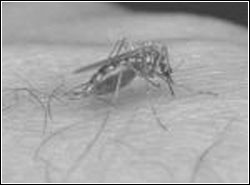 The more than 3,000 mosquito species, grouped in 39 genera and 135 subgenera, serve as obligate intermediate hosts for numerous diseases - a major cause of human mortality and morbidity. Three genera, Anopheles, Aedes and Culex are primary vectors for pathogens owing to their obligate haematophagy.
Malaria, dengue, and Japanese encephalitis are three most serious human diseases transmitted by the mosquitoes. The daytime biting mosquitoes are great pests and dangerous carriers of dengue fever and mosquito-borne encephalitis in Southeast Asia. The dengue virus causes severe headaches, light sensitivity, aching muscles and sometimes death.
A hemorrhagic fever syndrome occurs when a second infection occurs with a different strain of dengue. Mosquito-borne encephalitis is a viral inflammation of the brain that can infect humans, horses and a variety of other mammals and birds.
The Asian Tiger Aedes albopictus is associated with the spread of dengue fever. It bites in the daytime and rarely at night. Early morning and late afternoon are peak biting times. Tiger mosquitoes are strongly attracted to humans but will feed on cats, dogs, other mammals, and birds.
They bite any exposed skin surface but prefer ankles and knees and are aggressive feeders. Its generalized feeding behaviour contributes to its vector potential.
A source of stagnant water such as automobile tyre, open containers, trash cans, holes in the tree trunks, broken vases which gather rainwater are excellent breeding grounds for tiger mosquitoes.
The eggs of Aedes can survive in the absence of water and whenever the water reaches these collecting sources the development of eggs starts. It is because of this reason that this mosquito has been transmitted by the export of tyres around the world.
It does best in residential areas where shade and water-holding containers are common. It is found in all neighbourhoods. Older residential areas with a good deal of shade are preferred sites.
Areas near commercial establishments which store a large number of tyre casings outside are often infested with the greatest number of tiger mosquitoes. The potential threat of this mosquito is grave.
The itch and swelling is caused by an anti-coagulating substance from the mosquito’s salivary glands injected into the bite wound to maintain a free flow of blood.
The itching sensation occurs soon after and may persist for few days. Scratching leads to secondary infection, especially in young children.
Controlling the pest mosquitoes through chemical pesticides has generated several problems including insecticide resistance, safety risks for humans and domestic animals, and other environmental concerns. The high cost and sustainability have increased the interest in integrated control measures.
Controlling mosquitoes by insecticides can be effective and provides temporary relief from biting annoyance and can reduce the risk of disease transmission. Spraying is most effective when done during early evening (one hour before to two hours after sunset) and early morning (two hours before to one hour after sunrise).
Those killed are replaced by the newly emerged adults because of their rapid breeding cycle. In communities infested by moderate to high populations of tiger mosquitoes, adult mosquito control spraying may be necessary once per week, or more frequently, from February to May and September through November.
The tiger mosquito larvae are susceptible to toxic spores, whereas the insect juvenile hormone methoprene does not kill tiger mosquito larvae but prevents maturation to adult mosquitoes. The problem of controlling tiger mosquitoes with Bti and methoprene is how to deliver the products to breeding sites.
Due to a large number and cryptic location of breeding sites, application of larvicide’s is labour intensive and beyond the resources.
Repellents of plant origin do not pose hazards of toxicity to human and domestic animals and are easily biodegradable. Natural products are safe for human. Insecticides from plant origin and biorationals provide alternatives to synthetic insecticides and potential toxicity and their use as insect antifeedant reduces pest management costs, lower the risk to environment and humans, and reduce or delay the development of insecticide resistance.
These antifeedants are included as the integral part in the IPM programme.
Citrus contains a broad range of natural chemical substances. Several citrus limonoids and limonin derivatives are antifeedants. Citrus limonoids are readily extracted from citrus seeds and are available in large quantities as waste products of the citrus industry. Citrus limonoids work both as toxins and feeding deterrents.
In structure-activity studies of limonin, it has been determined that the furan ring and epoxide groups in the citrus limonoid structure are critical for the antifeedant activity of the limonoids against larvae. Citrus limonoids have been shown to suppress adult populations due to repellency or dispersal from treated plants.
Limonoids inhibit ovipositon due to nutritional disruption caused by limonoid induced antifeedant effects. Studies conducted showed that limonoid applications are effective in controlling insect populations.
Limonoids derivatives are widely distributed in plants of Rutaceae and Meliaceae. There are about 50 reported limonoid aglycones, of which 36 compounds have been isolated from plants of the genus citrus and related genera. Besides, their economic importance in the processing of citrus fruits, limonoids have a wide array of biological activities, emerging as a potentially sound, potent mosquito control agent with low cost, easy-to administer and risk-free properties.
The bitter taste in citrus can be used against many insects. It has thus been used as the starting material to synthesize new antifeedants against insects. Limonin causes cessation of feeding, reduces locomotor activity, and regurgitation at high levels in larvae. Increased levels of antifeedant activity can be seen when greater amounts of limonin are ingested and when overall feeding activity of the larvae is high. The depression in feeding rate that occurs after limonin treatment may be due to a toxic effect taking place after the plant material is ingested.
Pakistan is an agriculture country with much of its production being based on agriculture products. Fruits, and in particular citrus enjoy an important place. Due to its excessive production and usage there are problems related to the peels and seeds that become a source of pollution when thrown out on the roads and sideways. The present idea of exploring the insecticidal contents of the peel and seeds has been derived from the numbers of potent that are present in it and to a general feeder appear in the form of bitter taste in the citrus.
The list of breeding sites is extensive and includes water holding containers with primary sites in residential areas such as clogged rain gutters, tyres, buckets, cans, bottles, boats, flower pots, bird baths, outdoor statuary, ornamental pools, plastic or canvas tarpaulins, children’s toys, rain barrels, and pet food and water dishes. It is estimated that poor sanitation and dumping of garbage around residential properties provide breeding sites for tiger mosquitoes. We do not have the resources to remove and drain mosquito breeding sites. The elimination of the breeding sites for tiger mosquitoes is largely the responsibility of the individual to conduct thorough and repeated efforts to remove or drain all such sources on his property. On an individual basis, this is not a large task. The original cleanup which one must follow as the religion must be implemented.
If we want to save our environment from the havoc of life-threatening vectors it is important:
* To find other best options besides keeping preventive tactics in hand like reducing or eliminating the sources of infection.
* Use of non-chemical control approaches like the exploration of plant products for treating mosquito breeding places.
* Establishment of laboratories for identification of mosquitoes and related issues is a key to solve the problem in advance.
* Training local people to combat the problem associated with mosquitoes is a must.
* Regular sprays during the active mosquito periods are a must to get rid of day and night time feeders.
* There should be proper sites for collection of garbage and which should be regularly removed from and around residential areas.
* Every possible effort should be taken to cover sewage pipes that are active breeding sites.
* Stray automobiles tyres should be discarded while others must be properly covered to avoid breeding of mosquitoes in them.
* Draining or removal of water holding containers, even on a localized basis will provide remarkable long-term reductions in mosquito annoyance.






























