



 0
0

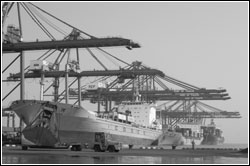 INDIA’s trade deficit is widening rapidly, as the country’s hunger for imported fuel – to sustain high economic growth – has pushed up its import bill. During the first half of the current fiscal (April-September), the trade deficit ballooned to $24.6 billion, from $20.3 billion in the first-half of 2005-06.
India’s oil imports zoomed to $28.66 billion, up by a massive 36.8 per cent, during the first half of the fiscal. In September alone, oil imports crossed the $5 billion mark, as against $4 billion in the same month in 2005. Non-oil imports have grown at a more modest 11 per cent.
India’s imports during the first half of the current financial year amounted to $83.92 billion, up a huge 32 per cent over the corresponding first half of the previous fiscal. In September, imports shot up to $15.63 billion (as against $10.48 billion in September 2005).
But with oil prices tumbling – it was down to a little over $57 a barrel last week, before gaining a bit – India’s import of crude is expected to be lower in the second half of the fiscal. But traditionally, the second half of the financial year is the busy season, when demand for oil, electricity, food grains, consumer goods, capital goods and industrial products soar.
Imports have been growing as the economy continues to expand remarkably. Gross domestic product grew by 8.9 per cent in the first quarter of the current fiscal, on the back of a 9.1 per cent increase in the previous quarter.
India’s current account deficit is also growing. It shot up to $6.09 billion in the first quarter of 2006-07 (April-June), as against a surplus of $1.81 billion in the previous quarter, and a deficit of $3.6 billion in the corresponding quarter of the previous fiscal.
Exports too have been rising, but not as fast as imports. India’s merchandise exports shot up by 37 per cent in the April-September period, adding up to $59.3 billion. Commerce Minister Kamal Nath is confident that the country would attain the targeted $125 billion in exports by the end of the fiscal.
Last year, exports crossed the $100 billion mark for the first time. Exports are likely to touch $165 billion in 2010, when India’s share in global merchandise trade is expected to touch the one per cent mark. At present, it is just 0.8 per cent.
Optimistic projections have it that India’s external merchandise trade (both imports and exports) will add up to $500 billion over the next three years – representing $300 billion in exports, and $200 billion in exports. The country expects another $100 billion in service exports (mainly IT and IT enabled services, besides other ‘invisibles,’ including revenues from foreign tourists).
FOREIGN funds have also been injecting huge funds into the country; in August and September, they pumped in $3 billion into the markets, boosting the Indian rupee, and also equities.
In fact, India’s buoyant capital markets continue to attract international players, many of who plan to set up asset management companies over the next few months. The Indian mutual fund industry has done extremely well, with assets under management having shot up to $65 billion at the end of August, a huge 60 per cent annual increase.
There are 30 asset management companies in India at present, both domestic and international ones. But the number is expected to cross 45 over the next few months, as several European and Far East Asian funds plan to start fund houses in the country.
Last month, UK-based Dawnay, Day International (DDI) got an in-principle approval from the country’s capital market regulator, the Securities and Exchange Board of India, to float a mutual fund here. DDI plans to launch mutual fund schemes by early 2007, and hopes to raise about a billion dollars by 2010.
Credit Suisse group of Zurich is also setting up a mutual fund in India. Other European financial giants that have been lured by the booming Indian capital markets include Rabobank and Aegon of the Netherlands, and AXA of France. Four Japanese financial majors – Sumitomo, Nikko, Shinsei, and Nippon Life – have also shown interest in setting up asset management companies.
South Korean firms, which have been active in the stock markets, also plan to set up mutual funds. Mirae, a South Korean finance major – which has invested about $800 million in the Indian stock markets, and plans to raise another $200 million from its investors – has plans for a mutual fund in India.
Besides setting up asset management companies, international funds are also bullish about the stock markets, and continue to pour money into it. EM Capital Management LLC, a US-based firm, plans to invest about $400 million in Indian equities.
Kuvera Capital, a UK-based hedge fund - which has a presence at the Dubai International Finance Centre - also plans to launch operations in India. Another Gulf-based fund manager, Forsyth Partners (originally from the UK), aims to enhance its exposure to the Indian markets to about $250 million in two years.
The Forsyth India Opportunities Fund is the only fund-of-funds available internationally using domestic Indian funds; it manages $120 million through 16 India equity funds. Forsyth, which offers a range of fund-of-funds investment options and manages over $3.5 billion in assets, recently shifted its global headquarters from London to Dubai.
THE fire at the prestigious Jamnagar refinery of Reliance Industries Ltd (RIL) last week is feared to result in a loss of Rs19 billion in turnover and set back profits by Rs1.25 billion. Of course, the loss could be notional, because Reliance has a comprehensive insurance policy, covering even loss of profit.
The RIL refinery in the state of Gujarat is the third largest oil refinery in the world, processing 660,000 barrels of crude a day. The refinery, operating at 95 per cent capacity, had refined over 15 million tonnes of crude in the first half of the current fiscal (April-September).
The Jamanagar refinery accounts for 25 per cent of the total liquefied petroleum gas (LPG) production in India, and the fire has given rise to fears of a shortage of the commodity. But the Indian government has directed public sector oil marketing companies to begin importing LPG to ensure domestic supplies.
The Reliance group (controlled by the elder Ambani sibling, Mukesh) is investing Rs270 billion in expanding the Jamnagar refinery complex. This would then make it the single largest refinery complex in the world.
India’s energy requirements are galloping, with the economy growing at over eight per cent annually, and with plans to raise this to 10 per cent over the next few years. India at present imports over 70 per cent of its crude oil and natural gas requirements.
The average price of the Indian basket of international crude peaked at $66.8 per cent barrel in the first quarter of the current fiscal, up from $49.3 in the corresponding quarter of the previous fiscal. But with international oil prices having dipped by about $20 a barrel over the past few weeks, the average price for the remaining quarters is expected to be much less.
Last week, a high-powered advisory panel urged the government to formulate policies to ensure energy security for the nation. India plans to set up a buffer stock of crude to reduce price volatility.
The energy advisory committee has urged government officials to use options contracts and futures market, to reduce risks and volatility, and also to build up sufficient foreign exchange to guard against price spurts.
Indian energy giants like ONGC have been investing in oil and gas blocks abroad – especially in Russia, Africa and Latin America – to ensure that the country is cushioned from the effects of a sharp increase in oil prices.






























