



 0
0

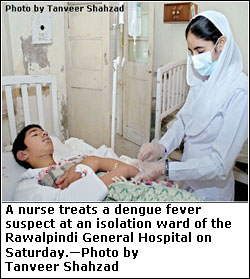 ISLAMABAD, Oct 21: Two confirmed cases and a large number of suspects of dengue fever coming to different hospitals of the twin cities of Rawalpindi and Islamabad have sent a wave of concern among the people, health experts and administrations of the two cities who have sprung into action to control the mosquito-born disease.
The doctors have started taking precautionary measures like collecting emergency kits and setting up a screening unit at the Rawalpindi railway station as they expect a lot of suspect passengers coming from Karachi and other parts of Sindh.
The dengue fever has so far claimed 23 lives. Over 1,000 have been admitted to different hospitals in Karachi and other parts of Sindh and 300 among them are in serious condition.
“Only the blood samples received from the KRL and CDA hospitals have so far been tested positive”, Dr Birjees Kazi, chief of the public health division, National Institute of Health (NIH), told Dawn on Saturday.
“We have collected a sizable amount of precautionary emergency kits containing necessary medicines, disposables and analgesics to deal with any emergency,” said Dr Mujeeb Khan, director accident and emergency department at the Rawalpindi General Hospital (RGH), where the officers’ ward has been converted into a quarantine unit.
Initially, two suspects were admitted to the RGH of which one was discharged when his tests were found to be negative while the other is still in the hospital, he said adding a large number of disposable masks and gloves have also been provided for the nursing staff for necessary barrier.
However, he brushed aside the impression that there has been an outbreak of dengue fever in the city though, he said, prevention was the only key to check the spread of the mosquito-borne disease since no vaccine is available in the world.
Dengue viruses are transmitted to humans through the bites of infective female “Aedes mosquitoes,” which generally acquire ‘Arbo’ virus while feeding on the blood of an infected person. After virus incubation for 8 to 10 days, an infected mosquito with virus is capable, during probing and blood feeding, of transmitting the virus, to susceptible individuals for the rest of its life. Infected female mosquitoes may also transmit virus to their offspring by transovarial (via the eggs) transmission, but the role of this in sustaining transmission of virus to humans has not yet been delineated.
Realising the gravity, the Railways hospital has established a medical centre from Saturday to screen passengers coming from Karachi with identical symptoms.
The presence of such a centre at the railway station has also made the curious passengers to share their concern about the dengue fever with each other and how to prevent themselves from the disease.
Manned by Dr Mohammad Zahid, Divisional Medical Officer, and Dr Naveed Atta Malik Senior Medical Officer, the screening centre becomes alive whenever a train from Sindh approaches the station.
The centre will continue to function for the next three to four days during which people would also be apprised of preventive measures, Dr Naveed said.
“We have not yet detected any patient though passengers feeling uneasy or with fever occasionally approach us for medical advice”, he said.
Meanwhile, in the isolation ward of the RGH, Mohammad Irfan, 15, a resident of Chor Harpal (Rawalpindi), is praying that his blood samples sent to the NIH test negative.
“For the last 10 days my son has been suffering from high fever,” Irfan’s father Masood Iqbal, a government official, told Dawn.
Despite visits to a private clinic at Peshawar Road, the fever did not subside, he said.
“My son has not taken any food for the last 10 days as he vomits whatever he eats.” However, Mr Iqbal was quite satisfied with the treatment available in the hospital, saying the doctors regularly visited the patient and provided treatment free of charge. They have also asked me not to touch the patient.
About the sudden spread of dengue fever, especially in Karachi, Dr Naveed said the flood-like situation in cities, especially in Karachi, due to heavy rains and stagnant water had provided ideal breeding grounds for mosquitoes and one could assume that aedes mosquito also got multiplied in large numbers.
About symptoms, he said, initially the patients suffered from high grade fever, severe multiple joint pains, abdominal pains and severe headaches associated with vomiting. Rashes also develop above the umbilicus, face, arms, chest or back of the patients.
The simple dengue fever converts into Dengue Haemorrhagic Fever (DHF) when bleedings starts from the mouth and nose. There is 100 per cent recovery from the simple dengue fever, however, the mortality rate increases from 6 to 30 per cent in case it converts into DHF. The only prevention is to cover the water containers, drums or buckets where the breeding takes place, Dr Naveed said.
Dengue fever can lead to high fever, with flu-like symptoms, and even to brain haemorrhage.
During epidemics of dengue, attack rates among susceptible are often 40-50 per cent, but may reach 80-90 per cent. An estimated 500,000 cases of DHF require hospitalization each year, of whom a very large proportion are children. At least 2.5 per cent of patients die, although case fatality could be twice as high.
Without proper treatment, DHF case fatality rates can exceed 20 per cent. With modern intensive supportive therapy, such rates can be reduced to less than 1 per cent.
Dengue haemorrhagic fever (DHF) affects most Asian countries today and has become a leading cause of hospitalization and death among children in several of them, according to World Health Organisation.
A rapid rise in urban populations is bringing ever greater numbers of people into contact with this vector, especially in areas that are favourable for mosquito breeding, where household water storage is common and where solid waste disposal services are inadequate.


























