



 0
0

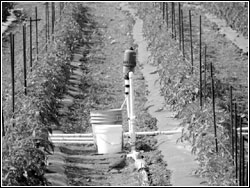 THE supply of nutrients to crops can result in high yield with minimum pollution. The application of fertilisers dissolved in irrigation water or fertigation suits the situation where there is a need to split the nutrient usage into a number of applications during the growing season. This technique makes it possible to apply any fertilizer material on a regular basis.
Under certain conditions, this may allow better recovery and utilisation of applied plant nutrients, particularly where leaching is possible. With the exception of foliar sprays, fertigation is one of the quickest ways to correct an existing nutrient deficiency, particularly for macronutrients - nitrogen, phosphorus and potassium.
Nitrogenous fertilisers can be applied through fertigation systems as the technique will allow nitrogen supply to match with plant demand as plants take up nitrogen throughout a growing season. Too much of nitrogen may result in excess vegetative growth or leaching which may in some crops affect the harvested yield or quality. Fertigation reduces the loss of nitrogen through leaching or denitrification.
On some farms nitrogen application may be reduced due to the utilisation of applied fertiliser nutrients. Urea, a major source of nitrogen is a non-ionic compound and is compatible in solution with virtually all other fertilisers. However, caution may be required where fertilisers containing ammonium nitrogen are applied through sprinkler irrigation systems, particularly where the pH of the irrigation water (either inherently or as a result of adding alkaline fertiliser) is high.
Though not a common occurrence, ammonia gas may form in water droplets remaining on the leaves, particularly if the pH is above 7. This may result in foliar burn as free ammonia is toxic at low concentrations to plant tissue.
Urea may also be converted to ammonium in irrigation water in which the enzyme urea is present due to algae growth. The conversion of urea to ammonium can be limited by preparing urea solutions for irrigation prior to use.
Little use is made of phosphorus in fertigation systems in annual crops. Phosphorus is mostly taken up early in the life of a crop, and is important in stimulating root growth and early development. Hence, in annual crops, phosphorus is best applied with or near the seed at planting.
In row crops, phosphorus can also be incorporated into the soil prior to planting along the position of the intended rows, if these are known. This allows the use of granulated phosphorus fertilisers like DAP, which cost appreciably less. There is usually no need to apply additional phosphorus after planting. Furthermore, unless underground irrigation emitters are used, phosphorus applied during the growing season will remain close to soil surface and will not reach the zone of major root growth.
Unlike nitrogen, phosphorus does not move far from the site of application. In calcareous, sandy loam soils, however, it can diffuse to two inches from the point of its placement. In calcareous, clayey soils phosphorus seldom moves one inch away from the point of its placement. However, encouraging results about the efficiency of fertigation technique for phosphatic fertilisers have been observed for some field crops.
In perennial crops like orchards, phosphorus can be applied dry, or through fertigation systems. Annual application is at the start of the main growing season often applied in smaller doses on a more regular basis in combination while nitrogen and potassium throughout the growing season.
Like nitrogen, potassium is suited to fertigation. It is taken up in large quantities (second to nitrogen), and is particularly important late in the growing season in fruit and flower formation, and boll-filling in cotton crop.
Crop utilisation of applied nutrients and produce quality are often enhanced where potassium is applied through fertigation. Potassium chloride (muriate of potash) is commonly used due to less cost. There are situations where chloride should be avoided in crops such as tobacco, or where the soil and/or irrigation water is high in chloride.
Potassium sulfate (sulfate of potash) can be used instead of potassium chloride fertilizer where there is a need to avoid chloride, but is considerably less soluble than potassium chloride. If potassium is present in high concentrations in the irrigation water, there may be no need to apply potassium fertiliser or its application rate can be reduced.
Our calcareous soils are also becoming deficient in micronutrients like boron and zinc. With other micronutrients (trace elements), crop requirements for boron can be met through soil applications and/or foliar sprays. Boron can be applied with care through fertigation systems as it behaves similar to nitrate nitrogen in the soil. Boron can burn plant roots if applied at high rates and/or to a small area or volume of soil. Therefore, it is best to split the seasonal or crop requirements into a number of applications during the growing season.
Fertigation with boron fertilisers is only recommended where at least 50 per cent of the soil is wetted. Farmers should not use fertigation as a method of applying boron on crops that are sensitive to boron toxicity, or on tree or vine crops with dripper irrigation systems. Once taken up by the plant and incorporated into plant tissue, boron is immobile. It is not readily relocated from old leaves to the growing points. In this respect it is similar to calcium. Regular applications of boron help ensure a continuous supply of boron for plant growth, and help minimize leaching losses on sandy soils.
The metallic trace elements like iron, copper, manganese and zinc can be applied through fertigation systems under certain circumstances but often other application methods will be more effective, e.g., foliar sprays of iron in horticultural crops. If applied through sprinkler irrigation systems, they will be slow to move into the soil, particularly those with high clay content.
Chelates may move further into the soil than the sulfates. In short season annual crops, fertigation will be a relatively ineffective way to apply these nutrients. Fertigation of metallic trace elements is more successful in perennial crops e.g., where tree roots are feeding close to the soil surface. In the case of copper and zinc, there is no need for split applications. A single application can remain effective for a considerable period of time.
Regular application of iron is required in fruit crops and will be best if applied through systems in which the volume of wetted soil is restricted e.g., drip and trickle systems and under tree sprinklers to reduce fixation losses in the soil.
It is generally better to apply iron as foliar sprays. As an alternative, chelates can be used to enhance fertilizer use efficiency. The chelates are organic compounds that form a claw-like ring around metal ions such as zinc. When applied to the soil, the chelate protects the metallic ion in the soil delaying the formation of insoluble compounds.
Plant roots are able to absorb the trace element directly from the chelate. The chelates have wider compatibility in solution than the sulfates. They can be mixed in solution with phosphate and sodium borate fertilizers. It is recommended not to apply metallic sulfates and chelates together.
Chelates are typically several times more expensive than other forms of trace elements. Copper may not be required where copper-based fungicides are used, or have been used extensively in the past. Zinc may not be required where zinc-based fungicides like mancozeb are used.






























