0
0

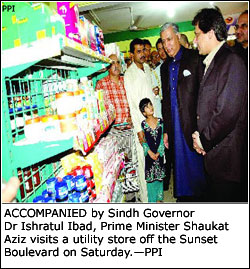 KARACHI, Oct 14: Prime Minister Shaukat Aziz on Saturday asked the KESC to take necessary steps to bridge the gap between demand and supply of electricity to resolve the problems faced by the people of Karachi.
“There is a surge in electricity demand as a result of high growth and investment in industrial sector,” he said while presiding over a meeting at the Governor’s House to review power supply situation in Karachi.
He said “we are closely monitoring power situation in the city to solve the problems faced by domestic and industrial consumers.”
Shaukat Aziz said there was an urgent need for KESC to improve its transmission system so as to become in a position to distribute additional power. He also emphasised on mobile transformers be used as backup support to tackle breakdowns or power shortage problems.
Federal Minister for Water and Power Liaquat Jatoi told the meeting that the government would provide the KESC with necessary funds to enable it to stabilise power supply situation.
CEO of the KESC Frank Scher Schmidt claimed that at present, there was no shortfall in power supply as demand and supply stood at almost the same level.
He said that the KESC was working on a plan to increase its power generation and distribution capacity and under the plan, the capacity would be enhanced by up to 1,000 megawatts within two years.
Earlier, talking to newsmen after visiting a utility store in Gizri area, the prime minister said that petrol prices in the country would be reduced after reaching the old subsidy level.
He said that the government had frozen petrol price in the country at the level of Rs50 per litre at a time when the price in international market was touching $70 per barrel, thus paying subsidy to the tune of billions of rupees since then.
Now, the prices in the international market were coming down gradually, the amount of the subsidy was also declining. “When it will reach the subsidy level where the government had frozen the prices, the petrol prices in Pakistan will come down,” he added.
Referring to the prices of essential items, prime minister claimed that for the first time in Ramazan, the prices had been brought down through an effective check on markets.
“We are satisfied that our measures to control prices during Ramazan have directly benefited common person,” said Shaukat Aziz.
He said that the prices of essential items, including atta, lentils, sugar and ghee, had come down in Ramazan. He noted that for the items like fruits, vegetables meat, etc., the price control magistrates were playing their role in controlling their prices.
Mr Aziz claimed that atta was selling at Rs11 per kg which was the cheapest in the entire South Asian region. Similarly, sugar is available at Rs27.50 per kg at utility stores.
“We have dispelled the common impression that price of a commodity cannot come down after touching its peak in Pakistan,” he added.
“We are trying to stabilise prices of essential items in the market and encourage opening of new markets. Pakistan is facing a challenge of an inefficient supply chain and the government is trying to improve this system.
“There is only one Sabzi Mandi in Karachi and I have asked the Sindh government to open five more. This will improve supply side and will ultimately have a positive impact on overall prices.”
Earlier, Prime Minister held a meeting with Governor Dr Ishratul Ibad soon after his arrival here on Saturday, and discussed with him the implementation of decisions taken by the federal and provincial governments to ensure the availability of essential commodities at affordable prices during Ramazan.
The prime minister stressed that the provincial governments should continue to be vigilant to ensure that there was no supply dislocation, adding that any attempt to create artificial price-hike and price manipulation should be encountered with full force of the law.
He said that the provincial and local governments should take more steps to expand distribution network and to improve supply position.—PPI/APP