



 0
0

 KARACHI: Though the Millennium Development Goals are achievable, Pakistan does not fare well as far as progress in education-related MDGs target are concerned.
The government is following a skewed policy in which more funds are being allocated to higher education at the cost of primary education.
The government allocated Rs18.7 billion to education in the budget 2006-07 as against Rs16.4 billion last year, showing an increase of 12.7 per cent. This budget is little over two per cent of the GDP. To achieve the millennium goals, in views of experts, it should be no less than four per cent of GDP.
Pakistan, therefore, still has to go a long way to reach these targets. Unless education is given the priority that it deserves in the policy framework, this sector will continue to show weak performance.
According to the Pakistan Millennium Development Goals 2005, under the Medium Term Development Framework (MTDF), net primary enrolment and literacy is targeted to reach 77 per cent and primary completion rate to 80 per cent by 2009-10. The corresponding MDG targets are 100 per cent and 88 per cent, respectively.
These targets present a major challenge. If the net primary enrolment increases at the rate of 2.5 percentage points per annum, observed in the last four years, it will be 64.5 per cent and 77.5 per cent by the year 2009-10 and 2015, respectively. Only if the per annum increase more than doubles to five percentage points, net primary enrolment would achieve the MDG target of 100 per cent by 2015. The current net primary enrolment rate is 52 per cent.
The report for 2005 claims that most of the development indicators have improved significantly since 2000, supported by large increases in pro-poor budget spending. Where improvements are quantified, however, the rate of change does not appear to be sufficient for the goals to be reached by 2015, and official statements refer more to commitment than confidence. No concrete data for recent poverty levels is provided and the report concedes that recent economic growth has not necessarily benefited the poor due to inequitable distribution.
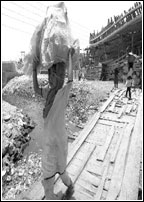 MDGs FOR EDUCATION: The 1990 Conference on Education for All pledged to achieve universal primary education by 2000. But in 2000, 104 million school-age children were still not in schools, 57 per cent of them girls and 94 per cent were in developing countries -– mostly in South Asia and Sub-Saharan Africa. The MDGs set a more realistic, but still difficult, deadline of 2015 when all children everywhere should be able to complete a full course of primary schooling.
The World Bank report on “Pakistan Country Overview 2006” points out that gender gaps remain in schooling, largely due to the rural areas where only 22pc of girls above 10 have completed primary level or higher schooling as compared to 47pc boys.
While the Pakistan Social & Living Measurement Survey (PSLSMS) 2004-05 indicates an improvement in Net Enrolment Rate (NER) and Gross Enrolment Rate (GER) from 42 per cent to 72 per cent respectively in 2001-02 and 52 per cent to 86 per cent respectively in 2004-05, it still indicates that almost half of the primary school-age cohort is currently out of school.
While elementary education GER has increased from 41 per cent in 2000-02 to 46 per cent in 2004-05, it remains far below the targets. Moreover, gender gaps remain large, especially for rural females. While the NER shows an insignificant gender gap in urban areas, NER for rural girls at 42 per cent trails behind rural boys’ NER of 53 per cent.
To meet the MDGs by 2015 of achieving universal primary education and gender parity, continued focus will be required to implement education reforms, especially targeting rural areas and females, with intensive monitoring of outcomes.
“Education service delivery in Pakistan faces a multitude of challenges, including inadequate supply of trained and sufficiently motivated teachers, poor physical infrastructure and other facilities, and poor quality and relevance of curricula. Under-investment in quality education needs to be corrected to improve supply of services and positively influence enrolment, retention, teacher quality and attendance, and learning achievements,” observes the Pakistan MDGs 2005 report.
According to the PSLM survey, 16.75pc schools were without shelter, 39pc schools without drinking water, 62pc schools without electricity, 49pc schools with toilets, and 46pc without boundary walls.
According to the Ministry of Education statistics for 2004-05, the total number of primary institutions stood at 157,158, enrolments in these institutions were 21,333,206, and the number of teachers in these schools was 450,136.
It is interesting to note that half of the world’s illiterate and 22 per cent of the world’s population live in South Asia. Sri Lanka and Maldives have almost attained full literacy. The adult literacy rate for India is 61 as compared to 53 per cent in Pakistan.
The overall adult literacy rate of Pakistan for the fiscal year 2004-05 is 53 per cent against the ambitious target (according to the Education Reform Action Plan 2001-05) of increasing it from 45 per cent in 2001-02 to 60 per cent in 2004-05. It is also below the PRSP (Poverty Reduction Strategy Paper) target of 58 per cent for the period of 2004-05. The MDG target is to reach 80 per cent literacy till 2015.
The literacy rate increased at an average of two per cent per annum in the past four years and with this rate it is highly unlikely that Pakistan will be able to reach the MDG target unless and until there is a major change in the policy and implementation framework.
According to the Asia Pacific Report Card on Education for All, Pakistan ranked last out of 14 countries in the Asia-Pacific region in terms of education. The report entitled “Must Do better” published by the Asian South Pacific Bureau of Adult Education (ASPBAE), a network of 200 bodies involved in formal and non-formal adult education, observes that Thailand holds the top position in the region, with an ‘A’ grade, while Malaysia comes second with a similar grade. Sri Lanka is awarded a ‘B’ grade in third position. The Philippines and China both hold grade ‘C’ in fourth and fifth positions respectively.
Vietnam scores a ‘D’ grade in sixth position, while Bangladesh, Cambodia, India and Indonesia are all ranked at grade ‘E’. Nepal, Papua New Guinea, the Solomon Islands and Pakistan occupy the bottom four positions with ‘F’ grade. Experts believe that at the moment a lot of money is being spent on the education sector through donors and local resources, but there has to be a committed effort and also accountability to achieve the ‘education for all’ targets of the MDGs. Officials at the federal education ministry said the government had taken major steps to improve enrolments, including free education up to matriculation in a phased manner; provision of missing facilities in schools; provision of free textbooks in a phased manner; grant of scholarships and incentives to girl students; uniform academic session from 1st of September throughout the country; availability and accessibility of schools particularly in rural areas; increasing budgetary allocations for education; improvement of teacher’s status/salary status and priority to recruitment of female teachers particularly at the primary level; and national textbook policy formulation.
They said during the last five years expenditure on education had substantially increased from Rs75.887 billion in 2000-01 to Rs170.708 billion in 2005-06. This includes additional funding under the Education Sector Reforms (ESR) and mega action plan launched by the ministry in the wake of millennium declaration of September 2001. However, the ministry is cognizant that still there is a long journey to reach cherished destination of four per cent of GDP spending on education by 2010.
When asked about the likely impediments in way of achieving education sector goals, a ministry official said different action plans had used different indicators. Where some indicators of education included in various plans are similar, their benchmark data are not the same. This results in lack of comparability and coordination issues.
“Capacity of the district level machinery for better service delivery is low. Although a number of donors are making huge intervention in education sector in Pakistan, their programmes are project-based, disjointed and fragmented, leaving little impact on the ground situation. They select the geographical area of their choice and the field of intervention in education as well,” he added.
He pointed out that significant and visible improvement in education scenario might happen if donors’ programmes were well coordinated and these are aligned towards the government’s policies and plans.
Politicisation of education sector, particularly in appointments, postings and transfers has reached its extreme. The ministry wants absolute de-politicisation and feels that the sector should be handed over to educational managers and academicians at their respective levels.
In reply to a query, the officials said that in order to achieve MDG target, the Ministry of Education had planned to raise the spending on education from the existing 2.1 per cent of the GDP to four per cent and this had been supported at the highest levels of both the president and the prime minister.
“The ministry has already submitted different options to the finance division for necessary incorporation in the Poverty Reduction Strategy Paper II. One of the plausible options is gradual enhancement of expenditure on education to four per cent of GDP up to 2010–11,” they added.






























