



 0
0

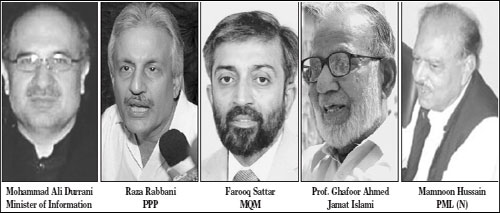 KARACHI: The government takes credit of putting the economy back on track and hopes to achieve the Millennium Development Goals (MDGs) by 2015. The opposition, with little knowledge about the goals, termed the government’s claims hollow. It feels that over the past few years the economic deprivation of masses has actually aggravated.
The level of awareness among the second tier of leadership of mainstream parties was found to be low, some of them even admitted of not being familiar with the term of MDGs at all.
Mohammad Ali Durrani: Information Minister Mohammad Ali Durrani held that scaling down of poverty level from 32 to 22 per cent reflected that the government’s seriousness towards development goals.
The minister admitted that no public awareness campaign was launched by the government to popularise the plan but economic achievements highlight that the government was doing well in this direction.
“The documentation of the economy coupled with proactive strategies by involving the private sector and massive inflow of FDI in various sectors will generate more economic activities impacting all segments of society positively and getting us nearer to our targets,” the minister added.
He said the continuation of the current regime with consistent economic policies coupled with the involvement of stakeholders in decision-making would lead the country to achieve the MGDs three to four year ahead of the deadline of 2015.
Refuting the hue and cry by the opposition, he said that the facts and figures of the government were acknowledged by reputed international organisations which showed that they had trust in the present regime and its polices that had revitalised the economy bringing back the country from the edge of bankruptcy in 1999 and putting it back on the development path.
“Rural consumption is rising, reflecting rise in living standards. This has put Pakistan into middle income group of the world,” the minister boasted.He said health and education sectors were given top priority and hopefully all MDGs would be met. “We are now concentrating on creating awareness about the causes of some major diseases.”
Rashid Rabbani: Pakistan Peoples Party Karachi President Rashid Rabbani while talking to Dawn on the subject said that the government had failed to do anything for the common man.
He said that the government churned out bogus numbers to create an illusion of wellbeing. The government’s claims of reducing poverty, generating new employment and improving health facilities under the Millennium Development Goals (MDGs) were false as the ground realty was totally different from what had been propagated.
He said the term MDGs was not known to many in the political field, which exposed the centric attitude of the rulers, adding that being a representative of depressed masses, the PPP had incorporated these goals in its manifesto for the upcoming elections next year.
Mr Rabbani said thousands were rendered jobless in the name of rightsizing under the pressure of foreign donors -– IMF, World Bank, ADB, etc.
“Millions are looking for jobs but jobs will only be created when the capacity of the economy will be enhanced by installing new industry,” he said, adding that during the last five years not a single industry or plant had been set up in this mega city, which is industrial hub of the country.
He said the rising inflation had already reduced the purchasing power of the masses forcing them to stand up in long queues to get commodities from utility stores at subsidised rates. “Only a democratically elected government under a system of check and balance can deliver.”
Mamnoon Hussain: Sindh Pakistan Muslim League Senior Vice-President Mamnoon Hussain said he did not know about the term of MDGs, but the goals described therein were basic part of the manifesto of the PML (N).
He said reducing poverty, creating new jobs, providing better health facilities were prime objective of his party.
Contradicting official figures, he said that surveys and researches conducted by leading independent economists and organisations had proved that the incidence of poverty had gone up in the country.
“The figures offered by the government do not conform to the reality as the rising inflation, crimes and suicides reflect the economic deprivation.”
He said that under the present one-man rule of President Musharraf a particular class had flourished at the cost of middle and lower classes, Mr Mamnoon said.
Prof Ghafoor Ahmed: Jamaat Islami Naib Amir Prof Ghafoor Ahmed said that inflation was on the rise, suicide rate was soaring, no new jobs were being created, and this indicated that the government had not delivered.
He said that he did not know much about the MDGs, but was not ready to accept the government claim of reducing poverty to 22 per cent and insisted that it had risen to 45 per cent instead.
The MDGs may not be known to every activist of political parties but the goals are part of their manifestos of most political parties.
He said the Jamaat Islami’s Shoora meeting would be held on 30th of this month in which the basic objectives of the party for the upcoming elections would be decided.
“Only real democracy and transparent elections can bring about positive change in life of ordinary Pakistanis,” he added.
Dr Farooq Sattar: Deputy Convener of the Muttahida Qaumi Movement’s Coordination Committee and its Parliamentary leader in the National Assembly, Dr Farooq Sattar was sceptical regarding the government’s claim of reducing poverty under the Millennium Development Goals. He admitted of knowing little about government’s strategy in connection with the goals.
He doubted the reliability of official statistics collection system and said that microeconomic indicators were not very promising. He saw rising crime rate linked to poor economic indicators. He admitted though that macro indicators of the country were improving.
He said meeting of health and education goals would depend on larger allocations to these sectors in the budget and suggested that at least five per cent of GDP should be spend on these two sectors.
He said cent per cent provincial autonomy in executing provincial subjects was indispensable if the government wanted to deliver at grass-roots level. “Currently the provinces are dependent on the federal government for 85 per cent of funds, which is the key reason for slow progress on developmental projects.”





























