



 0
0

KARACHI: That people in cities like Karachi and Hyderabad are dying of drinking contaminated water leaves no doubt that the Millennium Development Goals (MDGs), set at the dawn of this century by leaders of 190 countries including Pakistan, have remained flat and lifeless in Sindh.
Health services in Karachi, the economic powerhouse of Sindh nay Pakistan, are not adequate enough to contain the much feared dengue fever which has now acquired epidemic proportions, claiming more than half a dozen lives with over 500 cases having been reported so far. The recent monsoon rains in Karachi and Hyderabad paralysed the entire civic machinery, and the two cities have yet to recover from the impact.
In a population of 40 million, more than 15 million — mostly in rural areas of Sindh — live in abject poverty. Despite government’s commitment to cut down the number of poor and hungry by half till 2015, the socio-economic situation in Sindh has worsened in the wake of a drought spanning three years, rains, floods and storms that devastated crops, livestock and human settlements.
“An insensitive government in Islamabad and a coalition of uncomfortable partners in Karachi have contributed to worsening the socio-economic situation in Sindh,” a retired bureaucrat remarked.
“The number of poor and hungry in rural Sindh has rather increased during the last five years,” said a young officer of Sindh government who hails from a small village in lower Sindh and whose duty takes him to a greater part of the province which offers him an opportunity to see for himself the quality of life, the availability of education and health facilities, the gender discrimination in case of enrolment in schools and provision of medical care, etc in most of the districts of Sindh.
“The federal government does not allow provinces to carry out poverty surveys in their areas,” he revealed, adding that a study carried out with the assistance of a United Nations agency to draw a strategy for tackling poverty had been finalised several months ago.
“This survey incorporates findings about poverty and hunger, absence of health and educational facilities in many districts and other aspects,” he said.
A sub-committee of Sindh cabinet headed by provincial Planning and Development Minister Shoaib Bokhari is expected to look at the report for approval, and its subsequent implementation for achieving the millennium development goals. Now the time is set after Eid.
This report, it is believed, speaks of startling disparity in urban and rural population.
Over a year ago, the Sindh government carried out a multi-indicator cluster survey report with the active assistance of Unicef.
Dealing with quality of life in urban and rural areas, the report is gathering dust on the table of Sindh Chief Minister which is now jokingly called a “graveyard of official files and summaries”.
Officials in Sindh government do interact with the federal government and world agencies on implementation and review of the work being carried out to achieve the millennium development goals.
“Six years back when the international community set these goals, the developed countries and financial institutions promised generous donations,” a senior bureaucrat recalled. At an international gathering of Unesco in Paris last year, he said the developed countries and donors were found wanting in fulfilling their commitments.
“Now there is a call to review, revisit and revise these goals because the promised funds are not coming,” he said.
“You build your country on your sweat, blood, tears and sacrifices,” he stressed while pointing out that dependence on money of taxpayers of other countries to develop education, health and other facilities in your country will never bear fruit.
There are officers in the Sindh government who recall how Rs89 billion loan assistance given by World Bank in the name of Social Action Programme (SAP) was literally squandered away by bureaucrats and politicians in the 1980s and 1990s.
“Not a single head rolled,” he moaned.
“The Annual Development Program (ADP) has been transformed into an engineering plan constructing endless buildings rather than consolidating a mix of social and economic infrastructure on need basis,” is a candid observation of an official document in the year 2001 when Hafeez Sheikh was finance minister.
In last three fiscal years, Rs117 billion were invested on development in Sindh and another Rs50 billion are being invested in the current fiscal year. This massive investment of Rs167 billion has not changed the economic and social infrastructure landscape of Sindh. A look at the big city like Karachi, second tier cities like Hyderabad and Sukkur and small cities and towns like Larkana, Dadu, Jacobabad and Thatta convey stories of year-long negligence and wastage of money on cosmetic projects.
With an army of more than 450,000 employees, Sindh boasts of the highest density of civil servants, the biggest number of senior officers put on special duty and sent homes with pay and benefits — at one time more than 52 — as well as the highest number of ghost employees in education, health care units and other departments.
No wonder there are more than 41,000 primary schools in the province, however, the enrolment of children from 5 to 9 years is only 44 per cent. Of 100 boys in the 5-9 age bracket, only 51 go to school and 40 never see any school in their entire lives.
The problem is much more acute in case of girls, only 36 per cent of whom get enrolled in schools and 64 never see any educational institution. The gender inequality in school enrolment is much sharper in rural areas because of the distance of schools and social backwardness. Dr Hafeez Sheikh had introduced a scheme of Rs100 a month scholarship plus free meals and books for girls. Mothers were engaged as helpers to cook meals and to present the same in schools where their daughters are taught. However, no monitoring was carried out to find out the results of this scheme.
Out of more than 41,000 primary schools in Sindh only 11,277 have proper buildings, 34,000 have electricity connection, 25,000 have drinking water facility and about 24,000 have toilet facilities.
At one time, there were 7,000 schools without teachers that were converted into parlours or livestock pens by the local waderas. Out of 450,000 employees of Sindh government, more than 100,000 are employed in Sindh. Quite a big number go to villages to collect their salaries.
Let’s take a look at the schools being set up. Against more than 41,000 primary schools, there are only 2,539 middle schools which means there is just one middle school to accommodate students from 16 primary schools. Hence, the number of dropouts is increasing every year. Not just the capacity, the distance of schools from the place of residence of the students, particularly girls, is one more reason for this increase in dropouts.
There are 1,568 secondary schools, 182 higher secondary schools, 23 intermediate colleges, 201 degree colleges, eight post-graduate colleges, six professional colleges, 68 vocational institutions and 50 technical institutes.
Health facilities are there in the cities, but they are offered at a cost that goes beyond the capacity of most of the citizens. In rural areas, the health care is just pathetic. For every 10,000 patients, there are eight beds, one nurse and 3.43 doctors. But these are lifeless and flat figures.
In short, whatever goals have been set for millennium development for the world, the quality of life in rural Sindh is worse than it was in Moenjo Daro 5,000 years ago. Isn’t it a pity that the Sindh which boasts of a number of politically and socially powerful landlords has the largest number of landless peasants.
"We will have time to reach the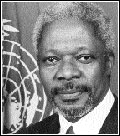 Millennium Development Goals – worldwide and in most, or even all, individual countries – but only if we break with business as usual. Millennium Development Goals – worldwide and in most, or even all, individual countries – but only if we break with business as usual.
We cannot win overnight. Success will require sustained action across the entire decade between now and the deadline. It takes time to train the teachers, nurses and engineers; to build the roads, schools and hospitals; to grow the small and large businesses able to create the jobs and income needed. So we must start now. And we must more than double global development assistance over the next few years. Nothing less will help to achieve the Goals."
United Nations Secretary-General |





























