



 0
0

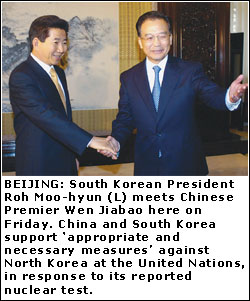 UNITED NATIONS, Oct 13: The five permanent members of the United Nations Security Council and Japan on Friday inched closer to an agreement on imposing sanctions against North Korea for conducting Monday’s nuclear test after the United States dropped mention of threat of force from the resolution.
“If all goes well, the resolution could be adopted by Saturday,” a diplomat told Dawn.
The latest American draft resolution invokes Article 41 of the UN Charter, which makes it possible to impose economic and diplomatic sanctions but excludes military sanctions.
The US added the provision against military action after a special envoy from China met President George Bush, Secretary of State Condoleezza Rice and National Security Adviser Stephen Hadley at the White House on Thursday.
The envoy, Tang Jiaxuan, told the US leaders that China agreed that ‘strong measures’ were needed to punish North Korea but it wanted only sanctions related to the proliferation of weapons of mass destruction, National Security Council spokesman Frederick Jones said.
After the meeting, Ms Rice said it would take more effort on both sides to gain the support of China, which would have to implement many of the sanctions.
“I think the Chinese clearly understand the gravity of the situation,” Ms Rice said. A bout voting on the resolution, she said: “I think it will be soon.”
In New York, China’s UN Ambassador Wang Guangya agreed that “good progress has been made” in improving the text. Russia’s UN Ambassador Vitaly Churkin said there had been “a number of improvements” and, importantly, council unity “is in good shape”.
The upbeat message came after more than two hours of closed-door negotiations among ambassadors from the five permanent members and Japan’s ambassador, who is the current council president.
“We have made very substantial progress,” US Ambassador John Bolton told reporters after the meeting.
“I don’t want to say we’ve reached agreement yet, but many, many of the significant differences have been closed, very much to our satisfaction.”
Article 8 of the draft resolution says all UN member nations are to prevent all goods, equipment, products and technology related to Pyongyang’s nuclear development from going into the country, and that such materials are banned from direct or indirect transfer to North Korea via land and sea. It also covers luxury goods.
Member nations will be obliged to freeze financial assets owned and managed by individuals and organisations proven to have helped the country develop weapons of mass destruction, including nuclear arms and missiles. When it comes to the contentious issue of inspection of North Korean vessels, UN members are called on to take “cooperative action as necessary under their own domestic law and in a way that does not violate international law”.
The draft resolution is ambiguous in determining the kinds of transactions UN members are prohibited from conducting with North Korea.
When it is put into action, however, such inter-Korean business projects as the Kaesong Industrial Complex and package tours to Mount Kumgang, which are cash cows for the North, will come under the scrutiny of a committee to be established in the UN to monitor whether member countries are adhering to their obligations. The UN will put more pressure on Seoul to inspect North Korean vessels in the East and West Seas.




























