



 0
0

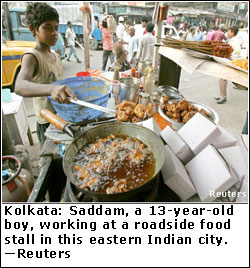 NEW DELHI: Ten-year-old Sonu sits forlornly on a plastic chair in a ramshackle street food stall in New Delhi, taking a break after serving customers tea.
A ban on child labour in households, restaurants, hotels and resorts came into effect in India on Tuesday but nothing has changed for the tired-looking boy, dressed in scruffy blue jeans and a faded green shirt.
Sonu, whose father also works in a food stall, says he’d rather be in school.
“But what to do? This is necessary,” said the boy, reality teaching him an early and harsh lesson in life.
Sonu comes from a poor family from a New Delhi slum and is one of the millions of children who work in roadside food stalls or in the homes of India’s upper and middle-class.
Officials hope the new ban, which will apply to children under 14, will protect underage workers from psychological and sexual abuse as well as from strenuous working conditions.
On the eve of the ban, Prime Minister Manmohan Singh warned of “firm action” against violators but appealed to Indians to give up the practice voluntarily.
Under the country’s existing Child Labour (Prohibition and Regulation) Act of 1986, children under 14 are already banned from working in industries deemed “hazardous” such as fireworks, matchstick-making, auto workshops or carpet weaving.
Activists say they have their doubts about how authorities will implement the new ban, given their past record.
“This ban on child domestic labour is a welcome step, but changes on paper are not enough,” Zama Coursen-Neff of New York-based Human Rights Watch said in a statement.
Less than five km from India’s labour ministry, 10-year-old Shehzad is covered with grime and dust as he uses a foot pump to inflate a tyre tube of a scooter belonging to a policeman, who watches him impassively.
Shehzad does not know children have been banned for a decade from working in workshops but says it does not make a difference.
“I can’t go to school as my father can’t afford to buy books for me,” the son of a rickshaw-puller said.
The new ban for children in food stalls and working in homes is aimed at providing legal protection to millions more children. Those found violating the law could face up to two years’ jail and a maximum fine of Rs20,000 or both.
The labour ministry says there are 12 million children under 14 years old working in India — the largest such group in the world — but activists say the number could be five times higher.
Dozens of former child labourers demonstrated outside the ministry.
“It’s the right of every child: bread, play, study and love,” they shouted at a rally organised by the Bachpan Bachao Andolan (Save the Childhood Movement or BBA).
The United Nations said stopping children working was just a first step, and urged the government to set up counselling support for freed children, provide shelters and ensure that they are welcomed back in their families.
“This declaration of political will needs to be concretised in the forms of safety nets for the children who will be freed,” said Victoria Rialp, UNICEF’s child protection chief in India.
Authorities say results from the new ban will not come overnight as many Indians do not see the age-old practice of employing children from impoverished families as a crime.
Activists say the new ban will expose the problems faced by child servants — whose living and working conditions are not exposed to public scrutiny — including sexual exploitation.
“These children are very vulnerable. Their employment is an invisible form of slavery,” BBA’s Kailash Satyarthi said.—Reuters




























