



 0
0

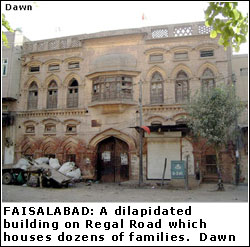 FAISALABAD, Oct 9: The City District Government Faisalabad and other departments seem to have learnt no lesson from the calamity that killed over 73,000 people in Oct 8 earthquake last year.
A mild tremor can cause fatalities as a large number of people are still living in dilapidated buildings in Faisalabad city district.
The district has many old areas, including Santpura, Monshi Mohallah, Dhobi Ghat, Gurunankpura, Partabnagar, Digoluspura, Gobindpura, Hajveri Town, Mansoorabad, Manawala, Malikpur, Dhudiwala, Mohammadpura, Gao Shala, Razaabad, Islamnagar, Nighebanpura, D-Type Colony, Bhaiwala, Samanabad, Panjpir, Saeedabad, Ghulam Mohammadabad, Nishatabad, Hajiabad, Noorpur and Madanpura, and eight bazaars around the Clock Tower.
Scores of rundown buildings in these colonies are still being used for residential purposes. These areas are densely populated where vehicles and other machinery may not enter in case of any eventuality.
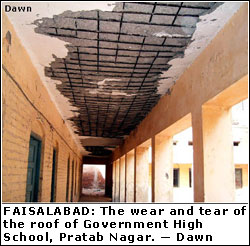
Besides that many state-run school buildings are also in a shambles, and most of them are on the verge of collapse. The Government School Pratab Nagar, for example, is one of many schools facing collapse. The roof of a classroom had caved in a couple of months ago luckily at a time when the school was off.
Most of the residents of these areas have no means to repair or reconstruct these buildings. Shifting to the other places is next to impossible for them. They are totally dependent on the government as far as repair or reconstruction of their properties is concerned.
When the Oct 8 quake shook the country, the Punjab Education Sector Reforms Programme (PERSP) manager had asked the Works and Services EDO to carry out a survey of 350 government schools. But, the EDO, reportedly, refused to do so for one reason or the other. The PERSP district manager confirmed that the EDO had refused to conduct a survey saying they had no proper facilities to accomplish this task.
Nasir Hanif, a cloth trader in Jhang Bazaar who owns many old buildings, said it was unfortunate that the provincial and district governments had not taken any step to make things better for those living in dilapidated houses or buildings.
During the rainy season, he said most of the people living in such buildings had to move to their relatives in other areas.
 He said not a single government official or functionary bothered to ask the residents of these localities to move to safer places during the rainy season.
The Faisalabad Development Authority (FDA) discharged its duty only by issuing notices to those living in dilapidated flats and buildings that fall in its jurisdiction to vacate them.
Hamid Ali, a resident of Digoluspura, said: “We are not afraid of any thing as we are already living in a hell.” He said: “Whenever a horrible incident takes place, the administration comes into action to save people, but it does not take measure before hand to escape such incidents.”
After the quake, then DCO Athar Husain Sial had ordered a survey of multi-storey plazas and buildings and announced the formation of a cell to compile a report whether they were built in accordance with specifications and standards.
It was also claimed by the then management that without an NOC, to be obtained from this cell, construction of a plaza or multi-storey building would not be allowed. The step was considered a harbinger to the change. What happened to the cell and its recommendations afterwards was best known to the bureaucracy as construction of illegal plazas and multi-storey buildings is still going on unchecked.
EDO (works) Mian Riaz Ahmad, who was head of the cell, said the survey order was just a routine matter and nothing more.
To a question about the number of state-owned old buildings, he expressed his ignorance in this regard and said we carried out repair work whenever we received funds.


























