



 0
0

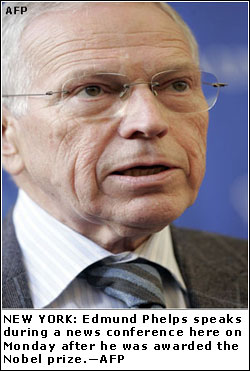 STOCKHOLM, Oct 9: American Edmund Phelps took the economics Nobel on Monday for work on the relationship between unemployment and inflation.
The Royal Swedish Academy of Sciences said the Columbia University professor won for challenging the assumption in the 1960s that policymakers could cut unemployment in the long-term by stimulating demand.
Edmund Phelps, 73, who owns neither a house nor a car, showed cutting interest rates or taxes would give only a short-term boost to employment.
“All you are getting is some higher growth in the short-term and a long-term inflation problem,” said Philip Shaw, chief economist at Investec Securities in London of Phelps’s work.
Mr Shaw added that Phelps’ work remained “the cornerstone of central bank practice today”.
Americans have swept all the Nobels so far this year.
Phelps said the academy had woken him to give him the news.
“My wife said it was two minutes past six. She passed (the phone) to me and said I had an international call of some sort,” he said.
“It didn’t take me very long to realise what it could be.”
Asked how he felt about winning, Phelps said: “Very happy of course. Very interested to learn all about it and what kind of work they gave me the award for.”
In his research, Phelps suggested that inflation was not a cause of unemployment but argued that there was a base level of unemployment which helped keep prices steady.
The academy said the theoretical framework Phelps developed in the late 1960s helped economists understand the root of soaring prices and unemployment in the 1970s and the limitations of policies to deal with these problems.
His framework helped central banks shift their focus towards using inflation expectations to set monetary policy rather than concentrating on money supply and demand.
“It may amuse you to know that my wife and I don’t have a lot of hard assets,” he said. “We don’t own a house and we don’t own a car. We have a few clothes here and there. But don’t misunderstand me. We don’t live a very austere life.”—Reuters




























