



 0
0

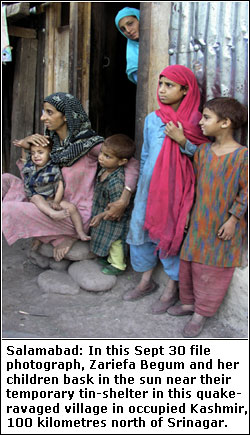 SRINAGAR: High hopes that 73,000 earthquake deaths would spur India and Pakistan to finally make peace over disputed Kashmir today lay buried beneath the rubble of continued violence in the valley and lack of trust and mutual suspicions on both sides.
The scale of the tragedy that struck both sides of the Line of Control dividing the Himalayan state on October 8, 2005, appeared to offer the best chance in six decades to set aside suspicion and hatred.
But peace looks no closer one year later.
Indian Prime Minister Manmohan Singh bluntly warned this week that Pakistan had to “walk the talk” on terrorism if their peace process was to move forward.
The warning came in the aftermath of public accusations from Mumbai’s police chief that Pakistan’s ISI spy agency had orchestrated a series of blasts that left 186 people dead and 800 more wounded in India’s economic capital in July.
Pakistan denied involvement and renewed offers to cooperate if any evidence was presented.
India did deliver some aid to Azad Kashmir when the earthquake struck the region on Oct 8 last year. Five border posts were briefly opened to allow aid to flow more easily from occupied Kashmir and relatives to visit their families. Some telephone lines were also opened.
UN Secretary General Kofi Annan saw a window of opportunity and called on the nuclear-armed rivals to harness the mood of cooperation forged by the disaster and strike a lasting peace.
But the positive mood quickly soured.
When Indian troops reported a sortie across the Line of Control to help quake-stricken Pakistani soldiers, the Pakistan army dismissed it as nonsense, sparking an unseemly squabble of claim and counter-claim.
The sub-continent’s legendary red-tape wrapped up aid and travel, slowing down the flow of goods and people to a trickle. Pakistan security forces tear-gassed hundreds of Kashmiris trying to cross the border without permits.
And deadly attacks by Muslim militants soon resumed.
New Delhi initially believed the giant quake had dealt a blow to the militants. Indian intelligence asserted guerrilla groups in Azad Kashmir had suffered major personnel and infrastructure losses.
However, only 10 days later on October 18, the militants walked into a high-security residential compound and shot dead the Indian region’s education minister and two of his guards. The violence has not stopped since.
On October 29, three bombs exploded in New Delhi, killing 66 people on the eve of Diwali, the biggest Hindu festival.
The trail of terror, to which India blames Pakistan, has this year taken in not just Mumbai, but also the holiest Hindu city of Varanasi where 15 people died in bombings last March.
Muslim militants were also blamed for a series of grenade attacks in Kashmir last May that left 15 tourists dead and 70 others hurt.
In the western Maharashtra town of Malgaon, 30 people were killed by a bomb outside a mosque this September.
“The hopes (of reconciliation) were dashed at the onset when they (India and Pakistan) rejected help from each other,” says political analyst Tahir Mohiudin.
“Things worsened as attacks in Srinagar, Mumbai and New Delhi were blamed on Pakistan.
“The lack of trust remains. As long as that continues we will not see any change in India-Pakistan relations,” said Mohidin, editor of occupied Kashmir’s leading Urdu weekly Chattan.
The foreign secretaries of India and Pakistan are scheduled to sit down next month for a new round of peace talks in a process that has produced a series of confidence-building measures and plenty of recrimination.
Individuals caught up in the Kashmir dispute despair at the failure to make real progress.
“Both India and Pakistan have remained indifferent to our feelings,” said Jameel Ahmed, 22, from Uri, a mountainous area devastated by the quake on the Indian side.
“I lost my 11 relatives in the other part of Kashmir. Initially, we thought they would allow us to cross the border freely to comfort our loved ones,” he said.
“My mother and I applied for permission (to travel) which was not granted,” he said.
Ahmed said Kashmiris feel the “peace process is not moving. Had it moved a bit we would have a direct telephone facility between the two parts of Kashmir.”
Today only one border crossing remains open for a select few who can obtain approval papers from police, army and intelligence services.
Senior separatist Shabir Shah, who has spent more than 20 years in jail for supporting Kashmir’s independence, today pleads for flexibility.
“The earthquake had generated a ray of hope,” he says. “India and Pakistan wasted that golden opportunity.”
Shah said he tried to send 300 men — carpenters, engineers and masons — to help reconstruction in Azad Kashmir. “Most people are not cleared for travel ... India didn’t clear my men.
“Confidence-building measures are all right but New Delhi should enter into a serious dialogue with Pakistan on the real issue of Kashmir,” he said.
“The violence might have set back the process, but blaming Islamabad for every attack without any evidence complicates the issue.” For Noor Ahmed Baba, head of political science at the University of Kashmir, little has changed and distrust envelops India-Pakistan relations.
“The earthquake provided a golden opportunity to make borders irrelevant. People had high hopes that India and Pakistan would work together,” he said.
“But that didn’t happen because of the old mindset on both sides, particularly on the Indian side. The mindsets have not changed.”—AFP



























