0
0

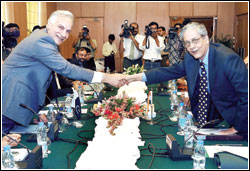 THE one-hour positive meeting between President Pervaiz Musharraf and Dr Manmohan Singh at Havana and their decision to resume the composite dialogue between the two countries has opened the path for larger trade. As a first step, India had suggested the inclusion of about 300 items from that country for Pakistan’s positive list of imports for India.
And the Economic Committee of the Cabinet has approved that list of 302 items which include pharmaceuticals including those manufactured under franchise from foreign companies, which should be cheaper than the same kind of items available in Pakistan through imports or local manufacturing which are priced high.
Iron and steel imports from India approved now should be cheaper than imports from the West. So should be machine parts from India which have been coming otherwise through third countries or through smuggling.
The same should hold good for diesel locomotives and surgical goods from India. It is to be hoped that Indian exporters will not put up the prices for exports to India far above the higher exchange rate of the Indian rupee.
The actual trade between the two countries including a two-way smuggling and trading through third countries like Dubai and Singapore is said to be of $3 billion.
The two governments are loosing a great deal in revenue because of smuggling, while the products obtained through third countries cost far more than what direct trade would.
In fact, Pakistani businessmen wanted about 900 items more from India to be added to the positive list. For such an escalation they have to wait.
Both the governments of India and Pakistan want larger trade between the two countries. But while India believes that larger trade and greater cultural relations and more people to people exchanges will lead to a congenial climate for the solution of political problems, Pakistan wants political problems inclusive of the Kashmir dispute solved first or at least positive moves made in that direction simultaneously.
While there have been many meetings between the two countries including submit level talks, there has been no real progress in the area of resolving political disputes. Hence larger trade between the two countries is held up.
The total trade between the two countries is barely $1 billion while the potential is said to be of $5 billion. The two governments are loosing a great deal of revenue, while the products obtained through third countries cost far more than what direct trade would cost.
There are other deterrents to full scale trade between the two countries. India wants to be given the Most Favoured Nation (MFN) treatment by Pakistan in mutual trade. But Pakistan is not ready for that until India makes positive moves for a settlement of the Kashmir dispute.
India gave the MFN status to Pakistan two years ago but Pakistan argues that it is ineffective as there are several tariff and non-tariff barriers. Hence the volume of Pakistan’s exports to India is too small.
At the same time, the South Asia Free Trade Agreement (SAFTA) has come into effect after laborious efforts. But Pakistan wants trade between the two countries on the basis of the positive lists of both countries.
Under the SAFTA, the seven member countries of Saarc enjoy tariff concessions on 4872 items. India hence strongly objected to its exclusion from this list by Pakistan and proposes to take up the issue at the meeting of the ministerial council of SAFTA.
Meanwhile, Pakistan is importing more and more vegetables and meat from India as well as sugar to overcome its shortage of these essential items. As a result, trade between the two countries rose to $746 million in 2004-05 against $476 million in 2003-04.
In the earlier years, Pakistani businessmen were opposed trade with India, but now the textile mill owners find they can buy chemicals and dyes much cheaper from India and so is the case of textile machinery.
In addition, China is now able to sell a great many variety of manufacturers much cheaper than India. Pakistani businessmen have also become more self-confident and venturesome than before and are ready to compete with India on home grounds.
As a result of such developments and the inclusion of 302 items from India to Pakistan’s positive list, the volume of trade between the two countries should increase.
The infrastructure for larger trade with India is also being improved in Pakistan. An agreement has been signed for resuming the long abandoned shipping service between Karachi and Mumbai. And the Thar-Munabao railway line has been restored . But the major deterrent against the trade with India is the absence of an Indian visa office in Karachi or the old Deputy High Commissioner’s office. That is not to be opened until Pakistan is able to get suitable place for a visa office in Mumbai, which is taking a long time.
The approval of 302 items to be included in the list by the ECC so promptly shows that Pakistan is ready for larger trade with India and the greater number of items, inclusive of diesel locomotives. That should get the business on both sides more active to increase the volume of trade between them in a significant manner.
Now the Indian businessmen should explore the Pakistan market to ascertain what they can buy from us. It can’t be a one way trade for two long. Pakistani traders should also participate in Indian trade fairs not only in New Delhi but also in other parts of India.
And President Musharraf has also reaffirmed following his long US visit that negotiations to build the Iran-Pakistan-India gas pipeline are on and the details are being awaited from a consultant. Dr Manmohan Singh is very keen on the project and Russia is now reported to be interested in the tri-nation pipeline.
Meanwhile, its has been reported by the Transparency International that India is among the 30 countries identified for bribing to boost its exports.