



 0
0

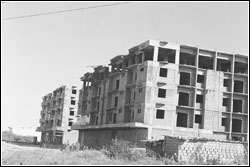 A HOUSE or a shelter is the minimum basic requirement of every citizen. Housing conditions reflect not only the physical facilities enjoyed by people but also their economic and social status. Labour-intensive, housing has a multiplier effect on many economic activities.
According to the Economic Survey of Pakistan, the construction sector employed about 2.21 million people in 2005 which represented about 5.77 per cent of the labour force.
But housing is not affordable for much of the middle and low income groups. Housing prices frequently rise as the demand for houses increases. The demand is not matched by supply because of the lack of adequate financing to facilitate the purchase or building of houses.
Home ownership in major urban areas is about 25 per cent and purchase of house in such locations is unaffordable to many due to high cost of land and building materials. Mortgage credit market is placed around Rs22 billion annually with lending rates at 12-9.5 per cent.
Almost all banks and financial institutions offer loans with a little difference at a rate unaffordable by the middle-income groups and salaried classes who need housing loans most. In fact, some of the loan schemes are aimed at those who can manage everything without such housing loans.
The three types of loan schemes are as follows: (a) for purchasing house/flat; (b) for constructing a house and (c) for renovating an old structure.
The House Building Corporation offers a major investment facility (through a large network of 58 district offices and 11 zone offices with its headquarters at Karachi) with around Rs1.8 billion per annum to public and private sector organisations.
As commercial banks provide loans at higher rates, the HBFC cannot fulfil the housing needs of middle and low income groups and there is a huge backlog. According to 1998 Population and Housing Census, there were over 19.7 million units in 1998 as compared to 12.6 million in 1980, indicating an increase of 53.8 per cent. The total number of required units calculated on occupancy rate of six people per house and the total population of 149 million was about 25 million units up to 2005.
The public and private sector together build about 0.4 million new houses every year and about 10 per cent houses are depleted/destroyed every year. The data indicate gap between demand and supply. The overall situation is shown in following table:
The backlog increased to 4.3 million units by 1998, which is now projected at 6.19 million units. The annual additional requirement is estimated at 570,000 units. Nearly 600,000-700,000 people arrive in major cities from various parts of the country pushing up the demand for housing. However, construction is not picking up at the required level, whereas annual production is estimated around 300,000 million units. The shortfall of the requirement is estimated at 270,000 housing units annually.
The demand for housing finance is enormous. It provides ample opportunities to banks to design products to finance construction.
The rising inflationary trends, the inequitable distribution of income and levy of taxes and sharp increase in the cost of construction have taken the worst toll on the incomes of the middle class which managed to save enough to buy a housing unit in the late 80s. Today for them, buying a house, or even a flat, has become almost impossible. The emergence of the concrete jungles of multi-storey buildings and housing apartments across the cities is enough to prove the point.
The major emphasis of the National Housing Policy is on resource mobilisation, land availability, incentives for home ownerships, developers and constructors and promotion of research and development activities to make construction cost effective. The main objective of the policy is to create affordability to owning a housing unit, especially for the middle and low income groups. But the objectives have yet to be achieved.
Banks’ exposure to housing finance has been enhanced to 10 per cent of their net advances; the maximum per party limit has been increased to Rs7.5 million with a debt equity ratio of 80:20 for a period of up to 20 years.
The total demand for house finance for 270,000 housing units is estimated at Rs68 billion and to clear the backlog for 500,000 housing units it is estimated at Rs125 billon. There is vast scope for a quantum leap in the housing business.
In the current economic scenario, a good part of economic revival depends on investment in housing sector.
Suggestions: It is the duty of the government to provide people their basic requirements including affordable housing. Here are some suggestions in this regard;
* Loan facility must be provided on single digit mark up basis;
* housing finance should not be restricted to a few cities like Lahore, Islamabad, Faisalabad, etc. and for few communities like bankers, business class, and federal employees; the facility rather should be made available in rural areas and to everybody;
* lowering of taxes is needed to reduce the cost of construction and increase the affordability of housing. The government should also reduce the excise duty on construction material;
* In the property registration system, there should be a computerised data base easily accessible to all so that dependency on land department and tehsildar may be minimised;
* a policy for stimulating expanded private sector participation be announced;
* low cost housing schemes closer to cities be introduced; to prevent slums and promote improved local environment for city dwellers;
* bank loans should be on the long-term financial basis.
* Provision of utility services such as road communication, electric, gas, water supplies, sewerage, should be made within three months by the utility agencies before the completion of housing projects.
* verification required for carrying out construction business such as gaining of NOC, cancellation of plots, banning of construction, sealing of completed projects and the like, are the stumbling blocks and these impediments be removed;
* to stabilise high price of land, a ban be imposed on the transfer of plots for five years in a housing scheme.






























