



 0
0

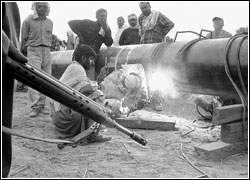 Islamabad and Tehran have agreed to conclude quickly the talks on the $4.5 billion Iran-Pakistan-India (IPI) gas pipeline project. In the trilateral scheme of gas pipeline project, Iran would be the supplier, India recipient and Pakistan transit facilitator as well as buyer of Iranian gas.
The security situation however needs to be improved in Balochistan across which the strategic pipeline will pass.
According to one estimate, Pakistan is expected to get $200-$500 million annually in transit fees alone. Some MPAs in the Balochistan assembly have recently demanded a higher royalty as the greater part of the IPI gas pipeline passing through their province. The house later unanimously admitted a motion that seeks to debate the issue.
Some assembly members believe that the success of the IPI project is linked to accommodation of Balochistan’s demands. Their concern revolves round two main issues: Balochistan needs to be assured of a royalty that will satisfy the people of the province and the locals must be ensured maximum employment in the project.
The proposed Iran-Pakistan gas pipeline project conceived in 1993 was later proposed to be extended to India. The pipeline would carry 1.1- 3.4 billion cubic feet per day (BCFD) gas from Iranian Pars field to Pakistan. A 2670-km pipeline of 32 to 44 inch diameter would be laid from Iran to India, 707 km of which would traverse Pakistani territory, a greater part of which will pass through Balochistan.
Under the plan, Iran would build the pipelines from its Pars gas field to Jiwani in Balochistan (near Pakistan’s border), while Pakistan would lay the pipelines from its side up to Jiwani. This would greatly save the cost of the proposed Iran-Pakistan gas pipeline project by $1 billion.
The gauge of the pipeline would be increased from 36 inches to 40 inches if India shows interest in the Iran gas pipeline project. The inter-state gas distribution company (SSGC) puts the cost of the Iran pipeline project at $2.1 billion. The length of pipeline has been calculated as 2106 km.
India’s oil minister recently called the proposed gas pipeline from Iran across Pakistan ‘a risky venture’ that would be difficult to finance. He viewed that security for any pipeline was a concern because it would run across volatile areas of Pakistan where other pipelines have been attacked in the past.
The proposed plan for laying Turkmenistan-Afghanistan-Pakistan (TAP) gas pipeline could not be materialised due to the prevailing political instability and uncertain security situation in Afghanistan.
Islamabad has however repeatedly been rejecting the India’s concern contending that it can effectively handle the security of the proposed IPI gas pipeline. Petroleum and Natural Resources Minister recently claimed the government had been looking after the 6,000-kilometer-long domestic pipeline network that provided gas countrywide. But the recent incidents of targeting gas installations and blowing up of gas pipelines have become a routine in the province.
The acts of sabotage have several times forced the gas company to shut off the main compressor plant, thus suspending gas supply to parts of Balochistan, Sindh and Punjab. A decline in production has reduced the province’s share in gas royalty to Rs1.5 billion in.
The transportation of hydrocarbons from energy-rich Central Asia and Iran to energy-starved South Asia is a complicated business involving strategic interests of big powers and corporate interests of global energy giants. The proposal of laying gas pipelines from Daulatabad fields in Turkmenistan or South Pars fields in Iran to Gwadar in Balochistan has triggered a cold war between pro-project and anti-project actors in the regional geopolitics.
The US opposes the IPI pipeline project but supports the TAP pipeline project. On the other hand, the Russia supports the IPI pipeline project and opposes TAP pipeline project. While India’s position in the game is that of running with the hare and hunting with the hound.
Balochistan’s concerns about the IPI gas pipeline needs to be addressed. The primary beneficiary of the economic gains from transit fee for trans-regional gas pipelines should be shared by the locals in the form of royalty and job opportunities to Balochis in the IPI project. And the locals should be made directly responsible for the security of the pipeline traversing in their territory. The provincial government needs to be involved in the pipeline issue.
In short, the current Balochistan crisis needs to be amicably resolved through political reconciliation on the autonomy issue.






























