



 0
0

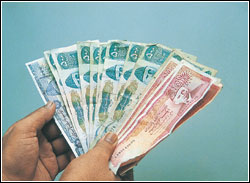 HOME remittances touched a record $4.6 billion in the last financial year. And in the first two months of the new financial year (July and August) the remittances increased by 22.72 per cent over the same period last year or by $150 million to $811.85 million.
In August, the amount remitted through the banking channels was $435 million or 24.81 per cent over the same month in the previous year. Clearly, the amount sent home by overseas Pakistanis is on the rise constantly since 9/11 when it had dropped below a billion dollars.
This is happening despite the decline in the number of workers overseas. More money is coming from the US than from any other single country including Saudi Arabia and UAE. Workers abroad now prefer sending their earnings/savings home rather than retain them in foreign countries and get that frozen on one account or another by foreign governments.
The country’s finance managers are delighted as this inflow helps to reduce the negative balance of payments, which peaked at $5.5 billion last year. The country is facing a trade deficit of over $2.2 billion in the first two months of the current financial year.
But one powerful department of the government is not happy on tax exemptions on the sustained rise in home remittances though that helps the economy a great deal, particularly its external account. That is the Central Board of Revenue and its Chairman Abdullah Yousaf is very vocal about its concern in its area.
He is convinced, as are many others that some of the remittances represent tax evaded income sent abroad through the hundi system and then repatriated through the banking channels as home remittances. In fact, bringing the money home as workers remittances is regarded as a patriotic act.
Some of this could be tainted money of corrupt officials at home(or even ransom money) which could not be declared or revealed here as that could bring their conviction after they are sacked from their top jobs. So when the money returns home, that is all white and can be spent lavishly and openly.
It is difficult to check the money as it comes in as foreign companies may not issue certificates of payment. Nor can our labour attachés certify the authenticity of our earnings. If the government insists on such certificates, the senders of the money can produce fake or forged certificates and the whole exercise will be futile.
What could be possible, if at all, is checking the money going out of the country first through the hundi. But that is too tough an exercise as among the senders are senior corrupt officials including from the police and intelligence services, and they know their hundi system pretty well. It is an old, well anchored institution whose secrecy is well guarded.
So, if the money cannot be checked as it goes out, it cannot be verified as it comes back as earnings or savings of Pakisani workers overseas. So the practice may continue as long as we desperately need foreign exchange to balance external payments or reduce the current account deficit.
Once cleaned up through such a monetary u-turn, the money can be invested in several tax-free enterprises, particularly for real estate deals as has been happening in recent times. The rising inflow of remittances has pushed up the price of real estate in the country, particularly in the Defence Housing Authority of Karachi and other Defence housing societies which are increasing in number. It goes into the stock market for profitable speculation with too little tax paid. Clearly such money has a long tax- free run while the CBR looks at it helplessly and protests in vain.
The ill-gotten or untaxed money is sent abroad and used to bring in a great deal of goods tax-free or at concessional rates which is sold in the local market at high prices.
But many of the overseas Pakistanis complain on return, that the prices of many such items are low in Pakistan, it is no longer rewarding to bring in such goods for sale.
And yet, recent reports said the government was adding 700 more items to be brought in by overseas Pakistanis duty- free or at concessional rates. But will they be able to compete with the cheap Chinese goods in Pakistan?
All that is too frustrating for the CBR chairman who wants to be as rational as possible, more so when the World Bank and the IMF urge the CBR to raise the low-GDP ratio now at 10 per cent.
The CBR cannot urge the government to scrutinise the sources of remittances diligently and weed out the tax-free or tax-evaded money coming back continuously as honoured home remittances. If the government tries to do that, such money will not return through the banks or the inflow of such money may be stopped until safer times return.
The larger picture should be seen clearly. As crimes increase and kidnapping for ransom becomes more common, the money earned through this process has to go out or be obtained abroad to ensure the culprits security.
Similarly, as corruption spreads wider, and the sums involved becomes larger, the money has to be sent out or obtained in countries other than Pakistan to ensure the culprits’ safety. Similarly, if a person has a large tax evaded income, he prefers to send that out and receive it later as home remittances of some relative living abroad.
So such crimes within the country have to be checked and the widespread corruption come down. The tax evasion should curbed to check the informal economy becoming larger and larger.
Even otherwise, the efforts of the CBR to increase the revenues in a big way by enlisting the services of other agencies in anti-smuggling operations have been a failure. It had given anti-smuggling powers to the army, navy, coast guards and Frontier constabulary and Rangers. As those powers did not produce any great results, they were withdrawn six months ago.
And now the CBR has Rs950 million to acquire speed boats to check smuggling by the sea. But for spending that much money, the CBR wants a proper study of the anti-smuggling performance of the coast guards using its own speedboats. If the results of the study were not found very encouraging, the CBR may not deem it wise to spend Rs950 million on acquiring speed boats for its own anti-smuggling operation.
The CBR finds its permitted areas for raising revenues limited. But it sees plenty of opportunities for far larger tax collection if permitted which it is not. That makes the CBR to tax the taxed even more and face a storm of protests.






























