



 0
0

 THE prices, especially those of essential items, continue to rise. So far, the volatility in prices has not been controlled nor have the various factors responsible for it been effectively addressed.
First, the price hike is the outcome of demand and supply gap. Even in case of many food items, the pre-dominantly agricultural economy produces much less than the country consumes. The food deficit is made up by surging imports, estimated at over $1.7 billion for 11 months of the last fiscal.
There is rampant market abuse and prices are artificially manipulated. In the absence of modernisation of agriculture, the production of many of the kitchen items like vegetables and cereals are subject to vagaries of nature.
Finally, the governmental intervention required to stabilise prices of at least of essential items is weak and efforts in this direction are half-hearted. The anti-competitive law under official discussions has yet to the finalised and enforced.
According to State Bank, the food inflation increased last month to 11.1 per cent - the highest for last 13 months- on the back of recent rains that affected production, transportation and supplies from farm and factories to the main markets. The situation led to price increase of such essential items as wheat flour, bread, cooking oil, ghee and vegetables.
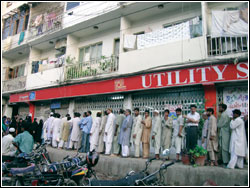
Prime minister Shaukat Aziz announced on Wednesay a subsidy of Rs650 million for reducing prices of 38 essential items during Ramazan which are sold through the Utility Stores. But neither the subsidy amount nor the coverage of the utility stores is sufficient to benefit the majority of the vulnerable poor.
Even among officials, there is a growing consensus that the government will not be in a position to stabilise prices and curb profiteering and hoarding unless it allows the Utility Stores Corporation (USC) to increase substantially its make share in items of daily use by the common man, both in retail and wholesale business.
The market is governed by wholesalers, stockists and producers who create imbalance between the supply and demand. Taking an undue advantage, they increase prices of essential consumer items. This artificial price hike badly hurts consumers.
The government is said to have been advised that the USC would not be able to achieve its objective if it restricts itself to retailing activities. It has to enter into the business of wholesale and bulk distribution.
To stabilise prices, it is said that USC should be in a position to control 30 per cent of the total market share specially for the essential food items like wheat flour, sugar, pulses, rice, vegetable ghee, cooking oil, washing soaps, fresh and powered milk, red chillies, spices and tea.
The USC should maintain buffer stocks of daily essential items to act as a price moderator in the market to prevent profiteering and hoarding. The corporation should buy quality items directly from producers and manufacturers and sell them at cheaper prices.
Such bulk purchases from the producers will enable the USC to secure maximum rebate in prices, which with bulk handling will ensure a steady supply of these articles to consumers at much cheaper rates.
The government has been advised that demand and supply position should remain stable and prices of the essential kitchen items need to be made affordable to the poor consumers.
In the free market, the government intervenes only through policy measures, such as improvement in supply and distribution through imports and USC. The government should achieve its policy objectives of price stabilisation through a chain of USC expanded stores and improved distribution so to act as deterrent against profiteering, hoarding and black marketing.
In fact, USC stores network, some officials believe, must operate as “ price stabiliser” for which the ministry of industries, production and special initiatives has submitted a detailed plan to the Planning Commission for approval.
The Plan for “Expansion of the Network of Utility Stores Corporation of Pakistan (establishment of 17 warehouses/distribution centres and opening of 440 new stores”) has been submitted for approval in line with the announcement of the prime minister made on July 11, 2006.
Phase-1 will cover establishment of 16 warehouses/distribution centres and opening of 315 new stores at district and tehsil headquarters so far not covered by the USC network. The second phase will cover the opening of 125 another new stores.
The eight new warehouses/distribution centres will be set up at Bahawalpur, D.G. Khan, Gujranwala, Nawabshah, Swat, Sahiwal, Rahimyar Khan and Khuzdar for which suitable places are being located. Both the phases will be completed by December 31, 2006, subject to availability of necessary finances from the government.
A total of Rs812.16 million will be provided by the government to help open these new stores and centres. The ministry of industries has informed the Planning Commission that there was an urgent need to upgrade USC’s infrastructure, services, warehouses, facilities, management capabilities, professional manpower and to induct an experienced and trained retail chain stores management.
There is also a need to have a regular training of officers and sales staff to upgrade their efficiency in management and sales and to ensure networking of stores/warehouses and USC with the market”, the ministry told the Commission.
A provision has also been made for the security arrangements for the stocks, cash and staff in Balochistan for the next five years. The total cost of the security arrangements has been worked out to be Rs45.90 million. The security guards for stores and warehouses will be arranged from the security companies. Necessary help/assistance of the law enforcing agencies will also be sought whenever required.
The prices of utility stores, the Planning Commission was informed, are fixed at reasonable level to cover USC overhead expenditures and margin. USC prices are on an average 10 per cent lower than the market. However, the ministry’s claim of providing standard products at utility stores do not go well the Commission officials expressing their concern over it.
The USC presently deals in more than 2000 consumer products. In the Holy month of Ramzan each year, the corporation reduces the sale prices of essential consumer goods by another 10 per cent to provide further economic relief to consumers and combat unjustified hikes by the private sector.
The opening of 440 stores, the ministry of industries maintains, will generate more revenue both direct as well as indirect for the government. All the commodities as well as branded items being procured by USC from the suppliers are subjected to deduction of income tax and general sales tax at source which is deposited in the government treasury, whereas wholesalers and distributors generally avoid paying income tax and the GST. In this way the government is deprived of huge amount of taxes by the transactions which are conducted by the private sector without payment of taxes. It is estimated that about Rs4.4 billion will be collected in the revenue in government exchequer in the form of taxes and income taxes.
The Central Development Working Party (CDWP) of the Planning Commission and the Executive Committee of the National Economic Council (ECNEC) have been requested by the ministry of industries and production to accord approval for network expansion of USC through establishment of 16 warehouses/distribution centres and opening of 440 new utility stores throughout the country and provision of working capital in the shape of grant/equity of Rs812.17 million to USC.






























