0
0

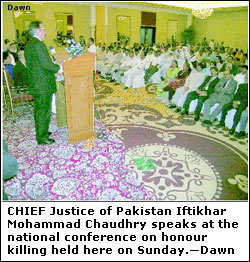 KARACHI, Sept 17: The courts in this subcontinent award lesser punishment to the offenders found guilty of killing a female under the influence of ‘grave and sudden provocation’ than they deserved.
This was observed by the Chief Justice of Pakistan, Justice Iftikhar Mohammad Chaudhry, while speaking at the inaugural session of the national conference on “Honour Killings: Religious and Traditional Misinterpretations” on Sunday.
The three-day conference has been organised by the British Council in association with the Advisory Committee of the honour killing awareness raising project.
According to the chief justice of Pakistan, honour killing, like most other evils, is not confined to any particular society or territory. Rather, it is committed in different countries of the world. In many countries, the offence is known as domestic violence.
He defined the term ‘honour killing’ as: “killing of a female, and sometimes her love-interests and other associates, for supposed sexual or marital offenses, typically by her own relatives, with the justification being that the ‘offence’ has brought dishonour to the family.”
Such crimes are perpetrated for a wide range of offences, marital infidelity, pre-marital sex, flirting, refusing to enter into an arranged marriage, being the victim of sexual assault, seeking a divorce even from an abusive husband or allegedly committing adultery, can all be perceived as impugning the family honour.
Justice Iftikhar referred to the reports submitted to the UN Commission on Human Rights, and said it showed that honour killings did take place in Albania, Bangladesh, Brazil, Canada, Denmark, Ecuador, Egypt, Germany, India, Iran, Iraq, Israel, Italy, Jordan, Morocco, Palestine, Sweden, Turkey, Uganda, United Kingdom, United States and many other countries.
Honour killings are more common in poor rural communities. In Pakistan, methods of honour killings in different parts of the country vary from each other. In Sindh, it is often called ‘Karo Kari’, under which the victim is hacked to death, often in complicity with the community. The tribal Parkton communities in the NWFP and Balochistan call honour killing ‘Turn’. The victim can be hacked, stabbed, burnt or shot. The words of both these terms mean ‘black’.In Punjab, the killing, usually by shooting, is more often based on individual decisions and carried out in private. In most cases, the husband, father or brother of an accused woman perpetrates the murders. In some cases, jigs or tribal councils decide that the woman should be killed and send someone to execute her.
Justice Iftikhar pointed out that honour killing is the subject matter of a large number of judgments of the courts in Pakistan. The law reports are full of cases of killings resorted to in different segments of the society. Judges decide each case on its own facts and circumstances by applying the relevant law.
The chief justice said that the Criminal Law (Amendment) Act-2004, is an important piece of legislation on the subject. It has dealt the issue of honour killing more directly and removed the lacunae in the penal law.
It has defined the offence committed in the name or on the pretext of Karo Kari, or similar other customs or practices.
The chief justice referred to the Ghotki (Sindh) incident where three minor girls had been given away in “Badla Sulah”, and appreciated the role of the DPO concerned for getting a case registered against the perpetrators of the crime.
According to the chief justice, killing of an accused woman is not Islamic by any standards.
He said that Pakistan had taken good number of measures on the legislative front against honour killing. However, mere laws did not guarantee the elimination of this evil customary killing. An enabling environment is a must to achieve the desired goals.
Speaking on the occasion, Sindh Minister for Education Dr Hamida Khuhro recollected the historical perspective of honour killing in the undivided India.
According to her, Sir Charles Napier took note of the mysterious murders of women which had gone unreported. These murders were, in fact, hushed up by the families and a general silence about the same was maintained.
He issued a proclamation stating such cases would not be condoned and that the murderer would be put to death, she recalled.
Dr Khuhro stressed the need for legislation against honour killing and strict enforcement of such laws.
Dr Abduljalil Sajid, Chairman of the Muslim Council for Religious and Racial Harmony, UK, said “there is no honour in killing, it is murder and cannot be justified and be dealt with the rule of law.”
Similarly, killing has nothing to do with faith… no religion advocates the killing, he added.
The British Deputy High Commissioner in Karachi Hamish Daniel presented the vote of thanks.