0
0

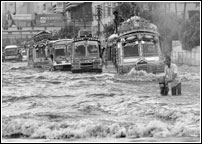 THE recent heavy rains experienced by the country, particularly the metropolitan city of Karachi, have played a havoc not only with civic life, but also with the economy as well.
What to speak of suburbs and old city areas, even dwellers of posh areas suffered badly due to flooded roads, break down of electricity and telephone services. The maintenance civic amenities and public services has remained neglected at all levels of the government.
Almost all the service-providers responsible for electricity, water, telecommunication, sanitation, roads and transport services seem devoid of concern for improving civic life. As such, it is imperative that civic groups/citizens and NGOs take a collective initiative to find a way out to make civic agencies accountable to general public. For this, various groups/NGOs need to develop a mechanism for monitoring and evaluating their performance.
In the past, proposals had come from various quarters asking the government to monitor and supervise the delivery of social services and other civic amenities through formation of committees / task force with representation from service providing agencies, union councils and general public preferably senior citizens of repute, to function as watch dogs. Because of indifferent attitude of the establishment, nothing happened.
India has also been facing similar situation with regard to supply of various utility and other public services. In the early 90’s when the city of Bangalore was coming up as an IT hub and its development process was being hampered due to intermittent break downs in electricity, telephone services, water supply and rampant corruption in public service agencies, different NGOs and civic groups evaluated the performance of these agencies through various surveys. The results were made known to general public as well as concerned utility service providers.
A sociologist, Dr Samuel Paul in collaboration with an NGO known as Public Affairs Centre (PAC) evolved a system for public services and introduced ‘citizens report cards’ for exerting pressure on service providers to improve their performance.
Based on the principle that it is the user of a public service who knows best whether the service is being delivered efficiently or not, these cards were introduced for quantifying information from various segments of population (categorised on the basis of their financial status) through their response to following questions:
a) how satisfactory are the public services? b)which aspects of a service are satisfactory and what are points of dissatisfaction? And, c) what are the direct and indirect costs for acquiring these services?
The programme launched by PAC is being funded by Foundation of India, a voluntary organisation and Ford Foundation. Voluntary financial support had come from their corporate and industrial sectors. In this regard no financial support was sought from the government of India.
For evaluating the performance of public service agencies, a pre-tested questionnaire was introduced to acquire public response, not only on delivery of service, but also factors adding to indirect cost falling on user of the service like indifferent behaviour of staff, their delaying tactics in dealing with complaints.
A seven-point rating scale (seven for highly satisfied and one for least satisfied) enabled quantification of responses. The data thus collected was analysed through use of computer software and end product gave ranking / scoring of each public service based on public opinion.
These ratings/scorings were subsequently discussed with senior officers of concerned agency and publicised among general public through electronic and print media. The findings of the survey were disseminated among civic groups, public representatives and NGOs through holding seminars and public meetings, etc
Overall findings of 1993’s report card survey were very disappointing. Only one per cent of population, covered under survey expressed their satisfaction, whereas 65 per cent were found dissatisfied with the delivery standard, staff behaviour and the practices of the service-providers.
The exercise was repeated in 1999 and partial improvement in telephone and medical services was noted. Bill collection procedures of telephone, electricity and water supply departments were also streamlined.
Another positive impact of this exercise was that the chief minister of Karnataka formed the Bangalore Agenda Task Force (BATF) which brought together prominent citizens for the purpose of improving quality of service and infrastructure.
A system for self-assessment of property tax was put in place. Above all the report card survey facilitated accountability of public agencies through quantification of feedback from public, particularly on corruption.
A similar exercise can be undertaken in metropolitan cities of Pakistan where public suffers due to increasing inefficiency, corruption and mismanagement in the civic agencies. Karachi Electric Supply Corporation and the PTCL have been sold to foreign buyers, yet their monopolistic position of the old corporate culture have gone from bad to worse.
Power outages have become more frequent and unannounced load shedding from the very start of current summer season has brought immense miseries to public and financial loss to businesses and manufacturing concerns.
In fact, citizens themselves need to voluntarily monitor and supervise the delivery of these services as there is an urgent need to initiate a well organised mechanism for making public service providers accountable to general public. To begin with, India’s citizens card system can be replicated in metropolitan city of Karachi with some modifications.
Civic groups and NGOs in collaboration with representatives from union councils and CBOs in each township of Karachi, can be included so as to put pressure on local government to improve performance with regard to water supply, proper maintenance of roads and sewerage system.
In fact, the introduction of local government system in Pakistan with 33 per cent women representation was aimed at making development programme people-centred and gender-sensitive as active participation of citizens at local decision-making level and development planning is essential for meeting service needs of a locality effectively. However, conflicting and imprecise legal framework and patronised politics of local bodies system has almost choked the of voice of citizens. ‘ Second generation reforms’ which Pakistan is required to undertake on priority basis also have focused on delivery of public services in order to improve quality of life.
Hopefully, the proposed mechanism of monitoring and evaluating public services will not encounter any financial constraint, if funding such a project is done by corporate sector including multinationals and private individuals. Financial support can be sought from Asian Development Bank and other relevant agencies also.