0
0

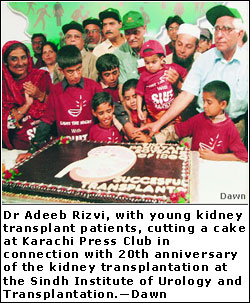 KARACHI, Sept 15: Speakers at a function on Friday called for enactment of cadaver organ donation law so that many precious lives could be saved through transplantations.
The function, organised by the Sindh Institute of Urology and Transplantation (SIUT), was held at the Karachi Press Club to mark 20 years of kidney transplantation in the country during which more than 1,800 people got transplanted the kidneys donated by their family members and were now leading a healthy lives.
The speakers noted with regret that a draft law on cadaver organ donation had been submitted to the government about 15 years back but the same had not yet been presented to the Senate for approval.
They pointed out that Pakistan was the only Muslim country with out a cadaver donation law despite the fact that there was a high prevalence of end-stage renal diseases in the country.
They said that organ transplantation was the ultimate therapy for all end-stage organ failures and the progress in technology and expertise, along with better immunosuppressive drugs, had given excellent results.
The patients and graft survival in kidney transplantation was 98 and 92 per cent, respectively, they added.
They said that the expertise for kidney replacement was present in the country but the absence of the cadaver law had made kidney a commercial commodity. Owing to poverty and no chick on the kidney trade, the commodity is available at a very low price.
They said that the developed countries had also been facing a similar situation before they introduced the cadaver organ donation law and brain dead law to counter the menace. They said that after these laws were implemented, the organs retrieved from one person encountering irreversible brain death could save 17 lives.
They said that the total number of solid organs required in the country was 25,000 annually of which kidneys amounted to more than 100 per million population.
They said that in the country, there were 120 dialysis centres, a majority of them in the private sector, and 20 transplant centres, 19 of which operating on a commercial basis.
The SIUT is the only public sector tertiary care centre where liver-related kidney transplantation is carried out free of cost.
Various international electronic media channels carried advertisements offering cheap organs from Pakistan and this is earning a bad name to the country owing to the unethical practices involved.
Earlier, India was leading in the organ sales business, but after enactment of a law banning the trade, Pakistan became one of the largest markets of the organ sales.
According to the speakers, the World Health Organisation (WHO) had raised this issue with the government many a times but the government remained unmoved. They said that the privately operated transplant centres catered the needs more of the patients coming form foreign countries as the cost of the kidney and surgery was enormous. They said that both the donors and the recipients needed continuous screening and monitoring after the operation which was not provided at private centres.
Even in the developed countries like the United Kingdom, people had to pay for the social security to get the medical treatment. Similar was the case of Sweden, France, etc.
In the United States, there were more than 25 million people not covered under medical insurance schemes.
In Pakistan, where above 40 per cent people lived below the poverty line, getting medicines and medical care is considered to be a luxury.
The SIUT is probably the only transplantation facility in the world that provided absolutely free medical treatment.
The speakers observed that with the government assistance and also donations from philanthropists, the SIUT had become the country’s largest free healthcare provider for urology, nephrology, transplantation and liver-related diseases.
They said that in the past 10 years, the institute had provided treatment to more than three million patients – over 25 per cent of them being children – from across the country and had spent more than Rs2.8 billion for the same. In the last five years, the number of treated patients had risen by 100 per cent.
They noted that the SIUT had treated more than 27 per cent of the country’s dialysis (carrying out over 100,000 dialysis sessions a year) and 15 per cent of the lithotripsy patients. The country’s first liver transplant had also been performed at SIUT in 2003.
They urged philanthropists to come forward and donate generously to the SIUT so that it could continue to provide best possible healthcare to the maximum possible number of patients free of cost. They said the institute this year required about Rs600 million to meet its annual expenditure.
SIUT chief Dr Adeeb Rizvi and KPC President Ghazi Salahuddin also spoke at the function conducted by KPC General Secretary Najeeb Ahmad.
The youngest recipient of kidney Amas Ahmad Shamsi cut the cake to kick off the celebration on the occasion. A large number of people who had undergone operation for kidney transplantation at the SIUT also attended the function.