



 0
0

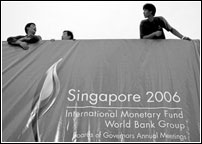 THE annual meeting of the International Monetary Fund (IMF) and the World Bank scheduled for September 19-20 in Singapore will focus on, “reforming of 61-year-old IMF”. It would be continuation of spring meetings of the IMF and WB steering committee in which the road map for the Fund’s policy agenda was spelt out to renew its commitment to help its members to deal with challenges of the 21st century.
The strategy covers all areas of the Fund’s activities, including conduct of surveillance of individual members’ economies and instruments for preventing and dealing with crises in emerging markets and the Fund’s own governance.
Included in the major changes under consideration are: closer monitoring of currency rates and exchange policies of the emerging economic powers of Asia. The Fund feels that tackling global imbalances will reduce the risk of chaotic exchange rate movements, abrupt shifts in financial markets, and crippling protectionism; change in voting power.
Rodirgo de Rato, Managing Director IMF is, “firm that his proposal will focus on adhoc increase (voting power) and that, of course, means that some countries will adapt -…to their actual weight in the world economy. There are clear examples of countries that have really changed in the last 15 years.”
Now the Fund will be given a mandate to conduct surveillance of the global economy and proposed surveillance is going to be biggest structural change since the break-up of fixed exchange rates in 1970.
The surveillance unit will be modelled on the Bank of England, with guaranteed independence from political interference and an annual to look at the linkages and spillovers between monetary and fiscal policies, exchange rates and financial sector issues in a key member country.
There will also be strong proposals on reforming IMF governance, including how quotas are calculated. The IMF’s steering committee hs endorsed the need for ad-hoc increases in quotas for countries under-represented in the current quota formula. It implies an increase for China, South Korea, Mexico and Turkey at this stage. Later Singapore, Thailand and Malaysia will also be cluded. However nothing is mentioned about the measure for an increase in basic votes and a change in the quota formula.
There will be nothing new for low-income countries as they are likely to lick their old wounds and Fund will continue its role for debt management through “refinement” of the WB-Fund debt sustainability framework.
When it comes to the present state of IMF, most economists agree that change is needed. Disagreement arises on the type of change. For some, the IMF has already done so much damage to the developing countries that it should be kept away. Others argue for varying degrees of reform.
The international campaign for the debt is central to the movement of ‘another world is possible”- an alternate route to globalisation. The debate for the non-payment of external debt became popular between 1982 and 1990 after the Latin America’s crises. From 1999 onward this movements in the South began to grow gradually stronger.
The campaign is not limited to civil society organisations. It remained an active issue for the international financial system. It also called for the cancellation of debt of heavily indebted countries.
On the other hand, according to a decision made at the spring meeting of the World Bank and IMF in Washington in April, 2006, the IMF is more likely to get a larger watchdog role in the 3world economy. The new strategies require the 184 member countries to agree an expansion of their obligation to report to the IMF.
Rodrigo de Rato, IMF Managing Director will draw up the details of the new consultation process and he has also submitted proposals of re-distribution of voting rights in the IMF- a step to include the large emerging economies like India, Brazil and China. A closer monitoring of currency rates and exchange policies of the emerging economic powers of Asia and elsewhere is mandated.
According to Rodrigo Rato ‘the moves were critical to coordinating economic policies and preventing an unruly unwinding of huge global imbalances in trade and investment flows that could spark world recession”…Coordinated action would be both politically easier and economically more effective than governments in systemically important countries acting alone.”
This step has attracted criticism that the lender has fallen out of step with modern economic realities, as demand for its lending has dropped sharply amid rapid globalisation of private capital flows and a desire among some members to repay the Fund.
Many economists are skeptical whether the new procedure, while giving more power to the IMF and making it more relevant for a globalised economy, with unprecedented capital flows across the borders, would make it effective.
China is apprehensive about a larger role for IMF to interfere in how countries manage their exchange rates. “Fund surveillance should comply with the objective of promoting exchange and financial stability and respect the autonomy of exchange rate systems that is granted to all (IMF) members,” China’s Governor Zhou Xiaochuan told the IMF committee.
Tensions remain between industrial and developing countries over how to re-allocate voting power beyond initial increases in the quotas for some emerging nations. The Group of 24 finance ministers for developing countries from Asia, Middle East, Africa and Latin America called for a more comprehensive package with timeliness to greater representation, fearing changes could stall after any initial increases.
A concrete proposal is underway for the September meeting to include a new formula to calculate quotas based on purchasing power parity of a country and not gross domestic product as is currently the case.
Actually, the world looks at the IMF to stop financial crises. The Fund’s efforts are failing. For example, all the IMF manages to do was to make the Asian recession deeper, longer and more painful. On the loud disagreements on the role of the Fund, Fred Bergsten, director, Institute for International Economics said: ‘the need is to save the Fund, not to bury it.”
Critics say that due to shortage of money, IMF would not opt for previous policies to bail out the debt trapped countries and it may not be able to impose its views. Economists do agree that it cannot perform its current mission with the sums, now down to well under $100 billion left in its treasury. Paul Krugman of the Massachusetts Institute of Technology estimates that, “the Fund may need another $200 billion just to bail out Brazil without imposing a severe recession.”
While eminent economists like Joseph Stiglitz support the trimming of the IMF’s role, the Fund should offer the bailouts to fewer countries, or focus its efforts on convening negotiations between debtor countries and their creditors.
There is also fundamental disagreement on fixing of the exchange rate. Whether countries as small as Hong Kong or as large as Brazil should have fixed exchange parities or float exchange rate. Jaffrey Sachs, director of the Harvard Institute for International Development, argues that fixed rates do not work well with unlimited capital flows.
He says, let currencies float. “There was a role for fixed rates in countries like Argentina and Brazil when they had to break hyperinflation and prove to investors that monetary policy would not repeat the blunders of the past,” he said. “The mistake was holding onto the fixed rates. They become a trap if kept longer than necessary, say 18 months or so.”
So he urges the Fund to help countries whose currencies are under attack, but only after the currency is set free. The money would be used to mitigate the impact of devaluation on the poor and to reassure investors that the country’s finances would be sound and its currency is unlikely to plunge much further.
Stanley Fischer, the Fund’s No2 official and many other economists, consider floating rates as unacceptably risky for developing countries. In this case, speculative investors, controlling billions of dollars can force currency values up and down in huge swings having no valid economic reason. Sudden currency swings play havoc with people’s lives. Depreciation can destroy industries that rely on imported inputs.
Criticizing of the policy, Fisher said: “It is no accident that countries turn to fixed rates to bring order to their economies.” The “IMF plus” proposal requires the Fund to eliminate the worst feature of its Mexican and Asian bailouts.
Under a new role of the IMF, the foreign investors will get, “guaranteeing international loans for a modest fee” up to a limit. The guarantees would be backed by special drawing rights that, in effect, use US dollars — together with backing from other major countries.
Jeffrey Garten, a former Commerce Department official, has recently proposed to turn the Fund or some other institution into a global central bank which can disburse money whenever the international economy hangs down. But economists points out that such a bank would require enormous resources and the legal power to intervene in the economies of member countries.






























