



 0
0

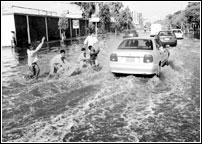 THE recent monsoon rains caused damages and destruction on unprecedented scale in Karachi. Damages to infrastructure, public and private property and productive assets were colossal.
In these crises, the entire municipal management system seemed to have fallen apart. The City District Government of Karachi (CDGK) and other agencies tried to respond to the situation, but their capacities were far too short compared to the scale and gravity of the problem. The urban infrastructure was worst hit.
In order to repair damaged roads and streets, the City Nazim has announced a tranche of Rs180 million, approximately Rs10 million for each town. While the intention of the Nazim is commendable, ad-hoc allocation of money for such important tasks will not deliver any worthwhile results. Maintenance, repairs and remedial works need to be carried out in a scientific and planned manner.
As a starting task, a comprehensive post-disaster assessment must be carried out. This type of assessment usually comprises stocktaking of physical conditions of infrastructural components; damage and destruction caused by rainfall/related happenings; causes that led to such damages/destruction; estimation of repair and maintenance costs as well as the available options that can be applied to a given situation.
From the onset, making the infrastructure fit for utilisation happens to be a difficult and crucial assignment. Preliminary assessments of rain damages have shown six patterns of impacts on the infrastructure.
Inappropriate planning and design of infrastructure components led to sizable damages. Network of roads, streets and lanes are visible examples. Planning of roads with incongruent bench marks pertinent to adjoining neighbourhoods and other physical entities were found to create enormous problems. For instance, the Clifton/Bath Island belt is a low lying neighbourhood.
In the absence of an efficient rain water drainage system, urban roads act as water carriers. Therefore, these neighbourhoods were flooded in the absence of any mechanism for drainage. Many neighbourhoods have experienced this problem which completely paralysed the mobility on urban roads.
Inappropriate planning and design of road and drain sections was another common flaw that was noticed along major roads and highways. Essentially, the major roads possess an outlet provision for rain water as well as any other form of spillage from sewerage channel defects or other sources. The slope of the roads is so designed that the water automatically ejects into the side drains. Disappointingly, the practice of designing these essential infrastructure components has long been dropped from the municipal manuals.
Some parts of University Road were recently developed by the CDGK, while a section contains a central drain-more often used as sewerage conduit – it does not possess a provision to allow rain water to enter and drain. Faulty slopes, choking due to solid waste/rubble deposits, blockages of openings and uneven road carpeting have caused the key problems in this respect.
Poor quality of construction is a growing ailment in municipal works. Road sections, pavements, pedestrian bridges, drains, sewerage conduits and curb stones, all display a sub- standard appearance and behaviours.
Few years back, the flyover at the crossing of Shahrah-e-Faisal and Rashid Minhas Road developed dangerous holes in the descending ramps only after two years of its construction.
Several city roads are completing ruined after rainfall. Choice of poor quality/sub-standard material, lack of quality control, lowering of contractor’s cash flow due to in built kick-backs, faulty designs and lack of appropriate expertise are some of the recurring disorders found in the system.
Programming of development works is an important consideration in urban infrastructure management. It is usually carried out with great care to obtain the best value for municipal spending as well as to reduce the inconvenience to the citizens. The city suffers from shift arrangements as all the prime transportation and sanitation projects seem to have begun in one go. Flyovers, trunk drains, interchanges and other related civil works were all initiated without any reference to scientific programming.
The City Nazim announced the launch of big projects assuming that the city will be able to brave the inconvenience. Little did he know that the limited capacity of contractors, inherent process jams in approvals and release of funds as well as delays would turn the city arteries into an inconceivable mess. The rains further compounded the problems.
One is not sure whether the quality of construction would remain as specified, given the endless spot damages caused to various components of projects. Loosing of earth, inappropriate concrete applications, poor quality of masonry works and stagnant water in vital spaces are common sights – not desirable in such important undertakings. In addition, the emergency relief turned out to be a non-existent entity.
The possibility of local/neighbourhood or even town-based relief work also did not exist. Similarly inter-agency coordination was lacking, eventually turning into an ugly blame game. One agency was blaming the other for diverting stagnant rain water to the jurisdiction of the other. Needless to say that the infrastructure is the common property of the city and its custodian agencies and each one has to share a collective responsibility to safeguard and manage it in the larger interests of the people.
Several important steps need to be taken. The first step is to create a viable institutional set-up to address the issues on a long-term basis. An administratively potent and professionally capable planning agency needs to be created within the framework of CDGK. This agency must be allowed to independently plan and guide the development process, including infrastructure development.
Even federal and military based urban projects should be scrutinised by this agency. The existing provision of master plan groups of offices (MPGO) in the city is not in a position to tackle these scattered responsibilities. The next step is to re-examine the process of design and execution.
A revised set of project guidelines must be prepared for making the planning, design execution and operation works compatible to strict standards of quality and performance. The design merit should not be compromised at any cost. And finally, the infrastructure planning must be undertaken in a co-ordinated manner.






























