0
0

Power to the provinces
A CHASTENED government, struggling to defend its actions in Balochistan, did not oppose a private member’s bill moved from the opposition benches in the National Assembly on Tuesday seeking the abolition of the Concurrent List from the Constitution as part of efforts to empower the provinces. Indeed, the parliamentary affairs minister, Mr Sher Afghan Niazi, who was only the other day vociferously justifying the killing of Nawab Bugti, welcomed the bill and said provincial autonomy was the “need of the hour”. Is this perception now shared by this government as a whole and more particularly by the military? Or is support to the bill merely a bit of tokenism to soothe ruffled opposition feathers? It would be tragic if the government is merely play-acting.
The private member’s bill specifically wants to do away with the Concurrent List, which extends to over 40 subjects and was meant by the 1973 Constitution to lapse in time. It was envisaged that the provinces would eventually be in a position to manage most of these subjects themselves. However, the trend unfortunately has all along been in the opposite direction as the centre — often consisting of just one person — has arrogated to itself greater powers of decision-making. The mere curtailment or cancellation of the Concurrent List will not automatically ensure that the provinces will be able to exercise control over issues of direct concern to them. For this there has to be a leap of faith on the part of those who seek to control our destinies.
Centralisation — spurred by military rule from GHQ — has already extracted a heavy toll. Disputes on vital issues such as sharing of water, federal revenues and other resources have again and again proved intractable and often reached flashpoint. The Council of Common Interest remained moribund year after year despite repeated demands for its revival, and it was virtually forced to hold a session recently only after the Supreme Court held that the Steel Mills privatisation should have been approved by the council. The concept of inter-provincial coordination is virtually non-existent: the provinces just happen to be together without shared goals or a common vision. All these are matters that should receive immediate and serious attention if we really believe in democracy and true federalism. The trend towards concentration of power in Islamabad has to be reversed and steps initiated in that direction within the tenure of the present parliament. The practice of trying to rule the provinces by contrived majorities that are beholden to the centre will also have to be abandoned. This has led only to the creation of suspicion of the centre’s intentions in the smaller provinces, which feel that their concerns and misgivings on many vital matters are not being taken seriously into account. Even the loyalist government in Sindh could not hide its resentment when it appeared that the federal government had decided to unilaterally go ahead with the building of the controversial Kalabagh Dam. Provincial leaders should be respected. In this context, it was not right that the Balochistan National Party was allowed to leave the legislatures so easily: a greater effort ought to have been made to keep them inside.
Misgivings about the accord
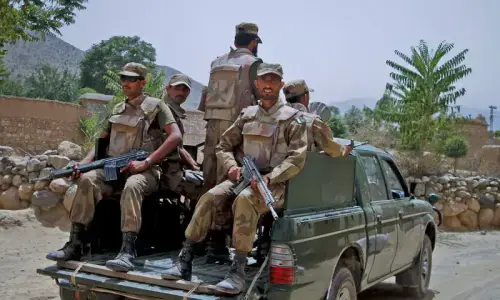
TUESDAY’s agreement between the government and the militants in North Waziristan has aroused some international concerns, though the American reaction seems to show an understanding of Pakistan’s position. While it expressed some reservations about the deal, the State Department appeared mindful of the fact that this was “a historical problem” and that the agreement was in the interest of peace and stability in the area. The spokesman acknowledged that President Musharraf had discussed the issue with Ms Condoleezza Rice when the US Secretary of State visited Islamabad. This lends credence to the belief that Pakistan had kept America informed of the talks and that the accord did not come as a surprise to Washington. There is no doubt that the agreement is based on ground realities. Two years of conflict had shown that the security forces were unable to pacify North Waziristan. The foreign militants could have been taken care of if they had been on their own. But regrettably they enjoyed the support and protection of some powerful clerics and maliks.
The concerns about the agreement centre round Osama bin Laden and other Al Qaeda leaders, especially in the light of the faux pas by the head of the Inter-Services Public Relations. Does the clause that anyone who lays down his arms mean that he can live peacefully, even if he happens to be Osama? Later, in a TV interview, Prime Minister Shaukat Aziz said there was no amnesty for “anyone who is wanted or is a terrorist or has committed acts of terror anywhere in the world”. The issue is not Osama’s personality but the impression that the agreement seemed to provide a sanctuary for foreign militants and local Taliban. It now remains to be seen how the government utilises the peace accord to ensure a ‘containment’ of the Taliban phenomenon and the pacification of the area in the real sense of the term. Basically, it is economic development that can erode the hold of the clerics and the maliks and bring the tribal belt into the 21st century. The military operations had to come to an end, for they were a waste of men and material, but the greater post-agreement task is to monitor the situation carefully and not let the militants consolidate their position.
Disenfranchising women
IT is unfortunate that the tribal areas in the NWFP should continue to be governed by medieval social practices while there is at least an attempt to question and debate regressive customs and laws in other parts of the country. A recent report describing the difficulties being faced by the Election Commission in enlisting women voters reflects this concern. According to the assistant election commissioner in the Khyber Agency, the majority of women were reluctant to give details about themselves and many did not even possess national identity cards which are required for voter registration. While it is too much to expect an immediate reversal of the situation in a highly patriarchal society where women face many restrictions in daily life, it is important to work towards giving them greater freedom and more opportunities to exercise their right of franchise. Unfortunately, there are no signs of this happening, and women in the NWFP are frequently barred from contesting or voting in polls. The Election Commission had taken note of this practice during the last local body polls. But it can do little to put an end to it, especially when rival political parties — even those claiming to be liberal in outlook — often band together to prevent women from voting in or contesting elections.
Ensuring a re-poll in areas where women have not been allowed to participate, or taking poll spoilers to task, is only part of the answer to the scourge of women’s disenfranchisement. The bigger challenge is to end their marginalisation by removing social taboos and restrictions and allowing them to enter mainstream political and social life. This can only come about if there is a change in the general perception in these areas that a woman’s role is restricted to her home and that decision-making is entirely a male domain.
Concept of justice in Islam
JURISTS have defined justice and equality as keeping a thing in its right place, or keeping the balance. It is this which keeps the sky and the earth in their right places. If today justice were to be excluded from this world, there would be such a deluge of cruelty and brutality as would sweep off our foundations.
This is an important and valuable right which Islam has given to man. The Holy Quran has laid down: “Do not let your hatred of a people incite you to aggression” (5:2).
“And do not let ill-will towards any folk incite you so that you swerve from dealing justly. Be just; that is nearest to heedfulness.” (5:8). Stressing this point the Quran again says: “You who believe stand steadfast before God as witness for (truth and) fair play” (4:135). This makes the point clear that Muslims have to be just not only with ordinary human beings but even with their enemies.
Justice and equality were the two main contributory factors to the expansion of the Islamic state from Arabia to Spain and from there to India. Some Christian and Hindus say that Islam was spread at the point of the sword. But the sword the Muslims had in their hands was justice. Take any book of history you will find this event recorded therein. When Abu Obaida, the Muslim supreme commander of Syria, had to evacuate the Syrian town of Hims, in the face of a sudden attack by a superior Roman force, he summoned the padres and the elite of the town and said to them:
“We received revenue and tribute from you, so that we spend it on your defence and betterment. But we cannot do it any longer, as we have to evacuate this town under duress. Therefore take back the seven hundred thousand dirhams you paid to us as revenue and tribute.” On seeing this astounding and unparalleled justice of their Muslim rulers, the chief padre said: “No deed of justice and equality can excel this unrivalled masterpiece of yours. By Holy Jesus, I give you my pledge that if ever we are at liberty to choose our rulers, we shall choose you Muslims and non-other.”
After the conquest of Khybar, a treaty was made between the people of Khybar and the Holy Prophet (PBUH), according to which half of the annual produce was to be sent to the Bait-ul-maal — the Muslim exchequer. In one year Abdullah-bin-Rawaha was sent to get the stipulated share. He divided all the grains into two equal heaps and permitted the people of Khybar first to choose one of them for them. The people collected large quantity of gold ornaments to bribe him. At this Abdullah-bin-Rawaha said, “You people have enraged me by offering this bribe. But remember, I shall not give up justice even in rage.” This greatness of the Muslim officer’s character had such an effect on the Jews of Khyber that one of them said with real conviction in his voice, “By God, the sky and the earth exists due to this justice of yours.”
Thousand of such remarkable events of justice and equality are recorded in history. It was this deep sense of true justice and equality on the part of our forefathers which won the hearts of Jews and Christians of Egypt and Syria, and the worshippers of fire of Iraq and Iran. Early Muslim rulers have to set such glorious examples of justice, equality, mercy and kindness that the non-Muslims felt compelled to sing their praises. We are commanded to be just and kind with others. The Quran says: “Lo! God enjoineth on you to be just and kind.” [16:90]
At another place the Quran says: “O ye who believe! Stand out firmly for God, as witnesses to fair dealing, and let not the hatred of others to you make you swerve to wrong and depart from justice. Be just, that it is next to piety.” [5:9]
“O ye who believe! Stand out firmly on justice.... and follow not the lusts of your heart.” [4:135]
Justice and equality which Islam asks the believers to practise is not limited only to the citizens of their own country, or the people of their own tribe, nation or race, or the Muslim community as a whole. It is meant for all the human beings of the world. Muslims, therefore, cannot be unjust to anyone. Their behaviour should be such that no one should ever expect or fear injustice from them and that they should treat every person everywhere with justice and fairness.
The Prophet (PBUH) has said that: “The life and blood of Muslims are equally precious” (Abu Dawud; Ibn Maja). In another Hadith he has said: “The protection given by all Muslims is equal. Even an ordinary man of them can grant protection to any man.” (Al-Bukhari; Muslim; Abu Dawud) In another more detailed Tradition of the Prophet (PBUH), it has been said that those who accept the Oneness of God, believe in the Prophethood of His Messenger, give up primitive prejudices and join the Muslim community and brotherhood, “then they have the same rights and obligations as other Muslims have” (Bukhari).
Thus there is absolute equality between the converts to Islam and the old followers of the Faith. On an occasion, a women belonging to a high and noble family was arrested in connection with a theft. The case was brought to the Prophet (PBUH), and it was recommended that she may be spared the punishment of theft.
The Prophet replied: “The nations that lived before you were destroyed by God because they punished the common men for their offences and let their dignitaries go unpunished for their crimes; I swear by Him (God) who holds my life in His hand that even if Fatima, the daughter of Muhammad, has committed this crime then I would have amputated her hand.”
Islam gives its citizens the right of justice and complete equality in the eyes of the law. As far as the Muslims are concerned, there are clear instructions in the Holy Quran and Hadith that in their rights and obligations they are all equal: “The believers are brothers (to each other)” (49:10). The Prophet (PBUH) has said that: “The life and blood of Muslims are equally precious” (Abu Dawud; Ibn Maja). In another Hadith he has said: “The protection given by all Muslims is equal. Even an ordinary man of them can grant protection to any man.” (Al-Bukhari; Muslim; Abu Dawud).
This religious brotherhood and the uniformity of their rights and obligations is the foundation of justice and equality in the Islamic society, the society in which the rights and obligations of any person are neither greater nor lesser in any way than the rights and obligations of other people.
Life after Fidel
FIDEL CASTRO’S succession may be easier to agree than Tony Blair’s, but there is plenty of chatter in Havana and beyond about what will happen when the iconic Cuban leader is no longer in charge.
In recent days the octogenarian Comandante has been shown on TV looking better - though frail and gaunt - after being hospitalised for surgery in July and replaced “temporarily” by his younger brother Raul. Still, friends and foes alike understand that after 47 years in power it is time to look to the future.
Cuba has not changed since he fell ill. Political prisoners are still behind bars, the media under strict state control and the small opposition divided and muted. Anti-Castro exiles in Miami, thinking about recovering property confiscated after the revolution, may be prematurely excited. The habit of official repression has been bolstered by US hostility that has long outlasted the end of the cold war. The CIA must have lost count of the times it has thought about killing Fidel.
But having learned the lessons of regime change in Havana during the Bay of Pigs fiasco, the US has more recently contented itself with maintaining its trade embargo. Washington’s first response to the news of Castro’s illness was to brace for a wave of refugees from across the Florida Strait. But its punitive policies also need to be reconsidered: easing the embargo and other restrictions that help maintain the Communist party’s siege mentality would be a smart way to encourage democratic reform inside Cuba without overtly interfering. Engagement is better than isolation, though it is unlikely to make George Bush a more welcome visitor than Venezuela’s Hugo Chavez.
Foreigners should not underestimate the challenge of change. No less than 70 per cent of all Cuba’s 11 million people were born after Castro and his men overthrew the Batista dictatorship in 1959; they know only his marathon speeches and all-night debates, and may well wonder how the uncharismatic Raul, himself no stripling at 75, can lead the country out of economic misery while preserving its comprehensive welfare system, famously good doctors, universal literacy and vibrant cultural life.
Raul is thought likely to use his tight control of the armed forces - which run the country’s most efficient and profitable companies - to opt for Chinese-style market reforms while preserving the power of the party. Two younger leaders might also end up replacing Fidel. But whoever succeeds him, the change must be driven from within - a Cuban filling for what is bound to be a disorienting post-Castro void.
—The Guardian, London