0
0

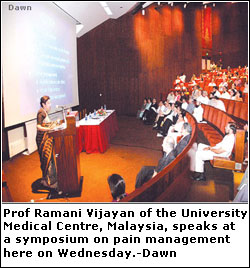 KARACHI, Sept 6: Market politics and monopoly of the multinational pharmaceutical firms have severely affected the easy availability of morphine, the most efficient and cost-effective pain reliever, to the patients belonging to the developing states.
This was stated at the 11th National Health Sciences Research Symposium on ‘Understanding and Managing Pain –Multidisciplinary Approaches’ which commenced here on Wednesday.
It was further observed that although it had been acknowledged globally that pain relief was one of the basic human rights, there were no appropriate and cost-effective interventions easily available to a good majority of the Third World nations.
The two-day event was opened by Aga Khan University President Firoz Rasul here on Wednesday. Chairperson of the organising committee Dr Gohar Afshan presented the welcome address, and Prof Mohammad Khurshid, Dean of the AKU Medical College discussed the significance of the event.
The formal inauguration was followed by plenary lectures by Prof Ramani Vijayan, University Medical Centre, Malaysia, and Prof Patrick McGowan, Barnet and Chase Farm, NHS Trust, United Kingdom.
“Availability of morphine in developing world is extremely low,” Prof Vijayan said in her presentation ‘Relief of Pain and Suffering from Antiquity to Modern Times’.
Highlighting efficacy of the drug, particularly for the cancer patients exposed to severe pain in their terminal stages, she said the discrepancy in its use could be understood from the available statistics reflecting its major use in the developed world.
Only six to seven per cent of the four billion plus people based in the developing world could have access to the medication (morphine) against more than 100 per cent needing it in the developing world, she elaborated.
The speaker mentioned that the WHO had been urging all countries to ensure easy and cost-effective availability of the drug for their people, in the face of the realisation that although a few die of pain, many were in pain and even more lived with pain.
Reminding that pain is not only a signal or symptom but a disease entity in itself, Prof Vijayan said management of chronic and persistent pain remained a major challenge even in the developed world.
The chronic and persistent pain that occurred with nerve injury or occurred for no apparent cause was stressed to be addressed on the basis of multi-disciplinary approach.
The senior medical professional said that modern pain management centres had input not only from physicians but also other allied health care professionals as nurses (with specialised training in pain management), clinical psychologists, physiotherapists and social workers who would use a variety of modalities from counselling to invasive procedures.
Prof Vijayan identified isolation of morphine from raw opium (1806), Morton’s public demonstration of the anaesthetic properties of ether (1846) and the use of cocaine as a local anaesthetic (Koller--1884) as the three significant events altering the course of pain therapy dramatically.
The breakthrough in understanding the mechanisms of pain was the landmark publication of the Gate Theory by Wall and Melzack in 1965, the speaker said.
Prof Gohar Afshan highlighted the fact that one in every fifth individual suffered from pain and one in four of them were those experiencing mild to severe pain.
Mentioning that these statistics were forwarded by WHO, she said little awareness prevailed about the situation.
“Realisation is so low in our part of the world that we do not even have pain management clinics in our country,” she said. She, however, noted that changing trends offering an opportunity to highlight its relevance and urgency were being witnessed now.
During the two day activity, she said, effort would be made to come forward with a mechanism for improving clinical management in the developing countries, including Pakistan, within the available resources.Research and promotion of education-cum-training for the available human resources were said to be some of the other major objectives of the exercise.
The moot is being attended by professionals like doctors, nurses, physiotherapists, etc., from across Pakistan, besides 13 other countries of Asia, Europe and America.
This, she hoped, would lead to national and international collaborations.
Prof Patrick McGowan, in his lecture on ‘Chronic Pain Management: A Progress Towards Understanding’ said that many of the modern drugs were extracted from natural herbs.
Albert Niemann was cited to have purified cocaine in 1860 and Karl Koller discovered anaesthetic properties of cocaine in 1884, followed by the marketing of heroin as non-addictive cough medicine in 1898. Karl Gustav August Bier used cocaine for intra-spinal anaesthesia in 1899 while procaine was synthesised in 1904.
The speaker also cited origins of acupuncture in 2700 BC followed by Edwin Smith surgical papyrus -- the first written record about the nervous system, coupled with Ayurvedic system of Hindu medicine developed in 1200-1400 BC.
Ibn-i-Sina in the middle ages was said to have come forward with his Qanoon-i-Tibb and Razi describing seven cranial nerves and 31 spinal nerves in Kitabul Hawi Fial Tibb.
He said the major development was witnessed in the 20th century as John Newport forwarded the phrase ‘parasympathetic nervous system’.
Prof Patrick said that since 2000, pain management was being recognised as a specialised mode of treatment.—APP