



 0
0

Strikes, politicians, and the poor
 As was expected, Friday’s strike against the killing of Nawab Mohammad Akbar Khan Bugti was observed across the country. Initially, a call for it was given by the Muttahida Majlis-i-Amal at its rally in Karachi but later it was endorsed by the Alliance for the Restoration of Democracy. Other parties and organizations, including the Human Rights Commission of Pakistan and the Awami National Party, also jumped on the popular bandwagon and announced their support for a shutdown. Because there was nobody to oppose it openly, the strike was bound to be a success and it was generally peaceful. The degree of its success varied from place to place. For instance, it was more successful in Balochistan than it was in Punjab. In Karachi, too, it was near total as fewer shops were open and scant buses were seen on the roads.
The Muttahida Qaumi Movement, which would have hampered it if it were on one of the myriad trademark issues agitated by the Muttahida Majlis-i-Amal or the Alliance for the Restoration of Democracy, played the silent spectator in this affair.
Even the government, against whose policies the strike was called, did not take any measures to scuttle the agitation. People in the government were rather embarrassed over the killing of the Baloch nationalist leader. Officials could not defend or justify the killing of a leader who had persistently defied the government’s writ in parts of Balochistan. Some of them expressed their dismay over what had happened and in the way it happened. Whatever controversial role Bugti might have played in the politics of Balochistan and, as is commonly alleged, killed and tortured numerous people, he died a hero’s death and became a martyr for the cause of his province’s perceived rights. He proved to be a courageous man as he shunned the comfort of home and opted to live in a cave with the danger of death and destruction looming large. He had reportedly told his bodyguards to shoot him to death when they sensed he could be captured alive.
Politicians are very shrewd people. It is not for nothing that they resort to strikes so often. They can see profound meanings where the common man sees only blanks and dots. They believe that by resorting to strike frequently they are making dents in the edifice of the ruling setup paving way for their own takeover.
What the common man finds in strikes and street agitations is only 'trivial’ things such as huge losses to the economy and suffering to the people, particularly students and daily wage earners. Neither government officials nor affluent politicians feel the pinch of these losses. Even a regular employee may get away with the absence of a day or two in a month. But the children of a daily wager may have to skip a proper meal or two. He has to provide for his family on a daily basis.
The skyrocketing prices have made the life of people with limited income difficult. Chicken, which sold for as low as Rs34 a kilogram during the bird flu scare days has touched Rs96 a kilo. The poultry dealers seem to be on the course of vengeance. When it was the bird flu-related slump, they mourned that there was no such flu in Pakistan and it was only a Jewish propaganda to ruin the Muslims financially. They daily released figures informing the public how much loss the poultry industry had suffered. Now when they have raised the prices to an unprecedented height, they see no conspiracy behind it. Where are the figures on the poor daily wager’s losses?
It is not chicken alone. Pulses have already made headlines necessitating the intervention of the prime minister who, to calm the masses’ nerves, opened more utility stores, whose utility has never trickled down to the common people. Fruits are already so pricy that only the rich can afford them. With disturbances in Balochistan, the main supply area of fruits to Karachi markets, their prices have virtually shot out of the reach of the common man. And don’t ask about the price of tomatoes without which no dish is tasty enough. They are as expensive as Rs80 a kilo. Every item seems to be in a competition to see its name into a world record book of highest prices.
And what do the politicians do if they do not take recourse to strikes? If they do have any fellow felling for the poor, they should not call shutdowns however serious an issue may be. After all they can air their grievances and demands at seminars and in the print and electronic media. And what are the local bodies’ councils, provincial and national assemblies and the senate are for?
Origami exhibition
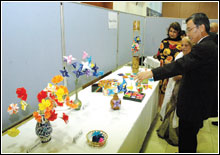 As a schoolchild, did you ever fly paper planes in the classroom or sail boats in water? In the present strict discipline era in the so-called English-medium schools, it is unlikely that pupils be enjoying such 'frivolous’ activities any longer.
The Japanese are known for making high quality cars and electronic gadgets. They produce fantastic electronic toys for their children and that of the world. They are very busy people, always striving to maintain their second highest position in the exceedingly competitive world of economy. They have no time for frivolous things. But they have not forgotten to keep their cultural traditions alive. They still make paper planes and ships. Rather they have perfected this pastime into an art form they call 'origami’.
Origami experts turn sheets of paper into enchanting pieces of decoration such as flowers, birds and wild animals and almost in every shape one can perceive. In many Japanese schools, it is part of education. It is also used to treat certain heath problems, besides using it as a means of promoting cultural ties with friendly countries.
Delegations visiting Pakistan from time to have exhibited very exotic kites, spinning tops, dolls and shows of stage performance. And how they excel in these handicrafts is marvelous to see.
At an origami exhibition that ended on August 25 and visited by hundreds of local enthusiasts, the exhibits on display were the creation of the consul-general’s wife.
The Japan Cultural Centre here has been organizing various shows aimed at brining the masses of the two nations still closer. With an improvement in the law and order situation in the city, one hopes their cultural activities will regain the past momentum.
— Karachian
Email: naseer.awan@dawn.com
Thinking together on Balochistan
THE death of veteran Baloch politician Nawab Akbar Khan Bugti in a military operation in Kohlu area of Balochistan is the latest example of our penchant for the use of force rather than dialogue to settle political differences.
The art of dialogue, which is a two-way street, has never been our forte. We have never been able to make effective positive communication a part of our culture. We do not possess the skill to dialogue, nor do we have the will to dialogue.
If we had, we would have been spared the military rules in this country, the assassination of Liaquat Ali Khan, the 1971 war, the execution of Zulfikar Ali Bhutto, and now the killing of Nawab Bugti, with all the attendant consequences.
If Nawab Bugti has been killed for the sake of development in Balochistan and for the sake of prosperity of its people, the irony is that development and prosperity in shell-shock Balochistan is now more uncertain than ever before.
Development cannot be attained through the barrel of gun. It cannot be attained if the Baloch leaders and people feel that it is being imposed upon them by force.
Development, including reforming the age old “sardari” system in the province, can only take place if the Balochis — both leaders and the led — are given a sense of participation in the process, including decision-making in their province’s vast reservoirs of natural resources and a fair share in these resources.
Making the Balochis feel part and parcel of development in their own province can only be achieved through a dialogue which is based on mutual respect, a process which one western author on the art of dialogue calls “thinking together”.
We did try thinking together on Balochistan, initially at least. The revived parliamentary committee on Balochistan that began in 2004 appeared to have made headway in talks between Nawab Bugti and the government in 2005. But suddenly this deteriorated into sabotages of gas pipelines and power lines in Balochistan, bomb blasts in Quetta, and eventually, military action in the province leading to Nawab Bugti’s death.
Could the dialogue on the Balochistan issue have proceeded differently in the past two years rather than in the way that it has happened? Did the dialogue manage to transcend beyond the non-productive win or lose argument/debate phase towards the higher stage where different ideas and possibilities of resolutions could be heard and considered?
As outlined in many western books on the art of dialogue (Dialogue: the Art of Thinking Together by William Isaacs; From Debate to Dialogue: Using the Understanding Process to Transform Our Conversation by Deborah Flick, etc.), one major reason for the failure of dialogues is when the conversation takes the form of a polarised “for and against” argument or debate with two potential win/lose outcomes.
This inevitably happens when both sides regard the dialogue as an opportunity to have their say in a serial monologue fashion, heatedly and passionately expressing their opinions about whether they should have this or that. Very often in such cases, attempt is made to solve a problem without even having agreement of what the problem is!
This manner of dialoguing is usually brought on when one side has an attitude problem and when no attempt is first made to address issues of equity in the dialogue. Flaunting power and attitude, and making the other side succumb through force and/or blackmail, as has happened in the Balochistan issue, cannot bring about any lasting agreement.
As many authors on the art of dialogue have pointed out, a dialogue will not succeed if the goals do not include increasing understanding and respect, and addressing the root causes of the differences. Showing respect for others by listening carefully to what they say as well as showing openness to modify deeply held convictions are important themes of successful dialogues.
In this respect, creating an emotional linkage that allows one side to feel empathetic towards the other is crucial in any dialogue, according to Daniel Yankelovich in his book, The Magic of Dialogue: Transforming Conflict into Cooperation. This linkage is said to occur when each side senses that the other is willing to look at things from their perspective and that the other side shares common ideas or values that they can respect.
Once this linkage is established, Yankelovich believes, more information can then be shared, understood and incorporated in the group thinking. More empathy builds more sharing which in turn leads to more understanding and so forth. This process enables the creation of win-win alternatives and agreements rather than the divisive win-lose structures.
Just as such effective communication can enable businesses to make more reasoned decisions and deals, and thus earn more money, similarly governments can through mutual understanding and shared thinking on solutions create more lasting and peaceful resolutions to seemingly intractable problems and conflicts that threaten the integrity of the country.
Given the fact that contention and divisiveness is on the increase, whether it be the military vs the Balochis, the military vs the opposition political parties, the “moderates” vs the “fundamentalists”, the Sunnis vs the Shias, the Punjabis vs the Sindhis, the Punjabis vs the Balochis, etc., etc., we desperately need to come together and hone our skills in dialogue to reduce all these differences and take a different path — for the sake of Pakistan.
If we do not create emotional linkages with each other, think together, collaborate with one another and share this country as one people, our survival and progress as a nation will forever be at stake, no matter how strong a military we have or how big a nuclear power we are.
Garbled history and out of tune too
TWO essential components of any song are its tune and words. Vande Mataram is a 19th century Sanskrit song that celebrates a utopian motherland which, to those who understand the meaning, is an allusion to India of their dream. There are references in an adapted version of the song to Durga, the Hindu goddess of power.
Durga is a multi-faceted deity who excels in putting erring men-folk in their place, if necessary by violent means. In Gujarat and other parts of western India, Durga rides the lion but by the time she is deified in Bengalshe switches over to the tiger as her mythical vehicle. Her visage thus changes according to geography. The talents of the calendar artist also play a role in this calibrated mutation. There are a few other variants to Durga.
She is known as Parvati, Shakti, Uma, Kaali, Mahishasura Mardini and by several other names. Some time after independence, the Indian parliament after considerable debate decided to make Vande Mataram a national song, nearly at par with the national anthem. That the national anthem was also written in the ancient Indian classical language of Sanskrit is perhaps a factor in the inability of a vast majority of Indians in failing to comprehend its meaning.
At some point, however, during the anti-colonial movement, Vande Mataram became a battle-cry against British rule. It was used to campaign against the communal partition of Bengal by Lord Curzon in 1905. Some Indian Muslim leaders feel the decision to give the song parliamentary sanction was incorrect. The government of the day however decreed that the first two stanzas be accepted as the complete song since they contained no reference to Durga.
Ever since it was adapted by the Bengali novelist Bankimchandra Chatterjee in the late 19th century, the song was understood mainly by the Brahminical elite. But today others in the Hindutva stable of the RSS, and some of their clones in the Congress, claim to be competent to speak and divine the essentially Sanskrit verses.
Poet and secular activist Javed Akhtar spelled out a possible way out for himself from the moral quandary. “If a narrow-minded Muslim preacher asks me not to sing it, I will most certainly make sure that I sing the entire song to my heart’s content. But if someone from the RSS presses me to sing it I will refuse to comply with even a single line.”
Historian Sabyasachi Bhattacharya, author of a book on the song, is incensed by a current controversy whereby the federal government wants that the song be sung in all schools on September 7. The order has given the votaries of Hindutva as well as orthodox Muslims a field day on TV. “I find it highly objectionable to see the song being used as a litmus test of one’s patriotism,” says Mr Bhattacharya.
After the song was sung at the Congress party session in Varanasi in December, 1905 to protest the partition of Bengal, it became the front-runner to be India’s national anthem. But it lost out to Rabindranath Tagore’s more secular Jana Gana Mana following opposition from Muslim groups.
There is another problem with the singing of Vande Mataram, particularly when the requirement is mandated by the state itself. Which tune of Vande Mataram is one to sing if sing it we must? The classiest composition was rendered in 1920 by a not so widely known Maharashtrian singer Vishnupant Pagnis. His Vande Mataram in Raag Miyan ki Sarang is by far the most captivating tune ever recorded. Only trained singers can attempt to make a worthwhile attempt to try it out. A 78 rpm version is still around, fortunately, for those who want to compare it with a tardier composition in Raag Desh played now a days in parliament. Or are we to sing the rabble-rousing Lata Mangeshkar version performed for the communal film, Anand Math? Or is the yuppy version the better choice, the one in which the Sanskrit mother is replaced by the more western Mama by Muslim composer A.R. Rahman?
At any rate, why does a secular country like India, which boasts of a scientific temper and a liberal constitution allow itself to be caught in non-essential quarrels between religious groups? It is difficult to guess the answer straightaway. But it is curious that the country spends quite a lot of time and effort in cultivating religious constituencies by strange acts of omission and commission. The Indian army, for example, is deployed to help conduct a Hindu pilgrimage in strife-torn Kashmir every year. The country’s foreign ministry is directly engaged in supporting pilgrims to visit Mansarovar and Mount Kailash in Tibet. The snow-clad mountain is the mythical abode of Shiva, the god of destruction, Durga’s consort. The home ministry on its part spends a fortune in sending Muslim contingents for Haj to Saudi Arabia every year. It would be impossible to find another nation state in this age that colludes with religious groups with the taxpayer’s money, to perpetuate its garbled sense of secularism.
There is some garble also in the Indian state’s perception of its own recent history. The ineptitude looms like a social menace as the country progresses to next year when 150 years of the 1857 uprising against British rule will be celebrated nationwide, in tandem perhaps with other South Asian countries. The problem presents itself in various layered and nuanced ways. In a subtle way, almost imperceptibly the essential difference is sought to be obliterated among the so-called national heroes. Ask a school child to name a few national heroes he or she is likely to throw up names like Shivaji, Rana Pratap, Rani of Jhansi and Bhagat Singh. If the school is very secular they would add the name of anti-British Ashfaqullah or even Company Quarter Master Havildar Abdul Hamid, who the legend has it single-handedly destroyed Pakistani Patton tanks with an assault rifle and some hand grenades in 1965.
Thus in one slide we are saddled with frames from idolised men and women who fought the British occupiers alongside those who fought the Mughals (read Muslims) and even those who fought Pakistan. This garble sometimes seems deliberate and is of a piece with the historiography patronised by both the Congress and the opposition Hindutva groups. Sometimes there are feeble protests, like the recent one against the chief minister of Rajasthan Vasundhara Raje Scinida, a Hindutva activist. Her forebears sided with the British when the rebel Rani of Jhansi was being hunted by colonial troops. They declined to help the Rani. She was booed recently when she unveiled a statue of the rebel Rani.
The great ruler of Mysore, Tipu Sultan, was similarly let down by the Marathas and the Nizam of Hyderabad alike when he single-handedly took on the British in epic battles. Tipu’s heirs are today believed to be roaming the streets of Kolkata, unsung while the votaries of the Marathas and the erstwhile ‘razakaar’ supporters of the Nizam have found a place in parliament where they all sing -– occasionally out of tune -– Vande Mataram.
Indians and other expatriates in the Gulf are increasingly becoming susceptible to the scourge of depression, according to a new research. The prime causes are discrimination at the workplace, longer working hours, home-sickness, and the chaotic state of peak-hour traffic. Psychiatrists are of the opinion that the aspiration-reality gap in the country — which only widens with the increase in the cost of living — is shattering the equilibrium of most expat residents, the United News of India says in a dispatch from Dubai. The lack of a support system, like the family in the case of most expats, has contributed to depression among one in 10 adults every year.
jawednaqvi@gmail.com


























