



 0
0

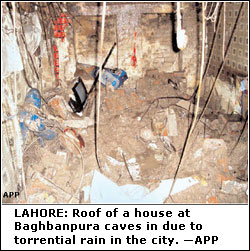 LAHORE, Sept 2: Persistent torrential rain in the central Punjab cities, including Lahore, and the catchments of eastern rivers caused urban flooding besides swelling the river Chenab and drains in Sialkot region.
The intermittent rain paralysed life in Lahore, flooding almost all roads especially the low-lying areas and forcing the people to stay indoors. It also brought about nip in the air as the maximum temperature dropped to a record 22 degrees Celsius against the month’s average of over 36 degrees C.
The river Chenab was in high flood at Marala, Khanki and Qadirabad. Torrential rains were also reported in the upper catchments of the rivers Ravi and Sutlej in India. But the Flood Forecasting Bureau said Indian dams over them had the capacity to absorb the flow of water. There was no immediate threat of flood in the two rivers and India would give prior information to Pakistan if it released water into them.
After Lahore, Gujranwala division was the worst hit where nearly 200mm of rain was recorded during the past 24 hours. Around 63mm of rain was recorded at Jail Road observatory of the Lahore Met office and 45mm at the airport and it kept raining till the filing of this report in the evening. Nearly 32mm of rain was recorded on Jail Road and 36mm at the airport from 5pm on Friday to 8am on Saturday.
Chief Meteorologist Shaukat Awan said the well-marked low pressure and the westerly wave that generated the torrential rain were moving out towards Nepal and the Himalayas, respectively. As a result, the intensity of rain would gradually decrease during the night. By Sunday evening the system would completely move out. “The peak has crossed. Saturday was the maximum activity day,” he said.
This was the first system of the current monsoon that has moved towards the catchments of the eastern rivers, giving torrential rain there and in the central Punjab after many years.
According to the FFD, the Chenab was in high flood at Marala, Khanki and Qadirabad because of the rain in the river’s catchments in India on Saturday and during the past two days. The flow at these places was 266,000, 237,000 and 202,000 cusecs at 5pm.
It said the level at Marala had started falling but it would rise at Khanki and Qadirabad during the next 24 hours with an expected flow of 200,000 to 300,000 cusecs.
Mr Awan said the areas between the Indian dams over the rivers Ravi and Sutlej had received heavy rain but this would not generate any flood in them.
“Right now there is no indication that India is going to release water in these two rivers. And if it does, we will have enough time to brace for any flood-like situation,” he said.
According to him, the rain was generated because of the confluence of the westerly system and the monsoon depression over northeastern Punjab and the held Kashmir. The depression had weakened into a low pressure on Friday but the focus of the confluence in Pakistan on Saturday was Lahore, Gujranwala, Gujrat, Hafizabad, Sheikhupura and Sargodha. Heavy rain had also been reported from Indian cities bordering Pakistan.
Besides swelling of the river Chenab, the rain also caused moderate flooding in storm water channels in Sialkot and Wazirabad regions, including Bhimber, Bhander, Palkhu, Jhajri, Basanter, Bein, Ujh, Kather, Sakki, Niki, Deg, Aik and Hasri. They would remain flooded till Sunday.
The rivers Indus and Jhelum were flowing normally and there were no chances of flood in them.
Meanwhile, the local Met office reported that by 5pm, Faisalabad received 45mm of rain, Mandi Bahauddin (20mm), Jhelum (21mm), Rahwali near Gujranwala (56mm) and Sialkot 9mm of rain.
By 8am on Saturday, Rahwali had received 141mm of rain, Jassar (84mm), Faisalabad (69mm), Sialkot (67mm), Kund (43mm), Okara (38mm), Chakwal (34mm), Mandi Bahauddin (25mm), Jhelum (21mm), Kotli and Sahiwal (17mm each), Muzaffarbad and Dera Ghazi Khan (12mm each) and Malamjabba recorded 11mm of rain.
The FFD has forecast fairly widespread rain over the upper catchments of the rivers Chenab, Ravi, Sutlej and Beas along with northeastern Punjab during the next 24 hours. Scattered rain might fall over the upper catchments of the rivers Indus and Jhelum along with Rawalpindi division.
LAHORE ACTIVITIES: Attendance in offices and schools remained thin because of the rain which also badly affected business activity. Traffic moved at a slow pace and remained jammed on many busy roads that were flooded.
The worst-hit areas included Lakshmi Chowk, Circular Road, The Mall near GPO, Old Anarkali, Misri Shah, Wasanpura, Samanabad, Multan Road, Mozang and Mozang Chungi. Numerous streets in Gulberg, including the one leading to the residence of Chief Minister Pervaiz Elahi, too, remained inundated throughout the day.
Power breakdowns and suspension of water supply added to the inconvenience of the people as many localities were without electricity till late at night.




























