



 0
0

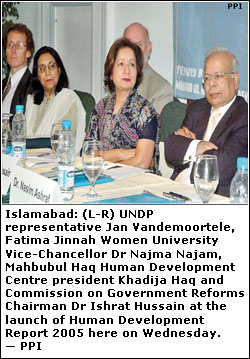 ISLAMABAD, Aug 30: A qualitative change in the governance can solve most of the problems of Pakistan, according to the chairman of the Commission on Government Reforms, Dr Ishrat Hussain.
“Institutions should be built to provide good governance which is prerequisite to removing poverty in the country,” he said at the launch of the 2005 Human Development in South Asia Report here on Wednesday. The report focuses on human security issues.
Dr Ishrat said the prevailing system worked for the privileged and the powerful and not for the common good of the society. That objective demanded that all citizens were provided equal access to economic opportunities, and justice, he said.
“Education for all, an independent and powerful judiciary and accountability of public representatives are needed to improve life in Pakistan,” he said.
Dr Naseem Ashraf, chairman of the National Commission on Human Development, supported Dr Ishrat’s submissions. “We lack freedom from fear. Without justice there can be no peace, and without peace there can be no development,” he said.
Dr Ashraf, who was active in the Association of Pakistani Physicians in North America before moving back to Pakistan, reminded the West that its “obsession with war on terror” would achieve nothing “until and unless there is justice for all”.
Resident Representative of the United Nations Development Programme Jan Vandemoortele on the occasion stressed “the urgent need for redirecting the scarce resources (of the state) to social sectors”.
He recalled that two-third of the people of Latin America were dissatisfied with their democratic governments. “They no longer believe in the merit of democracy because it did not deliver”.
Norwegian ambassador Janis B. Kanavin, whose country funds the Mahbubul Haq Human Development Centre, observed that South Asian countries were not poor but had high poverty because of their high expenditure on military.
“Deficit of justice is the root cause of conflicts (in the region),” he said, calling on the regional countries to “respect and apply” international laws and conventions on human rights.
Khadija Haq, widow of Dr Mahbubul Haq and lead author of the report, said the report was about the security concerns of the majority people in South who have always yearned to live in peace and harmony within their societies and with their neighbours.
“But the politics, the ideologies of a minority of the population, the greed of the captains of industry and commerce, and the politics and theology of the international and transnational financial, business and trading institutions have been standing in the way of letting ordinary people live a peaceful life,” she said.
She regretted that if anything the human security for the vulnerable groups in the region had worsened since the 1999 South Asia Human Development Report stated that the region was “divided between the hopes of the rich and the despair of the poor”.




























