0
0

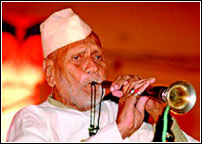 NEW DELHI, Aug 21: Shehnai wizard Bismillah Khan, who introduced the humble north Indian reed pipe to the concert stage, died in his home city of Benaras on Monday, highly decorated but always on the edges of penury given his countless dependents. He was 91.
His relatives said the Ustad was admitted to a private hospital on Thursday with age-related ailments and died early on Monday morning due to heart failure. The flow of tributes continued the entire day from the Indian president and prime minister down to the man on the street in Benaras. Some states declared official mourning as a mark of respect to his memory.
The Bangla channel of state-run Doordarshan, always the richest source of unsullied classical music broadcast in India, rummaged its archives to produce some Bismillah Khan’s gems through the day. These included a duet with the late sitar maestro Ustad Vilayat Khan, in which the two close friends played the evening melody of Raag Anandi. Through it they explored what became Shehnai’s forte under Bismillah Khan’s care -– a rich array of folk music from eastern Uttar Pradesh ranging from chaiti, kajri, to the more popular thumri.
A saddened Pakistani admirer recalled in an email to this correspondent. “You may have forgotten, but I still remember being at one of his performances during our ‘79 visit , or was it ‘78, in Delhi at an open air theatre. At one point there was a power breakdown, but Khan Sahab did not stop playing. The organisers brought a lantern and put it in front of him, and he kept on playing for a good fifty minutes amid pin drop silence. A great man.”
Bismillah’s musical journey began early when as a boy he would accompany his maternal uncle to the darbar of a minor prince. One day a whim caught the prince. He asked the boy to play “jo dhyave so paave, kashta mite tanakaa”, a popular Hindu devotional song of the time. The boy, brought up as a devout Shia Muslim, reproduced the song on the Shehnai so faithfully that the performance won Bismillah his first gold medal.
The Ustad would recall another milestone in his long walk to fame. “When I was around three and half years old, I used to accompany my uncle Ustad Ali Bux on his concert tours. Once after his recital in the Kashi Vishvanath Temple, I was asked to play the Shehnai. I did so with great courage and confidence. The listeners appreciated my recital and the temple authorities felicitated me with a medal.”
Bismillah’s grandfather and great grandfather were court musicians too. Father Paigambar Bux was a musician who played Shehnai at Dumraon, a princely state in Bihar. Bismillah Khan was born there on March 21, 1916, but was brought up at Benaras, where Hindu, Buddhist and Muslim cultures meet on the banks of the Ganges.
Had he saved even a small part of his earnings, this Shehnai player would have been a prosperous man. But he had the onus of feeding a hundred persons, ten sons included. He travelled across the world but didn’t like flying. In India he would mostly travel by train.
An accompanist or two, like for other instruments, won’t do for Shehnai. He had a retinue of 8-10 accompanists. He would travel to the railway station by cycle rickshaw, heading a caravan of 4 or 5, waving to familiar passersby, no less happy than a prince in a Rolls Royce!
Bismillah Khan was deeply religious. Without offering his morning namaaz, he wouldn’t ever put the Shehnai to his lips. “Music, sur, namaaz are all one. We reach the Allah by different ways. If a musician is not in communion with spirituality, with God, his is a dry art. Unless he becomes a mystic, his won’t be great music,” he would say.