0
0

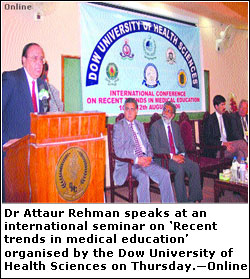 KARACHI, Aug 10: Speakers at an international conference have stressed the need for improving the content of undergraduate medical education programme in the light of local needs, tradition and resources available for the purpose.
The three-day conference on “Recent trends in medical education, was inaugurated by the chairman of the Higher Education Commission, Dr Attaur Rehman, on Thursday at the Dow University of Health Sciences (DUHS), the organiser of the conference. Delegates from Canada, Australia and Malaysia, along with about one hundred delegates from all over the country, are participating in the conference.
The objective of the moot is to suggest the expected outcomes of undergraduate and postgraduate medical education programmes in the light of advancements in health sciences and also to propose instructional strategies and outline assessments most appropriate for future physicians.
Speaking at the inaugural session, Dr Atta acknowledged that the recent advancements made by the DUHS in regard to teaching and training of its students and remarked that a real university was the place where students were provided with the highest quality of education and research facilities that would ultimately turn them into creative and compatible individuals making a genuine contribution towards the economical, industrial and social development of the country.
Talking about the approaches and practices of the HEC, he said that different schemes had been introduced to evaluate the skills of university teachers and enhance their capacity further as teacher and researchers. In addition to providing incentives for faculty members in varsities, programmes and projects were being executed so that Pakistani students could also have the excitement of excellence in higher education.
The HEC chairman said that the local medical varsities should also not lag behind in the pursuit of knowledge and ensure production of high quality postgraduates. The medical education institutions should also focus at researches addressing the local disease pattern and enabling their graduates to solve them, while having a clear understanding about the emerging diseases at the regional and global levels.
He mentioned that the government was ready to invest more for the promotion of higher education in the country and a significant increase had been made in the budgetary allocations for higher education, which was obvious from the fact that the funds for university had been increased from Rs3 billion to Rs26 billion in a span of three years.
Dr Atta said there were about 80 million people below 18 years of age who should be attracted through a comprehensive policy towards higher education and research.
In his address, the vice-chancellor of the DUHS Prof Masood Hameed Khan referred to various ongoing and completed educational projects at the varsity and appreciated the HEC for its financial supports. He informed that soon a dental college and an international college meant for medical education of overseas Pakistanis would start functioning as the units of the university in the city.
Dr. Sohail Naqvi, Executive Director, HEC, Dr Kaleemullah Thaheem, Deputy Director Medical Education DUHS, also spoke at the inaugural session of the conference.
In a keynote address, Prof David Cook, Director, Division of Studies in Medical Education, Alberta University, Canada, talked on past, present and future of medical education and remarked that the traditional curricula was based on what teachers wanted to teach.
However, he opined that now there was a need for those committed to medical education to grow and adapt to the environment that had changed around them.
Talking precisely on curricula making, he said that it should be taken into consideration that did the teachers and students actually understood what the programme was all about and what the underlying philosophy was. How it will work in practice, particularly in the case of consumers, physicians and supervisors of postgraduate trainers, and how the success of students will be evaluated, these too should be considered, he added.
He said that educators must ensure that changes which did not affect the fundamental approach to education would make it more effective. He said that curricula needed to be broadly based and it must include basic scientists and physicians as well.
During the academic session, Prof Naeem A. Jaffery talked about some of the recent initiatives to define a ‘good’ doctor. Doctors should learn and acquire the ability to practice safely and effectively, he added saying that doctors must also have the ability to assess and improve the quality of care and also be ready for being accountable as medical education relied heavily on considerable public funding.