



 0
0

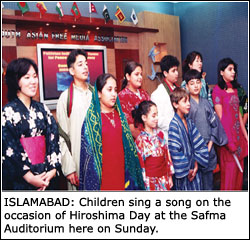 ISLAMABAD, Aug 6: Children and minorities at two separate functions called for an immediate end to Israeli aggression on Lebanon and stockpiling of nuclear weapons in the world, in general, and in South Asian Subcontinent in particular.
People still remember the destruction and miseries caused by the first atomic bombings on Hiroshima and Nagasaki 60 years ago, they said.
Dozens of children and their parents gathered at the Safma Media Centre to express their revulsion at the destruction of the two Japanese cities, on August 6 and 9, 1945.
The peace ceremony was organised by the Funkor Art Gallery and the Pakistan-India Peoples Forum for Peace and Democracy.
Rubab, the student of a capital school on behalf of about 100 children read an appeal on the occasion saying: “We do not want any kind of war because the life of children is ruined; we protest against all kinds of weapons, whether nuclear or cluster bombs; we also demand an end to the war in Lebanon”.
Another child, Bisma, in her speech recalled with deep agony the US bombings on Hiroshima and Nagasaki and its baneful affects of radiation on millions of children. She said children suffered from cancer and leukemia even after 60 years.
Safma Media Centre director Ashfaq Saleem Mirza criticised the United States for manufacturing the largest number of nuclear arms.
He told the children that 200,000 people died in the atomic bombings on Hiroshima and Nagasaki. It was the largest number of people killed.
President Truman decided to use the atomic bombs on cities inhabited by civilian people and innocent children, and not on military structures. He said Truman’s action was a war crime.
Criticizing the Israeli bombings on civilian installations, Mr Mirza said it should be considered morally reprehensible to drop nuclear weapons on electricity generating plants or on other factories where labourers go to work.
“Those countries who pride in possessing nuclear weapons are in fact paving the way for the destruction of human beings”, he observed and suggested that the use of nuclear bombs and their possession should be considered as a negative pursuit.
A film showing the devastating radiation effects on children was screened on the occasion. The film ended with the observation that Japanese youth were busy in different pursuits and may have forgotten the havoc the atom bombs had caused to them. Every one in all places should remember so that the incident might never ever be repeated again.
A book Sadako ki dua, written and illustrated by Fauzia Aziz Minallah was also launched on the occasion. Sadako, a victim of the atomic bombing, died of cancer caused by the radiation of atomic bomb.
Sadako endured the pain of the most terrible bomb used so far on human beings and turned her pain and sorrow into love and compassion. She wanted a world where children are protected from devastating wars. Today human beings have developed atomic bombs many times more powerful than the A-bomb that was dropped on Hiroshima.
Thousands of innocent children have been killed and maimed with terrible weapons in many wars fought after the second World War.
Dedicated to the survivors of the devastating earthquake of October 8, 2005, the book condemns killing and maiming of children by using nuclear weapons, chemical bombs, cluster bombs.
The author read the book to the children. “It shows the will of mankind to rebuild life anew after every catastrophe”, she observed.
She said the nation had learnt this lesson once again after the devastating October 8, 2005 earthquake.
As she spoke, two Japanese women, Ms Fumi Fuji and Chika Harada, representatives of Asian Network of Trust, Hiroshima, joined her. The two ladies, who were busy in relief work at Muzzafarabad, made paper cranes with the children.
The children sang Japanese songs Aogiri with Chika Harada. The song is about Aogiri, the first tree that sprouted in Hiroshima after the atomic bomb destruction. Children also sang Japanese song One Peace.
J.SALIK: In another programme to commemorate the destruction of Hiroshima, former Federal Minister J.Salik at his residence observed one-minute silence.
The participating children and women standing with lighted candles in hands prayed for world peace.
Mr Salik in his message on the occasion emphasized on the Pope Benedict, Bishop of Canterbury, Imam-i-Kaaba, Nobel Peace Prize winners and Muslim scholars to make combine result-oriented efforts to save the humanity from destruction of the expected 3rd world war by destroying atomic weapons.
He stressed upon the need of establishing peace centres in all over the world and asked the United Nations to provide adequate funds for strengthening peace efforts.




























