0
0

 KARACHI, July 30: For a population of over two million spread over different sectors of Orangi Town, the provincial government has established only nine dispensaries which are being run by the city government following introduction of the local government system. Almost all the health facilities are in a pathetic condition and need immediate attention.
Shortage of medicines, water and furniture, besides lack of maintenance, are the common problems of these dispensaries.
Ironically, the Shaeed-i-Millat dispensary located in UC 5 near Block L, has been functioning in a small room originally built for watchman as the seven-room building on a hilltop is crumbling and the staff has, therefore, vacated the same.
Conditions at this health unit appeared to be worst among the nine. Water is not available and the furniture has got broken to the extent of being unusable. Its main gate, doors, ventilators and windowpanes have been removed and the building is fully exposed to intruders and drug addicts. Many addicts have already occupied portions of the structure as their safe heaven. The doctor on duty told Dawn that even in this single room, he attends up to 20 patients a day. A social worker, Anwar Hussein, stressed the need for rebuilding the structure immediately to give it a shape of a dispensary with all facilities, including medicines, being available to patients as per their needs.
The most important health facility in Orangi is, perhaps, the Orangi Maternity Home, which needs immediate attention. Surprisingly, it has none of the essential facilities of water, power and gas. It is functioning only because the electricity has been drawn through a hook (kunda).
It transpired during a visit to the hospital that until three years back, it had two ambulances at its disposal, but at present it has none. The hospital does not have life-saving drugs and doctors have to refer emergency cases to some other hospitals.
Due to the non-availability of water, medicines, surgery instruments and other related utensils, the doctors could not perform surgeries. Basic diagnostic equipment like ultrasound, x-ray and weighing machine are also not available. A laboratory is there but without necessary equipment and articles for tests.
The number of nursing staff has been decreased from eight to four. There is only one medical officer (MO) and in her absence, the hospital has to be run by the nursing staff. The number of patients visiting the OPD daily is stated to be about 70.
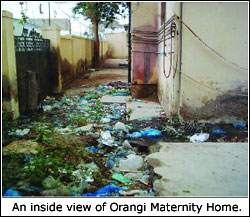
The building has already got its sewerage system damaged and the gutters within its compound are overflowing only to block one of the two main gates with filth and stinking water. The windowpanes are broken and there is no planning for its renovation, whitewash and replacement of the faulty lights and fans. The hospital’s boundary wall is not high enough to prevent thieves from climbing it. They have already taken away the ceiling fans and other valuables and the staff members had to purchase the same on their own.
People of the locality dump garbage right at the hospital’s main gate which not only presents an ugly look, but the foul smell emanating out of it makes the atmosphere in the whole locality intolerable. The hospital staff told this reporter that despite their efforts, the dumping site was not being removed, adding that they had to request every time to the authorities concerned for removal of the garbage.
Cracks have appeared in the building structure, they indicated, adding that they were at all time risk while remaining inside.
Adjacent to the maternity home is an urban health centre (UHC), with one medical officer, which receives about 50 patients a day. The dispensary doesn’t have water and electricity and its building has also developed wide cracks. The staff complained of shortage of medicines.
The urban health centre (UHC), Aligarh, located in a congested lane, is little known to the people of the area. The medical officer said that the number of patients visiting it was increasing and at present, the OPD receives 150 to 200 patients a day.
Al-Razi dispensary is another healthcare unit in Orangi. Located in UC 3, it is also in a dire need of water, furniture, electricity, sufficient medicines and power meter. About 50 patients visit the hospital daily. The entire water pipeline at the building needs to be replaced. There is no proper furniture even for the staff and the doors are also broken. The lavatories and wash basins are in bad condition and the accessories in the washrooms are damaged. Cracks in walls are clearly visible. Garbage is seen scattered everywhere around the hospital and there is no arrangement for its removal.
Ibne Sina dispensary, located in the UC 4 area, where have arranged furniture, fans, etc, on their own, also lacks water facility. The windowpanes and doors are broken. The daily general OPD at of the dispensary is done for up to 25 patients. The staff complained of shortage of medicines. The interesting scene at the dispensary was that its doctor was not present and the patients were being treated by a person who introduced himself as a ‘cook’. He claimed to have gained a good experience of nine years now and was competent enough to handle the job. Due to the non-availability of beds, patients were seen lying on wooden benches.The conditions at the basic health unit, Baloch Goth, in UC 13 is also almost the same.
The localities of Raja Tanveer Colony, Tori Bangash Colony and Raees Amrohvi Colony have no healthcare centres as the local residents’ repeated calls in this regard had so far remained unheeded. People of these localities have been demanding establishment of a hospital which could also cater to the needs of adjacent areas, Ittehand Town and Mohammad Khan Colony. It is learnt that three other dispensaries, one each in Mansoor Nagar, Bejli Nagar and Haryana Colony, are under construction.