



 0
0

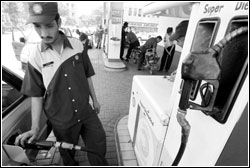 THE international crude prices briefly surpassed $78 a barrel on July 14, after Israel’s military attack on Lebanon raised fears of a wider Middle East conflict and possible disruption of oil supplies.
New York’s main contract Light Sweet crude for delivery in August soared to a record high of $78.40 per barrel overnight Thursday (July 13) while, in London, Brent North Sea crude for August delivery hit a historic high of $78.03 a barrel, on the same day.
Oil analysts have expressed the fear that prices may soon cross $80 per barrel, while $100 a barrel is being seen as a distant possibility. The oil companies are cashing on political premium.
Adjusted for inflation, the current oil prices are reportedly still below the level of $85 a barrel (in today’s money) reached after the 1979 Iranian revolution.
The current upsurge in oil prices is being attributed – besides Israel’s attacks of Gaza and Lebanon - to the move to refer Iran’s nuclear pursuits back to the Security Council, raising the possibility of sanctions.
Oil analysts fear that, in the event of sanctions, Iran may retaliate by cutting oil output or even by blocking the strategic Strait of Hormuz, which is the gateway for bulk of the Middle East oil. Such an action would no doubt aggravate the oil situation further.
The OPEC has stated that, although it does not have any control over the geo-political turmoil underlying the current oil market volatility, it will make all possible efforts to ensure uninterrupted supplies of oil to the intending buyers.
So far as the short-term and medium-term price outlook is concerned, a number of analysts fear that the higher prices may persist, as the global demand for crude oil is moving much ahead of supplies. Despite the worsening geopolitical situation, global economy continues to grow. United States and European economies are growing at their normal pace, while Japan’s economy is also showing positive growth after recovery. So far, as the developing world is concerned, China posted as much as 10.9 per cent growth in its last quarter, while the Indian economy is, also, growing at the rate of around eight per cent. As a result, global demand for oil continues to remain strong, while supply is constrained due to the current geopolitical situation and security concerns, among other factors.
It may be recalled that the international oil prices had jumped to $70.85 a barrel on August 30, 2005, when hurricane Katrina had caused severe damage to the oil production platforms in the Gulf of Mexico.
However, after reaching its peak on August 30, the price of oil had showed a downward trend and at one stage it came down to $56-57 per barrel.
One of the reasons for the downward trend was that the demand for oil in the US had weakened considerably as a result of widespread devastations caused by hurricanes Katrina and Rita and evacuation of hundreds of thousands of people from the affected areas.
In the present case, the global demand for oil continues to remain strong. Oil prices are, therefore, likely to stay at a high level, unless the higher oil prices start hurting the global economy and lead to an economic slowdown, which will no doubt pull down the global demand and bring down prices.
Already, analysts have expressed their fear that the upsurge in oil prices may lead to an increase in the global inflation. Later, counter-inflationary measures taken by governments in various countries may lead to decline in economic activities and pave the way for a global economic slowdown.
Since, Pakistan is already facing the problem of a high inflation rate, the government is making efforts to keep the inflationary pressure in check. At the same time, it should initiate measures to contain the trade/current account deficits, since higher oil prices are likely to push up the country’s oil import bill further.
If the global economy goes into a recession as a result of higher oil prices, Pakistan may have difficulty in raising its industrial production and meeting its export targets.
In such an event, it would be advisable to attach a higher priority to the agriculture, since an increase in farm production may help in achieving this year’s GDP growth target of seven per cent.
In any case, the government should be prepared to deal with any adverse effects of the upsurge in oil prices. It should take necessary steps to ensure economic growth with macro-economic stability.



























