0
0

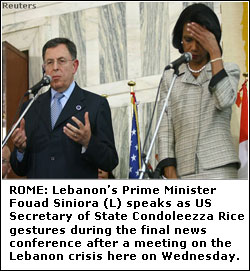 ROME, July 26: A summit of world powers broke up here on Wednesday after failing to agree to a demand for a ceasefire for the Middle East, vowing instead to work with “utmost urgency” for a truce and calling for an international force to be deployed in Lebanon.
A ceasefire to end the bloodshed in the region “must be lasting, permanent and sustainable,” said a declaration released after the five-hour conference.
But despite the determined language, the pledge fell far short of meeting United Nations Secretary General Kofi Annan’s plea for an “immediate cessation of hostilities” to stop the killing, with nearly 400 people dead in Lebanon, mostly civilians.
Neither Israel nor Hizbollah and its two key backers — Syria and Iran — were invited to the Rome conference, held two weeks after Hizbollah triggered the fighting with a cross-border raid by its fighters who killed eight Israeli soldiers and captured two.
US Secretary of State Condoleezza Rice resisted persistent calls from allies for an immediate ceasefire, saying root causes, including the disarming and disbanding of Hezbollah, must be addressed first.
The calls were led by war-battered Lebanon and Arab states, backed by European allies such as France and Russia.
“We are all agreed that we want most urgently to end the violence on a basis that this time will be sustainable. Because unfortunately this is a region that has had too many broken ceasefires,” Rice told a news conference.
The lack of endorsement for an immediate ceasefire left a riled Lebanese Prime Minister Fuad Siniora asking if his people were “children of a lesser God”.
“We are being pounded day by day, and scores of people are dying every day,” Siniora said, flanked by Rice and Annan.
“Can the international community continue to stand by while such callous retribution by the state of Israel is inflicted upon us?” he asked.
Rice insisted the “way forward” was based on UN resolution 1559, which calls for the disarming and disbanding of all militias, including Hezbollah, and for the Lebanese government to assert its authority over all its territory. Much of southern Lebanon is controlled by Hezbollah.
INTERNATIONAL FORCE: To that effect, Rice told journalists multilateral talks would occur “over the next several days” to discuss the establishment of an international security force for southern Lebanon.
“The mandate of the security force will be discussed over the next several days. We have asked for urgent meetings to take place so that a force can be put together.”
Rice warned Syria and Iran, long seen as Hezbollah’s puppet-masters, that it was time for those countries to “make a choice” about their role in Middle East peace.
“Syria has a responsibility,” Rice said. “And we are deeply concerned, as we have said, about the role of Iran. It is high time that people make a choice.”
British Foreign Secretary Margaret Beckett said later she expected the main points of the Rome declaration to be put before the UN Security Council “next week.”
The 15 nations gathered here also called on Israel to exercise “utmost restraint” while welcoming Israel’s decision to let aid into Lebanon including aid flights to Beirut airport.
French Foreign Minister Philippe Douste-Blazy lamented the failure to agree on an immediate ceasefire.
“There was no agreement and we agreed to work in a very urgent way for a cessation of hostilities. We would have liked the word ‘immediate’ more than the word ‘urgent’ in the text,” he said.
A diplomat in the meeting said that the dispute about ceasefire language alone took 45 minutes of the five-hour talks.
Siniora kept interjecting, saying that people were dying, according to the diplomat. “Rice told everyone they needed to get a ‘reality check’ that there was not going to be a ceasefire immediately.”—Agencies