



 0
0

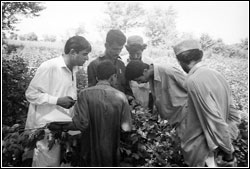 THE degradation of natural resources which pollutes the environment is a big threat to biodiversity.
Natural resources have been damaged mainly because of the failure to adopt sustainable change, misuse of chemical and pesticides, resource degradation, ignored biodiversity, neglect of human resource management and development.
The research on sustainable agriculture development and technology transformation was not encouraged nor efforts were ever made to save the indigenous knowledge for securing biodiversity. However, lately a team of dedicated workers have carried out a research on the “economics of ecological agriculture’ to tackle the problem.
The basic objective of this research was to find out ways for optimising land ,animal and plant output for preserving natural resources and energy flows and to enhance the biodiversity, with the help of farmers.
This research was conducted in the four ecological regions of the province, i.e. Upper Sindh, Lower Sindh, Central Sindh and the desert areas to compare the economics of ecological agriculture as against the existing practices and for which a continuous interaction between farmers and officials was maintained and certain crops were selected to achieve the desired results.
The study showed that farmers use ‘farm yard manure’(FYM) as fertilizer for increasing soil fertility and prepare pesticides from plants such as ‘neem’, ‘tobacco’ and ‘tooh’ which are easily available in these areas. Such a practice on the part of farmers proves useful in maintaining the ecological plot, whereas the chemically treated plot are managed with the chemicals.
According to these findings, the average crop (rice/cotton)yield of ecological plot is 18.5 maunds (one maund is equal to 40 kg) while the yield of chemically treated plot is 24.5 munds, which is obviously quite high.
Similarly, the average input cost of ecological plot is Rs7490 while the average input cost of chemical plot is Rs14935. The average output of ecological plot is Rs18793 while the average output of chemical plot is Rs21945.
This very clearly indicates that the practices of ecological agriculture are economically more beneficial compared to the existing practices as the average net profit of ecological plot is Rs8303 and the average net profit of chemical plot Rs7020.
The ultimate result of all this is that the farmers recognize the importance of ecological agriculture which is not only economically viable but highly supportive for enhancing biodiversity.
Moreover, ecological agriculture is safer for farmers compared to chemicals which leave their toxic impacts and also pollute the environment. In short, farmers and officials have recognized the importance of ecological agriculture and now, there seems to be a dire need to plan strategies for the promotion of ecological agriculture at a micro level in order to reduce farmers’ poverty with sustainable development of agriculture.
See in my eyes you dwell, be aware It may hit you”
Now it is our ethical and moral responsibility to adopt such practices which have symbiosis relationship and less expensive, to achieve these objectives we must take initiatives for the promotion of ecological agriculture at micro level to reduce the poverty of farming community and mobilize them for understanding & compilation order to optimize Land: animal: Plant interaction for energy flow to enhance bio-diversity. These objectives can be achieved through the formation of farmers’ groups, farmers’ clubs and farmer’s schools to facilitate them for wide adoptability of ecological agriculture.






























