



 0
0

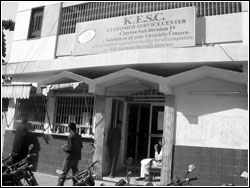 VERY insightful analyses of the electric power demand-supply gap in Karachi have appeared recently amply demonstrating the inability to create additional power generation capacity in good time. This inability stemmed primarily from the privatisation predisposition of the government.
For, according to these analyses, additional power generation in the public sector was put on hold due to an attempt to generate power in the private sector that did not turn out to be successful enough to close the gap.
In this power crisis, the prime minister even found an opportunity to complement his economic team for the ‘high’ economic growth due to which he thinks a demand-supply gap has surfaced.
While inadequate generation capacity may definitely be a reason behind the power crisis, questions continue to abound about the ability of the management to ride the turbulence. After all, can food shortage in the country justify famines? Can people be expected to go on sugar-free diets in case of artificial sugar supply shortfalls due to hoarding? Certainly not. For, shortages are expected to be managed to minimise discomfort and inconvenience.
The government intervenes to improve the supply situation even if it cannot hold those behind it to account due to their political and social clout. And, when the government fails to hold such elements accountable, independent analysts bring the situation to light and the people, at least, get to know what is going on. At least, a moral pressure is created on the culprits.
In the case of power shortage in Karachi, the government at least effectively begs Wapda to supplement power supply to Karachi. However, as in the case of food shortages, it looks the other way from those who must do their best to alleviate the power crisis in the interim. In the food situation, it is the political interest of the government that it must guard as in sugar.
In the power situation, it is the quality of their economic decision that they must defend which is of privatisation. In the case of food shortages, at least the independent analysts try to remove the lid from the crisis situation. In the case of power crisis, independent analysts touch the tip of the iceberg by only going into one key factor of the supply-demand situation.
While supply-demand gap is a key variable, presenting it as the only variable explains away the inadequate response that comes from private sector managements that should be agile and responsive enough to jump out of the groove instead of sinking deeper into it.
For example, one supply-demand explanation does raise the question of why the new KESC management refused to purchase 300 MW of electricity from Tapal’s and Fauji’s power plants that had “progressed satisfactorily” until it came time to negotiate tariff? So, which interest is uppermost—-consumers’ or short-term gain for shareholders’?
Strategic management calls for a trade-off in the short-run as being consumer-centric is to maximise the interests of the shareholders too on a sustainable basis over the long haul. This inadequate juggling of interests has, inter alia, caused the city’s electric power consumers dearly.
Another example of inadequate strategic management of the utility is the question reportedly raised by none other than KESC’s employees in general and its highly qualified engineers in particular. They say that pre-emptive measures are taken every year ahead of summer to limit breakdowns and faults. Although a “patchwork,” this would “remove the trouble spots and bottlenecks” in the electrical system and minimize misery during the summer.
These measures included, “…..addition of feeders where needed, addition and reinforcement of distribution transformers, enhancing the size of 11kv linking cables, bringing into the ring the PMTs and substations besides adding more power transformers at various grid stations and general preventive maintenance of transmission lines, overhead mains and sub-stations.”
However, the cost involved is to the tune of Rs200-250 million. This preventive maintenance was not undertaken this year. Once again, it smacks of a short-term financial orientation when the outlook should have been strategic. Also, the emphasis has been on administrative restructuring, as per the employees.
Strategic management calls for active involvement of the workforce. This does not seem to be happening at the KESC which is why old experienced and technical hands’ potential is not being tapped to alleviate the crisis to the extent it can possibly be alleviated by the involvement and empowerment of the KESC’s human resources.
Instead, premature restructuring gives them the feeling of being on the firing line that is a morale depressant and is a further erosion of organisational capacity to make an effective response to a crisis situation. The organisation seems to be managing by crisis as it lacks strategic alignment.
A key question then is as to why the concerns of KESC employees are being swept under the rug by the social and political powers-that-be in this country? This certainly smacks of the feudalistic mindset due to which only the upper echelons are heard as intellect is believed to be proportional to the size of the salary one takes home.
The fact, however, is that technical problem-solving knowledge abounds only with the one directly engaged with the task at hand. This is knowledge-management not being done at KESC yet as the tacit knowledge of employees is neither being tapped by the organisation itself nor is it being heeded by the social and political powers understandably due to their feudal mindsets.
The dictum of “humblest most intelligent” turned China around into a power house of the world. Our dictum of “intelligence confined only to the top” causes an intelligence-deficit plunging the country’s major economic centre of the city into darkness for a major part of the hot summer season.
So, however much an attempt is made to guard one’s own interest group, question is as to why was KESC taken over by private owners if they had no clue of the power demand-supply situation in Karachi? Had they not prepared a feasibility of their new venture?
Hypothetically speaking, if they took it on naively and unknowingly about the supply-demand gap, why are the breakdowns so frequent and why could the suggestions of KESC employees not factored in to pre-empt or minimize them? Why are the cables being cut? Why is the repair time a lot more prolonged than was the case when the KESC was in the public sector? Why are the complaint handling procedures made more onerous and time-consuming? What is the new statistics on power theft as compared to what it was under the outgoing public sector management?
Last but not the least, what is the experience of the contracting firm in running utilities? Was past experience a consideration in privatising this key utility or was it ignored in a desire to offload it to fulfill some criterion of foreign lenders?
While answers to the above questions are eagerly sought, suffice it to suggest that all privatised organisations should be subject to management audit, operations audit, external environmental audit, and social audit. These audits should be conducted by fiercely independent consultants and the concerned regulatory authorities should begin to assume, at least, some responsibility in this regard.
Privatised organisations should not be treated as excess weight on sinking ships which, once offloaded, can be forgotten about. For, privatised organisations must swim with the tide otherwise they can be more burdensome on the society than they were before privatization.






























