



 0
0

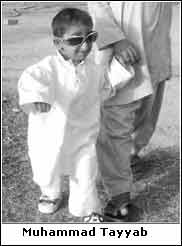 MULTAN, July 18: Muhammad Tayyab alias Bablu has barely two feet (62.5cm) height with 5kg weight at the age of ten. Doctors fear he is suffering from one of the rarest known diseases, the Russell Silver Syndrome (RSS).
Neither of Tayyab’s four siblings, nor anyone in his maternal or paternal families, had ever suffered from dwarfism, a popular name for the ailment.
Tayyab’s father Qari Muhammad Riaz, who originally belongs to Jalalpur Pirwala tehsil, is a prayer leader at a mosque situated in slums near Muzaffarabad in the outskirts of Multan city. Making both ends meet with meager resources has been a constant dilemma for Qari Riaz. “Bablu’s disease has made the circumstances more trying,” he told Dawn.
Pediatricians and endocrinologists say that diagnosis of the RSS disorder is not an easy task as there is no definitive laboratory test available for the purpose, and physicians have to mainly rely on the symptoms. The most common symptoms among the children with RSS are short stature without catch-up growth, normal head size for age, a distinctive triangular face, low-set ears and incurving fifth fingers.
The syndrome is named after Dr Russell and Dr Silver, the experts who had separately described in early 1950s the groups of small-for-gestational-age (SGA) children whose pregnancies had been made complicated by intrauterine growth retardation (IUGR).
Initially, the RSS was not considered as a genetic disorder but recent genealogy research has led the scientists to believe that the syndrome is genetic, but with difference. Scientists now believe that the RSS phenotype is associated with more than one genotype.
Bablu’s birth was administered by a village midwife. Qari Riaz said that at the time of his birth Bablu’s weight was hardly a kilogram with less than one foot height. He said Bablu showed some growth up to three years, but in the later years his growth was halted. “However, he has gained some more height and weight in the last couple of years,” he added.
Bablu hardly eats half chapatti in a day. However, he seems quite normal whereas the mental capabilities of his age are concerned. True to his nick, he is a bubbly child who becomes more animated on having a visitor. His younger brother Ilyas (6) is more than double in height and three times heavier than him, but one finds Bablu dictating him like a typical elder brother.
Qari Riaz said Bablu had learnt by heart the first two Islamic creeds and several Quranic verses. He said that he took his son to the Children Hospital Complex in Multan for diagnosis and treatment. However, he was referred to the Lahore’s Children Hospital for further diagnosis and Growth Hormone Deficiency.
At the hospital Bablu was examined by endocrinologist Prof Dr Javed Ahmed Butt. Reports say that Prof Butt also agreed that Bablu was an RSS child suffering from growth hormone deficiency as well. Doctors at the Children Hospital recommended several tests to confirm the diagnosis. “We returned back to Multan because we could not afford the costly tests,” Qari Riaz said.
In Multan, they again approached endocrinologist Dr Waqas Imran, who this time referred them to a specialist in pediatric endocrinology, Prof Dr S Jamal Raza, of the National Institute of Child Health in Karachi. The doctor recommended several costly tests, including one for the growth hormone deficiency from the Agha Khan Hospital.
“I had no choice except to come back because there were only few hundred rupees in my pocket,” he said, adding “I have sought assistance of local authorities to help Bablu get rid of the unusual disease but to no avail”.
When contacted, endocrinologist Dr Waqas Imran said Bablu’s treatment could only be started after the positive growth hormone deficiency test, and the AGH was the only facility in Pakistan to conduct this type of investigation.
He said there were chances that Bablu might regain his normal growth pattern once his treatment started.
It may be added here that synthetic human growth hormone, somatropin, are injected to regulate physical development among the children suffering from growth hormone deficiency. Usually, the synthetic growth hormones are injected daily until the child starts growing.
The diagnosis and treatment of the RSS besides the growth hormone deficiency is a costly affair for a father who has not enough resources to see his otherwise energetic child leading a normal life.



























