0
0

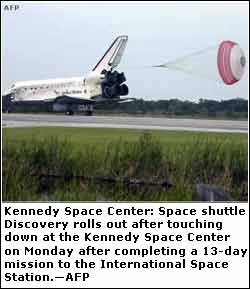 CAPE CANAVERAL, July 17: Space Shuttle Discovery ended a near-flawless 8.8 million-kilometre journey with a smooth return on Monday, giving a major boost to the trouble-plagued US space programme.
“It was an enormously successful flight ... we’re back on track,” Nasa chief Michael Griffin said following completion of the 13-day mission that paved the way for the resumption of regular shuttle flights in the wake of the 2003 Columbia disaster.
The crew and National Aeronautics and Space Administration leaders were delighted to see the space vehicle did not have the beat-up appearance of previous shuttle flights.
“This is the cleanest orbiter anyone remembers seeing,” said Griffin.
Nasa heaved a sigh of relief as Discovery came to a full stop on the 4,572-meter Kennedy Space Center runway on the Atlantic seashore on Monday morning.
“The final entry was beautiful,” said Commander Steven Lindsey.
The last moments of a shuttle mission are among the most critical.
It was upon re-entering the Earth’s atmosphere that Columbia had burst into flames on February 1, 2003, killing the crew of seven.
As it slices through the atmosphere, a shuttle is no longer powered by engines, but glides toward the landing facility.
Nasa hoped Discovery’s successful mission would help ease concerns over the shuttle programme that have persisted since the Columbia disaster, and pave the way for a resumption of regular flights in August.
Like last year’s first post-Columbia flight, the latest shuttle voyage was largely aimed at improving the safety of the shuttle missions that are critical to plans to complete construction of the International Space Station (ISS) by 2010.
Nasa says the orbiting space station is a key component in US ambitions to send astronauts back to the moon, and eventually to Mars. During the mission, astronauts Mike Fossum and Piers Sellers performed three spacewalks to test shuttle repair techniques and fix equipment needed to continue building the ISS.—AFP