0
0

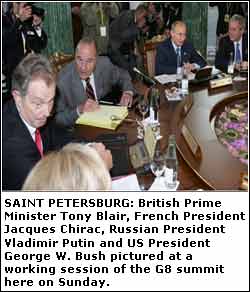 SAINT PETERSBURG, July 16: Leaders of the G8 group of world powers called on Sunday for “an end to Israeli military operations” in the Middle East and demanded that ‘extremists’ stop shelling Israeli territory.
In a statement agreed here after emergency talks on the crisis, they also demanded the safe return of Israeli soldiers captured by militant groups and the release of arrested Palestinian ministers and lawmakers.
However they did not specifically identify Iran and Syria as backers of the militants, as the United States had been pushing for, referring only to Hamas and Hezbollah “and those that support them”.
“The most urgent priority is to create conditions for a cessation of violence that will be sustainable,” said the text agreed by the leaders of Britain, Canada, France, Germany, Italy, Japan, Russia and the United States.
It identified a list of conditions required for this to happen, including “an end to Israeli military operations and the early withdrawal of Israeli forces from Gaza” as well as a halt to attacks on Israel.
“Those extremist elements and those that support them cannot be allowed to plunge the Middle East into chaos and provoke a wider conflict,” the statement said.
The G8 leaders also urged the United Nations to consider deployment of an “international security/monitoring presence” in Lebanon.
Afterward, French President Jacques Chirac called for the rapid disarming of all militias in Lebanon, where the Shia movement Hezbollah is based, in order to alleviate the long-term threat to Israel’s security.
Speaking before the statement was agreed, US President George W. Bush said that “as a sovereign nation, Israel had every right to defend itself against terrorist activity.
“Our message to Israel is defend yourself, but be mindful of the consequences. And so we’ve urged restraint,” Mr Bush said.
US Secretary of State Condoleezza Rice had rejected calls for a temporary truce, saying it would not address the underlying threat to Israel’s security.
Russia and the European Union by contrast made clear they want a ceasefire and have called Israel’s use of force “disproportionate”.
EU foreign policy chief Javier Solana, who arrived on Sunday in Beirut for talks with Lebanese Prime Minister Fuad Siniora, said before leaving Brussels that his “first task” in the region would be to try to secure a ceasefire.—AFP