



 0
0

Mumbai in the shadow of Agra
EXACTLY five years ago to date, after a brief euphoria in their bilateral ties, the India-Pakistan summit in Agra came to an abrupt end. The Bharatiya Janata Party blamed the failure the talks on President Musharraf’s “unifocal” approach to Kashmir and terrorism. That event was followed by state elections in Uttar Pradesh in February 2002, which the BJP lost despite a jingoistic propaganda in Ayodhya that included barbs aimed at Pakistan.
The terror attack on packed commuter trains in Mumbai on July 7 has now already become a game of calculation for political mileage in Uttar Pradesh, which goes to polls in February next year when the assembly completes its five-year tenure. The state’s embattled chief minister, Mr. Mulayam Singh, had come to power with the support of Muslim voters. Of late, his politics had been in tatters.
It seems that after a tedious innings, of little or no use to the state’s Muslims, Mr. Yadav was looking on helplessly at large-scale desertion by his traditional voters when tragedy struck in Mumbai on July 7. For months before the mass murder of 200 unsuspecting people, the Muslim voters in Uttar Pradesh had been gravitating towrads Ms. Mayawati’s pro-Dalit party, the BSP. The Congress, for several years a weak force in the state, was leaning on the Dalit leader to fix Mr. Yadav, its main quarry in the arriving polls in Uttar Pradesh.
But now, in the world’s most devastating terror attack on train passengers, Mr.Yadav has found an opportunity to turn the tables on both the Congress and the BSP. He has used the hunt for the Bombay terrorists, who are thought to be Muslim extremists, to up the ante against the Congress-led federal government. For one, he promptly extended moral support to SIMI, an obscurantist student’s organisation of Sunni Muslims with a base in Uttar Pradesh, after the group was named as a prime suspect as conduit for the blasts. Federal investigators pursuing SIMI were doing so at the behest of the Congress, Mr. Yadav charged.
By giving a clean chit to SIMI Mr. Yadav was able to book his profits at the vote bourse. Now he could watch the show from a safe distance even if SIMI or other Muslim groups were subjected to fair or unfair investigations. He was their deemed messiah.
The catch in this calculation is of course that SIMI mostly represents upper caste Muslims and Mayawati leans more heavily on the lower castes among the minority voters. Mr. Yadav may yet not be able to swing the Muslim vote away from the Dalit party, but that is another story.
Where does the BJP, which was decimated in the state in February 2002, stand in this ruinous game of self-seeking politics? Not unexpectedly, the party has called for the dismissal of the Yadav government. By taking this stance it hopes to create a Hindu vote bank, which is otherwise not so easy to assemble quickly because of caste complexities.
Since the stakes in Uttar Pradesh are high, much like they were in February 2002, the BJP is working on a more sure-footed backup plan to usurp Uttar Pradesh — usually a mandatory requirement since Uttar Pradesh sends the largest contingent of MPs to the Lok Sabha — before the Hindutva party gets back in the saddle in New Delhi.
One of the most important achievements for the BJP ever since the setback in Uttar Pradesh was the advent of Narendra Modi in Gujarat. As a matter of fact Mr. Modi was himself facing defeat in the arriving Gujarat elections in 2002 when dejected Hindutva volunteers boarded the train in Ayodhya. It was the same train that was set on fire in Godhra, killing scores of BJP activists.
The defeat in Uttar Pradesh was avenged in the Gujarat massacre of Muslims. The resulting communal polarisation handed Mr. Modi an overwhelming victory in the state polls that were delayed till late that year. (That means Mr. Modi too faces state polls next year!) Mr. Modi had lost several key contests to the Congress before the Gujarat massacre resolved that worry.
Mr. Modi merrily says Indian Muslims are “Musharraf’s children”. The BJP has planned country-wide rallies this week to denounce the Mumbai terror atatcks. It has delegated the task of addressing a rally in Mumbai to Mr. Modi.
According to an analysis by the Times of India, the task before Mr. Modi during his visit to Mumbai would be tricky. According to the newspaper, Mr. Modi “has to address an anti-terrorist rally organised by the Maharashtra BJP and, at the same time, attempt to de-link Gujarat from the recent Mumbai blasts.”
Mr. Yadav’s Samajwadi Party, seeking to further consolidate its gains in Uttar Pradesh from Mumbai’s tragedy, has demanded a ban on entry of Modi into Mumbai.
But that, said, the Times, is the least of Modi’s headache. “He would be hard-pressed to explain how the recent terrorist attacks in Mumbai had no Gujarat links.” Mr. Modi and Mr. Yadav between them occupy the high yield political space in which gullible Muslims and Hindus are used and abused.
The Times analysis also threw up another interesting insight into the murky affair of who carried out the attacks and why. There is a hint in it to suggest that the targets may have been Gujarati commuters. There is an attempt by the Hindutva groups to mask this facet of the investigations.
“This is an attempt which some saffron organisations are already making through SMSes which cite attacks in London and Madrid to project that trains were the target, not Gujaratis. Even officials of the chief minister’s office have begun saying that there is nothing to suggest that Gujarat or Gujaratis were the target of 7/11,” the Times of India said from Gandhinagar, the state capital of Gujarat.
The script for the BJP is clear. It knows its onions. If a hard-line against “Musharraf’s children” is not found feasible for Uttar Pradesh, where the BJP is busy setting up front offices of Muslim groups to divide their crucial vote, the thrust may shift to Musharraf minus the children. Such as scenario is unlikely to hurt anyone except the Congress. If the Congress talks too much about terrorism and Pakistan’s hand in the Bombay tragedy, without any clinching evidence, it would unravel whatever small gains it has made in the state where Congress icons Rahul Gandhi and Sonia Gandhi have a lot at stake.
The failure of the Agra summit may not have directly led to the BJP’s rout in Uttar Pradesh, but it does continue to shore up Mr. Modi’s worldview. If the Congress is bold enough to be sensible, as some of its own allies like the Communist Party of India are advocating, it needs to shed its myopia and not indulge in some puerile aloofness with Pakistan. It will see that President Musharraf has come a long way away from his “unifocal” approach if that is what he had in Agra. The current Congress stance smacks of a surrender to the communal politics of Mr. Modi and Mr. Yadav.
The Indian Council of Agriculture Research says it has developed a vaccine against bird flu. It said the Animal Disease Laboratory in Bhopal developed the vaccine in a record time of four months. The vaccine is aimed at fighting H5N1 virus and the spread of bird flu within the same species, but independent scientists have not yet verified it. If the vaccine is successful it will be cheaper than existing medicines.
javednaqvi@gmail.com
Robbers assume a new role
 When it comes to the enforcement of religious injunctions, neither the clergymen nor government officials are as effective as the robbers. “Cover your head with your 'dupattas’, auntie and sister,” commanded the leader of a gang of four as they entered a house in Korangi last week. “You are as respectable to us as our own mothers and sisters.”
When the first directive was followed with due fervour, the two women were asked to cooperate further and surrender their jewellery and cash they had in their home – a wedding had taken place there a couple of months ago. The foursome had already stripped the patriarch, sitting in the next room, of his mobile phone. They frisked him also to find on him anything else they could make use of.
Having accomplished their mission, they waved goodbye to the family that had gathered at the gate to see them ride off on two motorcycles. “Sorry for any inconvenience we might have caused you,” shouted one of them over the roar of their motorbike engines.
In another house when the male members were out to offer Friday prayers, robbers entered and commanded a youngster down with fever for several days: “Stand up!” The boy leapt to his feet, probably amazed to regain the strength he did not have for the last few days. Of course, then they went about their serious business. “Auntie Ji, please give us the key to the locker,” they asked the housewife, and swept along the jewellery and other valuables the family had arranged for the dowry their daughter.
A colleague travelling in a taxi was waylaid at the Submarine Chowk traffic signal by men on two motorcycles. He handed them his cellphone. When they asked for cash, he presented to the gunmen the Rs300 he had in his purse. The robbers told him to keep the money as he would need it to pay the taxi fare.
While a boy was waiting for a bus at a stop, a car pulled up. One of the young men in the car summoned him with the motion of his index finger. Considering that they might be asking for direction, the boy moved closer to the car. One of the occupants of the car said sharply: “Give me your mobile phone!”
Horrified, the teenaged boy threw up his hands and blurted out: “By God, I don’t have any.”
When the boy went home, he said to his father: “Okay, Papa, buy me the cheap set you wanted to.” The father, unable to comprehend the sudden change in the boy’s tone, consoled him: “No problem, son. I’ll buy you the same set you have been demanding.” The boy insisted: “No, no. I don’t want to lose an expensive one to cellphone snatchers.”
Many people have come to harm because of their empty purses. But the advice has become dated that you keep a few hundred rupees ready for the increasing number of robbers. Some people now keep two sets — one for themselves and the other to be offered to robbers. Small amounts of money is no longer robbers’ preference. There is no report that robbers have unearthed this foul play by their potential clients.
An acquaintance showed me a set that was 'bandaged’ with an adhesive tape, gleefully announcing that he was held up by phone-snatchers but they tossed the set back to him, grimacing as if it was something dirty.
A journalist travelling by a Metrobus from Malir towards the Merewether Tower says three men boarded the coach at Nursery on Sharea Faisal. One of them whispered something into the driver’s ear and another went to the conductor. Then, at the end of a sophisticated gun, the third one collected cellphones and other valuables. The newsman did not have a cellphone and said he had paid Rs20 of the Rs100 to the bus operator and offered the remaining Rs8O to the 'collector’.
“Are you telling the truth you just have this much?” the robber asked rather politely. “Yes,” he said, though he was tempted to say: “Have I ever lied to you?” The robber showed the generosity that has become the hallmark of his community and told the man: “Keep it. You will need it for bus fare.”
The robbers got off at the FTC stop, and seeing a police mobile parked a few yards away, the journalist also alighted. He told the policemen about the incident and said the culprits were walking down the footpath and he could help identify them.
The policemen demanded that the man prove his own identity first. He showed them his national ID card as well as the employer’s one.
The policemen refused to pursue the gangsters and dismissed his request saying: “Many people have begun carrying fake ‘press’ cards these days.”
‘Extra’ is not ‘ordinary’
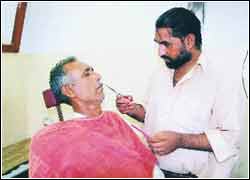
Known as Puppoo Bhai, Khalil is just one of the ubiquitous hairdressers found in every nook and cranny of the city. What makes him extraordinary is his profession, where even an ‘extra’ is not ‘ordinary’.
People belonging to his profession may boost your spirits in minutes either with the touch of their fingers to your head or with their lively gossip. They have the latest information on the neighbourhood and individuals. Their craft as well as schmoozing tactics may bind you with them in a lasting bond. “I have customers who come here from as far a place as New Karachi,” says Khalil. “They say they do not enjoy haircut by any other hand but mine.”
He refuses to serve people of his own profession. “They think they are smart enough to teach me my ancestral skill. But whenever I need their help, I do not have a particular barber to go to. And never give them instruction on how to go about cutting my hair, nor do I complain for a job ineptly done.”
Like every other hairdresser, Khalil provides free hair oil, comb and mirror service to his customers, who not only love to peep into his large mirrors but also like to exchange a 'hello-hi’ with him before leaving for their workplaces.
Newspapers at the barber’s place have been an enduring attraction for low-income people. It makes reading more enjoyable when you have someone to share with an item of common interest. The same newspaper updates Khalil on what is happening across the world, particularly in the Indian filmdom. He knows about his customer’s taste in music and plays the cassette he thinks his man would like to listen to during the process of haircutting and massage.
If you choose, he can copy from the chart of exotic specimen of styles hanging on the wall. Or you may give an outline of the style you would like to have -– hanging down the ears, or shorter on the sides and longer on the top, or where you would like to have the parting, etc.
He may also give you tips on how to keep your hair from falling or how to do their maintenance.
The hairdresser enjoys the rhythm of his scissors as much as a pop artiste likes the plucking of the guitar.
In his early 30s, Khalil, hailing from Khanpur Katora in Rahimyar Khan, has a two-year-old son. He is quite satisfied with his work and what he earns. In his own modest way, he tries to transmit his happiness to others also.
— Karachian
email: karachi_notebook@hotmail.com



























