0
0

 WEST Bengal was once the industrial hub of India, and many multinationals and Indian companies had their headquarters in Calcutta (now renamed Kolkata), the state capital (and once, the capital of the British Raj). Besides engineering, metals, mines, automobiles, jute and tea industries, the state also dominated other sectors of the Indian economy.
But the last 40 years had seen a steady decline in the industrial activity in West Bengal. The extremist violence of the late 1960s – when the Naxalite movement took roots in the state – saw industrialists abandoning Bengal. A decade later, when the Marxist regime came to power in June 1977, it brought back political stability to West Bengal, but triggered off a sharp economic decline.
Trade unions affiliated to the Marxists frequently began to organise strikes, driving away multinationals and top Indian corporates, who began relocating their business to Mumbai, Bangalore and Delhi. The following 25 years saw a sharp fall in the fortunes of the state, which lost its dominant position in the industrial map of India.
Maharashtra, Gujarat, Karnataka, Tamil Nadu and Andhra Pradesh emerged as dynamic powerhouses, attracting investors. Even international airlines cut down their services to Kolkata, and gradually they pulled out of the city. Kolkata got neglected, both nationally and internationally – despite its strategic geographic location. The eastern metropolis is the closest among Indian metros to the burgeoning South East Asian and Asia-Pacific economies, but failed to leverage its strengths.
While cities like Shanghai, Kuala Lumpur, Singapore, Jakarta and Bangkok blossomed economically Kolkata got caught up in a vicious cycle and appeared headed on a course of self-destruction. No new investments, rampant strikes, industrialists fleeing the city, bitter political conflicts and a tottering infrastructure.
But after four decades of stagnation, Kolkata and West Bengal are now witnessing a sudden revival. Buddhadeb Bhattacharjee, a new generation Marxist leader, and the state’s chief minister, is authoring a turnaround in the fortunes of the state and the city. Bhattacharjee is not only the most pragmatic Marxist leader in India, he is also one of the most pragmatic politicians.
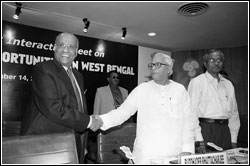
THE last few weeks have seen Bhattacharjee successfully wooing Indian and international businessmen and investors, interacting with the Prime Minister and other cabinet colleagues, finalising mega projects, getting the federal government’s approvals, and pushing for the transformation of the state.
While the Marxists and other communist parties are trying to block reforms in Delhi, Bhattacharjee is relentlessly pursuing those very goals in West Bengal, and appearing a winner. The re-election of the Marxist regime in recent polls to the state assembly – the sixth successive victory for the Communist Party of India (Marxist) in the state – has come like a steroidal boost to Bhattacharjee.
The chief minister has succeeded in getting huge commitments from Indian and foreign investors in recent weeks. Mukesh Ambani, chairman of Reliance Industries, India’s largest private sector group, announced plans to invest $870 million in West Bengal. Steel major, the Jindals, have plans for a $2.2 billion investment.
Ratan Tata, chairman of Tata group, has promised to produce his ambitious, Rs100,000 small car near Kolkata, and the state government is allotting him a thousand acres of land at Singur near the capital. The first car is expected to roll out in two years. Many other governments were wooing Tata, asking him to set up his new auto plant in their states, but the industrialist opted for West Bengal, where his group will be investing about $270 million.
ITC, the cigarettes-to-hotel-to-food major, has decided to invest $220 million in West Bengal, in a slew of projects, including IT, logistics, biscuits and agri-business. The Videocon group plans a nearly $200 million, while public sector oil giant, Indian Oil Corporation, will be investing $820 million in the state.
Indonesia’s Salim group and Japanese majors Mitsubishi and Mitsui & Company, are also committed to investing large sums in the state.
Besides hobnobbing with top industrialists, the Marxist chief minister of West Bengal was last week busy conferring with Prime Minister Manmohan Singh and Planning Commission deputy chairman Montek Singh Ahluwalia – most leftist politicians detest the duo, dismissing them as World Bank lackeys – in Kolkata, discussing investments in the state.
With billions of rupees in investment flowing in, Bhattacharjee is eager for major improvements in the infrastructure sector. While the central government has gone ahead with the privatisation and modernisation of Delhi and Mumbai airports, Kolkata is feeling left out.
Bhattacharjee’s wish list includes similar modernisation of Kolkata airport, its much-neglected port, the introduction of a mass rapid transit system (metro), and improvements in other sectors including power.
Two special economic zones (SEZs) have also been planned near Haldia, and the centre has called for tenders for a deep-sea port to handle the traffic to and from these two zones.
West Bengal, which appeared to have missed out on the IT boom in the initial phase, is also laying the red carpet for the software industry. Top Indian IT companies, including TCS, Infosys and Wipro, plan to set up units in the state, which is also seeking investments from hardware firms and chip makers. A sprawling IT park will also come up near Kolkata airport.
BUT the most ambitious project that is coming up in West Bengal is the chemical hub in Haldia, which is expected to attract investments worth about $22 billion. The federal government has approved the chemical SEZ in Haldia – dubbed the Petroleum, Chemical and Petrochemical Investment Region (PCPIR) – and investors are already making a beeline.
While the leftist parties supporting the United Progressive Alliance government at the centre are generally opposed to foreign direct investment (FDI), the West Bengal government has been aggressively seeking FDI for the chemical hub at Haldia. It is already in talks with American companies, besides other international majors.
Japan’s Mitsubishi, which has already invested over $300 million in Haldia, plans to set up a second unit at a cost of about $350 million. According to Sabyasachi Sen, West Bengal’s commerce and industries secretary, the government is in talks with both Indian and international majors for the development of the PCPIR.
The industry’s response has been good because of the presence of two gas pipelines, and the possible addition of a crude pipeline. Haldia is already a major base for Mitsubishi, Indian Oil Corporation (IOC) and Tata Chemicals.
Besides the planned expansion by Mitsubishi, IOC is also increasing the capacity of its refinery – from 1.5 million tonnes to 7.5 million tonnes – at a cost of $820 million. It is also setting up a paraxylene plan, but the West Bengal government wants the public sector giant to up its refinery capacity to 15 million tonnes. The state government also wants the oil major to invest about $3.2 billion in the Haldia chemical hub.
Federal petroleum minister Murli Deora last week endorsed the expansion plans of IOC, and there are indications that the company would consider investing in the chemical hub.
The West Bengal government is also pushing Mukesh Ambani, the Reliance chairman, to consider downstream investments in Haldia. Reliance is already putting up the world’s largest refineries complex in Jamnagar in Gujarat. The company is investing $6 billion in doubling its capacity at Jamnagar, from 660,000 barrels of crude oil a day (BPD) to 1.24 million BPD.
The group also plans to invest another $10 billion over the next five years on international exploration of oil and to develop recent discoveries in India.
West Bengal is also promoting the country’s first free trade warehousing zone, which will also come up near Haldia. Infastructure Leasing and Financial Services and MMTC Ltd will be developing this zone. Japanese trading major Mitsui & Co is eyeing the project, and is looking at putting up a 200-acre warehouse. But it all depends on the expansion plans by Mitsubishi.
The Bhattacharjee government is on a roll, with such mega investments being unveiled. India’s most politically stable state is fast emerging as its hottest investment destination.