0
0

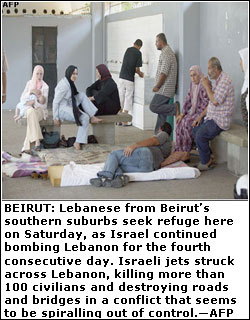 BEIRUT: The capture of two Israeli soldiers by the Lebanese resistance movement, Hezbollah, to bargain for prisoner exchange should come as no surprise - least of all to Israel, which must bear its own responsibility for the abductions and is using this conflict to pursue its wider strategic aims.
The prisoners Hezbollah wants released are hostages who were taken on Lebanese soil.
In the successful prisoner exchange in 2004, Israel held on to three Lebanese detainees as bargaining chips and to keep the battle front with Hezbollah open. These detentions have become a cause celebre in Lebanon.
In a recent poll, efforts to effect their release attracted majority support, much more even than the liberation of Shebaa Farms, the disputed corridor of land between Syria and Lebanon still occupied by Israel.
The domestic significance of these hostages is ignored by those who choose to reduce the abductions to an act of solidarity with Palestinians in Gaza.
Indeed Israel’s media are aware of recent attempts to capture soldiers, including a botched attempt a few months ago in which three Hezbollah fighters were killed.
Hezbollah’s leader, Hassan Nasrallah, confirmed the attack took five months to plan. Its timing was probably a coincidence.
It would seem, though, Hezbollah exerts some influence over the fighters in Gaza - those who captured Corporal Shalit were at the very least inspired by Hezbollah.
The regional significance of the abductions has also been misconstrued.
To suggest Hezbollah attacked on the orders of Tehran and Damascus is to grossly oversimplify a strong strategic and ideological relationship. Historically there has been an overlap of interests between Syria, Iran, Hezbollah and Hamas.
Together they form a strategic axis - the “axis of terror” to Israel - that confronts US-Israeli designs to redraw the map of the region. But the nature of that relationship has changed much over the years.
Since Syrian forces left Lebanon, Hezbollah has become the stronger party. It has never allowed any foreign power to dictate its military strategy.
It is ironic, given Israel’s bombing of civilian targets in Beirut, that Hezbollah is often dismissed in the west as a terrorist organisation.
In fact its military record is overwhelmingly one of conflict with Israeli forces inside Lebanese territory.
This is just an example of the way that the west employs an entirely different definition of terrorism to the one used in the Arab world and elsewhere, where there is a recognition that terrorism can come in many forms.
The attempt to frame Hezbollah as a terrorist organisation is very far from political reality in Lebanon, from public opinion across the Arab and Islamic world, and from international law.
Israel’s disproportionate response to the soldiers’ capture will have an impact on Lebanese domestic policy. Hezbollah has recently proposed a comprehensive national defence strategy; the Lebanese government has yet to come up with anything similarly convincing.
If demands for a prisoner exchange are successful then it shows that what Hezbollah would term the logic of resistance is the most effective defence strategy.
Israel’s escalation has been a poor PR exercise.
Even if it succeeds in showing the Lebanese people that Hezbollah can be a liability, this may well be cancelled out by Israel’s own aggression, which will only confirm Hezbollah’s repeated warnings of the constant threat posed by Israel.—Dawn/The Guardian News Service
(Amal Saad-Ghorayeb is assistant professor of political science at the Lebanese-America University).
asghorayeb@gmail.com